A Close Encounter of the Cricket Kind

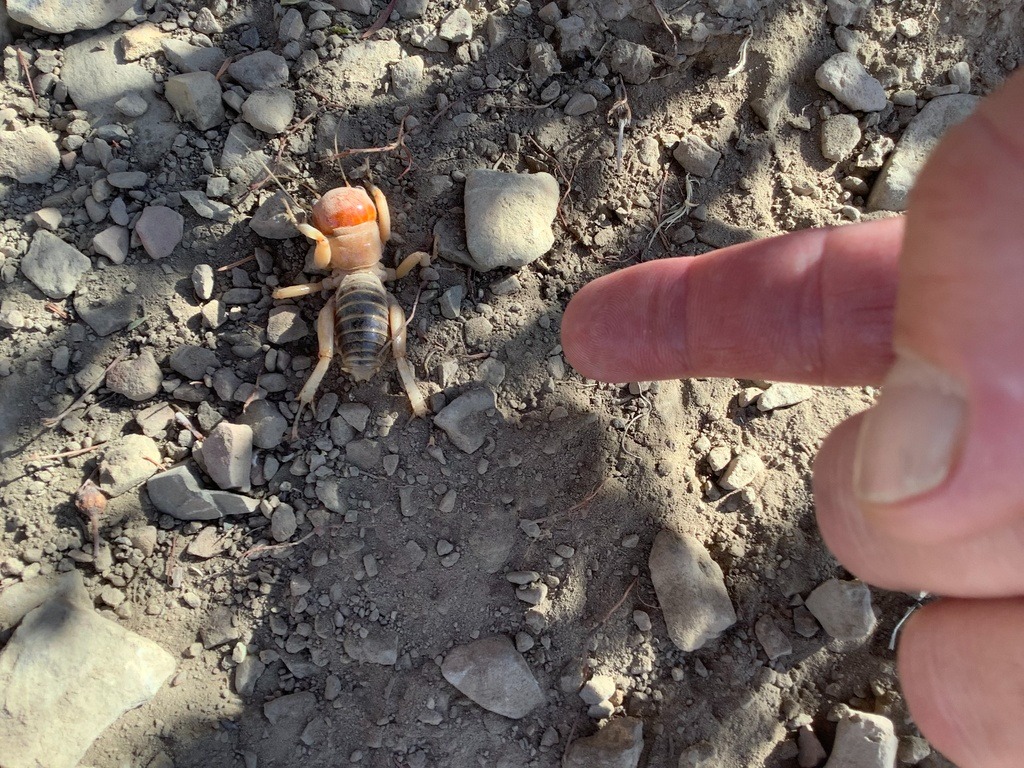
Jerusalem Cricket (Orthoptera: Stenopelmatidae) Courtesy & Copyright Marty Reeder, Photographer
Jerusalem Cricket
(Orthoptera: Stenopelmatidae)
Courtesy & Copyright Marty Reeder, Photographer
“Dad, what kind of bug is this?”

Normally, I try not to get distracted when going up as steep an incline as the Wellsville Mountains—stopping and starting again is as much work as slowly plodding on—but, I decided that a side quest to look at a bug might give me an excuse for a much-needed breather. Besides, I probably did the same when my dad took my siblings and me with him on hikes up the Wellsvilles when we were little. He sure loved those mountains, and the long hike gave him an excuse to dispense little morsels of life wisdom along the way.

When I approached the spot the kids were huddled, I was expecting to supply some wisdom myself on this bug.

A second later, I stood perplexed. I was looking at an insect I had never seen before. The bug was the size of my thumb and shifted awkwardly in what little dirt could be found just below the bare ridge of the Wellsvilles. Its dark abdomen was covered in scaled layers that became light on the edges, making it look something like the stripes of a bee. Unlike a bee, it had no stinger or wings. Its head was the size of a small cherry, with the color similar—an off-red or even orange. The six yellow, almost translucent, legs were hefty enough to support the massive body.

The kids repeated their question. My first instinct, thanks to the tones of red and orange and never seeing anything like it before, made me want to quip that it was clearly from Mars. I checked myself when thinking how this comment would compare to the boundless wisdom of my dad. In a moment of rare restraint, I told them that I had no idea and would have to research it. I snapped a photo, and we continued our march.

After surviving the Wellsvilles, I searched and discovered that we had observed a Jerusalem Cricket. Information on these insects is almost as scarce as a cricket sighting itself, so I decided to talk to someone with more experience.

Doctor James Pitt, an entomologist at Utah State who studies mathematical population models of various insect species, assured me that not only is the Jerusalem Cricket not from Jerusalem, it’s not even a cricket. Maybe my Martian bug idea was not too far off!

And while I thought its large and exotic, bee-like appearance signified danger, Dr. Pitt said that it was probably harmless unless provoked into a bite. I gathered from him that it was not prone to the large scale booms and busts of other locust-type insects—it was not even of the same family as those swarming pests. Instead, this is a bug that lives fairly solitary life cycles, mainly staying underground and only coming up occasionally. It seems as though our daytime sighting, and up in this high mountain environment of rocks and little vegetation, was somewhat rare. How did that cricket end up in such a place?

I decided to keep researching. Facts about females cannibalizing the males after mating or being known for feeding on potatoes did little to explain its presence on this high point (unless we were looking at a male determined to live a hermit-like bachelor life?). Besides, there were no potatoes on the Wellsvilles, and even the potato farmers I talked to were just as curious about this insect as I was. Chalk up another tally for Martian origins!

Still, I was not ready to give up. The more I learned, the more clear it was that, as foreign as the Jerusalem Cricket was to our modern heritage, some cultures with deeper roots in the region are much more familiar with it. Native Americans, ranging from the Yuma to the Navajo to the Hopi all included legends associated with the Jerusalem Cricket. I realized that my ignorance of them might have had more to do with what one article mentioned: urban development and roads tend to hamper these soil-burrowing and wingless bugs more than other, more mobile insects, limiting their range and visibility to people like us.

Thinking back to the moment my kids and I crowded around the Jerusalem Cricket, I started to feel as if the alien nature of this close encounter had more to do with us than the cricket. Perhaps we had something to learn from this subtle but persevering veteran of the West.

While learning about the Jerusalem Cricket helped provide me with this important perspective, it still did not reveal the mystery of what this particular cricket was doing way up on the Wellsville Mountain Range.

I just about gave up on making sense of the cricket’s location—hadn’t I learned enough by now? However, I thought I would read one more academic work before wrapping up. I discovered that the Hopi created figurines and masks of the Jerusalem Cricket for rituals, and they equated it with certain human-like traits. To them, the cricket represented human runners or racers, particularly over long distances. This was more in relation to their ceremonies, since Jerusalem Crickets barely achieve more than a crawl at the best of times, but the comparison stuck out strongly to me.

My mind went back to the Wellsvilles Ridge. I remembered that, when I was still very young, my dad participated in a Wellsville Ridge Race—a long distance run that went from one end of the Wellsvilles to the other. He would later go on to be the Cross Country Coach at Utah State for decades and just before he passed away over ten years ago, Utah State named their distance course after him and my mom: The Steve & Dona Reeder Cross Country Course. He is a distance running icon.

What was the Jerusalem Cricket doing up there? Something in me now thinks that perhaps the Wellsvilles are a place where distance runners go to dispense wisdom and perspective. I am glad that on the high slopes of the Wellsville Mountains, I got to have one of those runners give me wisdom for living life respectfully and responsibly. And I am glad to later meet another “runner” that offered perspective on the long legacy and hardy endurance of the wildlife that surrounds us.

I am Marty Reeder and my kids and I, and I’d like to think my dad, are all Wild About Utah.

Credits:

Image: Courtesy and Copyright Marty Reeder, Photographer
Featured Audio: Courtesy and Copyright Anderson, Howe, and Wakeman
Text: Marty Reeder, https://skyview.ccsdut.org/
Additional Reading: Marty Reeder and Lyle Bingham, https://bridgerlandaudubon.org/

Additional Reading

Wild About Utah Pieces by Marty Reeder

Stoffolano, John G., Jr., and Barton Wright. “Sösööpa—Jerusalem Cricket: An Important Insect in the Hopi Katsina Pantheon.” American Entomologist 51, no. 3 (2005): 174–79. https://doi.org/10.1093/ae/51.3.174.

Strand, Holly. “Cricket or Cootie?” Wild About Utah. October 17, 2013. https://wildaboututah.org/cricket-or-cootie/.

Weissman, David B., Amy G. Vandergast, and Norihiro Ueshima. “Jerusalem Crickets (Orthoptera: Stenopelmatidae).” In Encyclopedia of Entomology, edited by John L. Capinera, 2nd ed., 2054–61. Dordrecht: Springer, 2008. https://www.amazon.com/Encyclopedia-Entomology-Set-John-Capinera/dp/1402062427/

Weissman, David B. “JERUSALEM! CRICKET? (Orthoptera: Stenopelmatidae: Stenopelmatus); Origins of a Common Name.” American Entomologist 51, no. 3 (2005): 138–139. https://doi.org/10.1093/ae/51.3.138.
I’d Like to Report a Murder

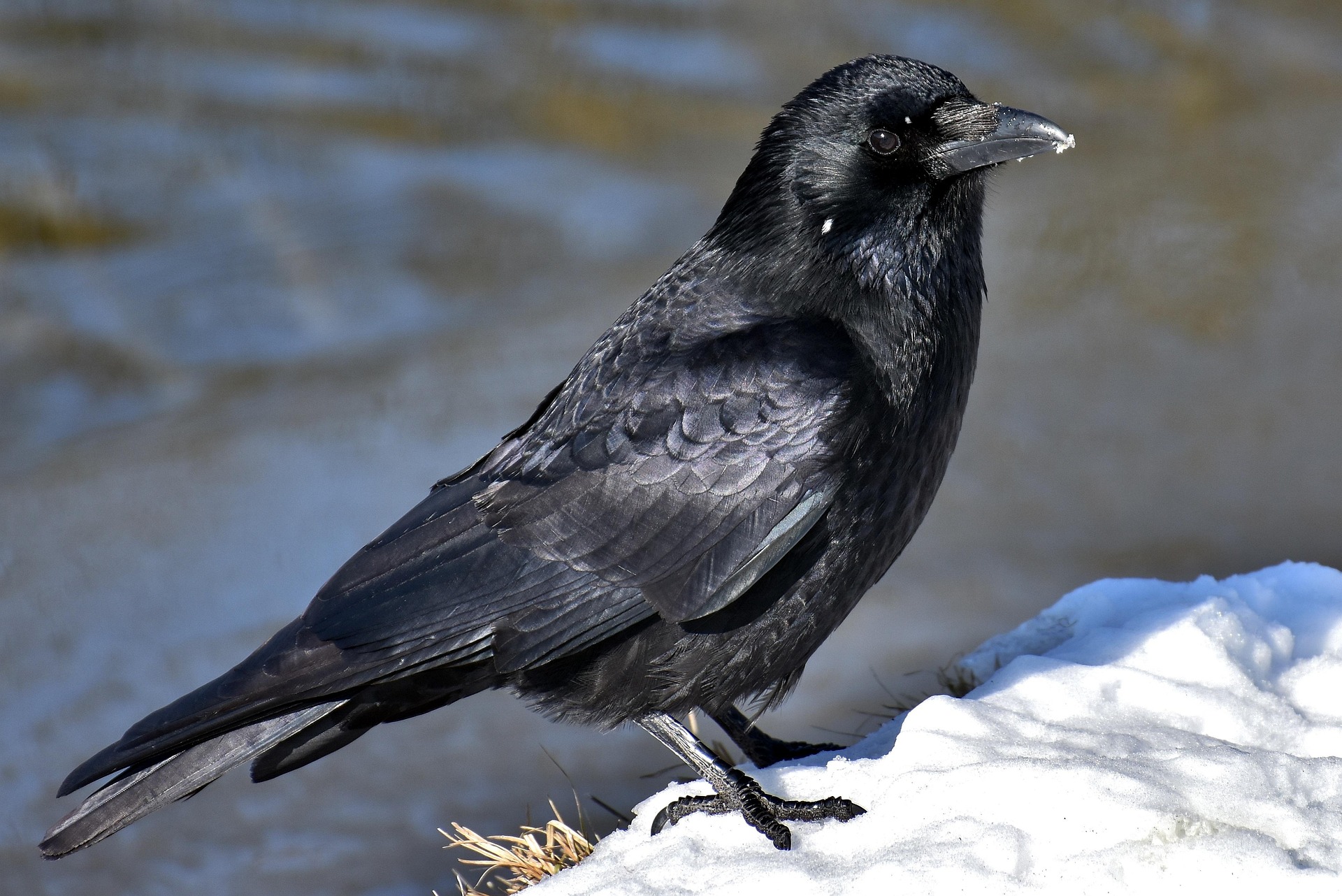
Pixabay - The American Crow (Corvus brachyrhynchos),  Courtesy Pixabay, Alexas Photos, Contributor
The American Crow (Corvus brachyrhynchos), Courtesy Pixabay, Alexas Photos, Contributor
Driving the return road from our family’s trip to Goblin Valley, I scoured the lonely San Rafael landscape, searching for something to keep me alert.

Suddenly, a shadow peeled off the ground and drifted into the sky. Was that an eagle?

A second later, I sighed. That was no eagle. It was a blasted crow.

You should know two things about this moment: first, as I would discover later, considering its size, solitary nature, and rural location, I was more than likely seeing a raven, not a crow. The other thing you should know is that at this time in my life I had a festering contempt for any bird of the corvid variety—corvid meaning crows, ravens, magpies … Our troubled past has its roots in walking to my work at Sky View high school and feeling personally targeted by the local murder, the term for a grouping of crows (tell me that your species is despised by the human race without actually telling me).

This murder lounged on the roof above my classroom and cackled at me in a way that seemed like obvious derision. I reciprocated anytime we went outside and we would heckle back and forth. I’d try to scare them off with some weakly tossed pebbles and sticks.

It should be no surprise then, that the Raven outside Goblin Valley brought disappointment verging upon abhorrence. Whether on roofs, bare trees in the winter, or even in the middle of nowhere deserts, crows are freaking everywhere I go!

And that is when it hit me. The only two animal species in this desolate landscape at this moment were humans … and corvids. Perhaps crows, ravens, magpies are so ubiquitous because they are intrinsically connected to one other species: humans.

Perhaps, just as crows followed humans to a wide-range of environments, they also adopted some of our best and most regrettable traits along the way.

In spite of those human-like faults, like greed, bickering and pestering, they also reflected some of our better qualities of ingenuity, community, and interspecies regard.

I begrudgingly saluted the raven, now a speck in the rear view mirror, and decided to reset my views of corvids. I reasoned that if I could not show crows respect, then how could I respect my own human race?

I decided to track down an expert. Dr. Becky Williams from the Utah State University biology department in the Uintah Basin extension, was kind enough to allow some amateur questions from me.

First, Dr. Williams assured me that crows are “aggressive territorial predators.” One could see how they might see a rooftop on the school and surrounding area as their own domain, and defend it aggressively against intruders! Hard to criticize a bird for that, when there could not be a more territorial predator than our own species.

When I spoke to Dr. Williams about the versatility of crows—their habitat reaches nearly as wide range of locations and climates as humans—she talked about a big reason being their intelligence. Corvid birds are smart, and that means that they don’t need as perfect an environment because they can come up with clever ways to survive.

Crows have bigger brains than their fellow fowl. They can remember thousands of different cache locations for seeds or other foods. They can even remember faces. Dr. Williams directed me to a study where crows recognized a unique human mask that researchers used in their interactions with a particular murder. When she told me this, I had no problem confirming what seemed to me a very targeted pestering from the same crows over several years.

This intelligence, Dr. Williams explained, tended to show itself in social animals: Crows, dolphins, humans … all spend a majority of their time in communities. The complex relationships of those communities causes them to need to remember who is a cooperator and who is a cheater. In other words, they make an in-group of those who work together, and they hold a grudge. What’s more human than that!

Once this information shifted my views on crows, I knew that I lacked much needed reconciliation. The south Smithfield murder of crows and I had nursed our historic differences, and it was time that I made things right.

When the murder showed up at their regular spot above my classroom, I tried meeting the crows outside. I wanted them to see my face as I gave them a snack. As soon as I reached into my pocket for a gift snack, they flapped off into the distance. My action of reaching for an object must have seemed familiar to them, as pulling things off the ground or out of my pocket was how I used to scare them off from before. They remembered the old me, and—as I had shamefully trained them—they retreated.

Just a couple of days ago, after weeks of non-aggressive attempted interactions, one of the more daring crows overcame reticence and dropped to the ground to investigate the unsalted peanut I dropped for them. He looked at it, looked at me, snatched it and withdrew back to the tree.

I am happy to report that now more of them are feeling comfortable picking up snacks I leave for them.

Am I looking to create a utopian bond between these crows and me? No. Perhaps dropping an occasional peanut and not yelling at each other will be the best that we can get. But I feel an immense satisfaction in seeing these remarkable animals respond to my overtures and believing that we have mended a divide between us and possibly even cultivated respect.

One of the biggest differences that I’ve noticed lately, is that when I step outside for my daily walk, no longer am I looking down to queue up the latest podcast with people cackling about political strife, or to take in media designed to ruffle the feathers of indignation of one group against another. Instead, as soon as I step outside, I look up. I’m looking for my new corvid friends—humbled, hopeful, grateful.

This is Marty Reeder, and I am Wild About Utah

Credits:

Image: Courtesy Pixabay, Alexas Photos, Contributor
Featured Audio: Courtesy Freesound.org): 210701 American Crows, caws calling, sparrows, robin, urban residential, TORONTO, 7am.wav by TRP, Thomas Ryder Payne. Sound designer, composer, musician. Based in Toronto. — https://freesound.org/s/616975/
License: Creative Commons 0
Text: Marty Reeder, https://skyview.ccsdut.org/
Additional Reading: Lyle Bingham, https://bridgerlandaudubon.org/

Additional Reading

Wild About Utah Pieces by Marty Reeder

Strand, Holly, Crow vs. Raven, Wild About Utah, September 15, 2011, https://wildaboututah.org/crow-vs-raven/

Kelly, Patrick, Greetings puny earthlings, Wild About Utah, September 28, 2020, https://wildaboututah.org/greetings-puny-earthlings/

Boling, Josh, Josh’s Raven Encounter, Wild About Utah, June 11, 2018, https://wildaboututah.org/joshs-raven-encounter/

Kolowski, Joseph, Outdoor Experiences in High-Def, Wild About Utah, June 10, 2024, https://wildaboututah.org/outdoor-experiences-in-high-def/

Boling, Josh, The Language of Ravens, Wild About Utah, February 19, 2018, https://wildaboututah.org/language-of-ravens/

How to Tell Crows and Ravens Apart by Sight and Sound, All About Birds, Oct 22, 2024, https://www.allaboutbirds.org/news/similar-species-crows-and-ravens/