Snow Fleas

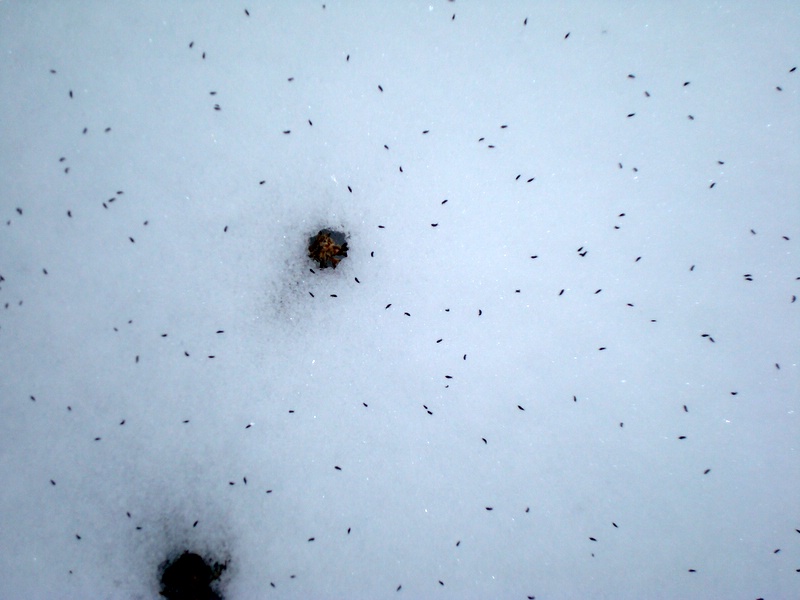
Snow Fleas, Bridgerland Audubon Amalga Barrens Sanctuary Copyright © 2008 & Courtesy: Jim Cane Bridgerland Audubon Society
Snow Fleas, Bridgerland Audubon Amalga Barrens Sanctuary
Copyright © 2008 & Courtesy: Jim Cane
Bridgerland Audubon Society

This is Linda Kervin for Bridgerland Audubon Society.

Now, in the waning days of winter, you can see Nature’s winter flea circus perform. Look for warm snow surfaces that are peppered by tiny black flecks that resemble a parenthesis on your 1040 form. Bend down to regard these flecks carefully, or scoop some up. If they move, then you are likely eye to eye with snow fleas.

Fear not, for they aren’t really fleas at all. They aren’t even insects! Snowfleas belong to the order Collembola, the springtails, closest relatives to the insects. Springtails are so named for a fork-shaped appendage, the furcula, folded beneath the abdomen. The animal can snap its furcula open like a barrette clasp, catapulting the wee creature several inches forward through the air.

Springtails are rarely noticed, but it’s worth seeing their miniscule acrobatics. It helps to have something white against which to view them. The white warmed surface of the late-winter snowpack provides one opportunity. Or you can often see springtails by placing a white card on the needle duff of a conifer forest floor, where springtails help decompose fallen needles.

Atop the snow, snowfleas apparently graze for algae and fungal spores, but really, how would anyone know? In turn, are there wee predators from which snowfleas must, well, “flee” in this chilly habitat?

Snowfleas aren’t social, but they sure can be numerous. Last March, the manager of Bridgerland Audubon’s Barrens Sanctuary estimated a population of some 8 billion snowfleas springing about just within the confines of their 140 acre reserve.

With those kinds of numbers, pets and Utahns everywhere can be grateful that snowfleas really aren’t true fleas, leaving us to enjoy the pleasure of tromping around on a sunny winter’s day.

This is Linda Kervin for Bridgerland Audubon Society.

Credits:

Photo: Courtesy & Copyright © 2008 Jim Cane

Text: Jim Cane, Bridgerland Audubon Society https://www.bridgerlandaudubon.org

Additional Reading:

Edible antifreeze promises perfect ice cream, Tom Simonite, 11 January 2008, New Scientist
https://www.newscientist.com/article/dn13178

Beneficial/Neutral Insects, University of Minnesota Extension Service, https://www.extension.umn.edu/yardandgarden/EntWeb/Galleries/outdoor/beneficial/snowflea.html

Snow Flea, Study of Northern Virginia Ecology, Island Creek Elementary School, Fairfax County Public Schools, https://www.fcps.edu/islandcreekes/ecology/snow_flea.htm
Pikas, Our First Haymakers

Pikas, Our First Haymakers
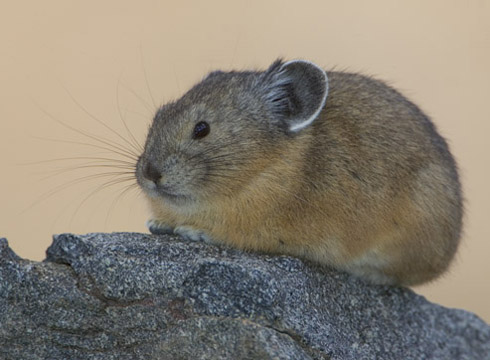
Pika
Photo © 2004-2008 Mark Chappell

“Make hay while the sun shines” is a venerable bit of farm wisdom that encourages cutting and drying of hay during fair weather. One, two, possibly three cuttings of alfalfa hay have been baled and stacked this summer by Utah’s farmers to feed dairy cows and horses this winter. More traditionally, ranchers have cut meadow or marsh hay to be piled in the lofts of their barns.

Utah’s first haymakers were not ranchers at all, however. These earliest haymakers cut hay for their own consumption. To see and hear these daytime haymakers, you must travel high into our mountains, to 9,000 feet or higher. Look for a boulder strewn talus slope or rockslide. Listen for this call….. if you hear it, you have found the pika, our first haymaker. That call was either declaring the pika’s individual territory or an alarm announcing you. These rounded relatives of our rabbits resemble a tawny-coated chinchilla or a plush, plump guinea pig. They have nearly circular small ears and no apparent tail.

All day long during the alpine summer, pikas are busy cutting grasses, sedges and wildflowers from neighboring meadows. They haul this back by the mouthful to tuck in crevasses in their stony stronghold to dry. These stockpiles are their winter larder. You see, unlike their alpine kin, such as marmots, ground squirrels and chipmunks, our pikas don’t burrow and they don’t hibernate. Unlike the snowshoe hare, pikas don’t get out much either once the snow flies. Under the snow pack, they simply dine on hay.

Pikas are strange little lagomorphs
(relatives of rabbits and hares)
that live in rocky areas and talus slopes
in alpine habitats in much of the
mountainous western US and Canada.
Photo © 2004-2008 Mark Chappell

In Utah, poke around for pikas amid high peaks along the mountainous central spine of our state, from the Uintas south to Brian Head, wherever peaks reach toward tree line and you can find. There you may find pikas making hay or loafing atop prominent stones in their rock jumbles, or contributing to the territorial calls of their talus slope choir. Their intolerance of heat keeps them from spreading downslope. Like the moose, they are one of the animals that will fare poorly with significant climate warming. For now, though, you can continue to peek for picas amid Utah’s glorious alpine scenery.

Credits:

Photo: Images of the Natural World, Courtesy & Copyright 2004-2008 Mark Chappell https://faculty.ucr.edu/~chappell/INW/
American Pika Page: https://faculty.ucr.edu/~chappell/INW/mammals/pika.shtml
Audio: Trout and Berry Days by Leaping Lulu, https://wildaboututah.org/about-us/
Text: Jim Cane, Bridgerland Audubon Society
Voice: Richard (Dick) Hurren, Bridgerland Audubon Society

Additional Reading:

American Pika, Utah Division of Natural Resources, https://dwrcdc.nr.utah.gov/rsgis2/search/Display.asp?FlNm=ochoprin

Pikas in Utah, Video from Utah DWR, https://youtu.be/czMoUzBUkTE

“Damn Cute Pikas” Narrated by David Attenborough and posted by Paul Garita on YouTube: https://www.youtube.com/watch?v=QVJuRgil0wQ&NR=1
American Pika, Nature Works, New Hampshire Public Television, https://www.nhptv.org/NATUREWORKS/americanpika.htm

Pika, Utah DWR Instragram Account, https://www.instagram.com/p/r7_haQtoZC/?modal=true

Fluffy_Memory_6238, Show me your war cry (Pika alert), Animals Being Derps, Reddit.com, https://www.reddit.com/r/AnimalsBeingDerps/comments/ppcaaw/show_me_your_war_cry/


Utah Division of Wildlife Resources Sensitive Species biologist Kevin Labrum talks with Brett Prettyman from SL Tribune about Pikas in Utah

Booth, Michael, Chirp one out for the pika: Climate change is destabilizing previously perfect Rocky Mountain habitat, December 4, 2025, https://coloradosun.com/2025/12/04/colorado-pika-population-global-warming/

Mobbing

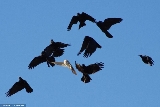
Mobbing: Crows mobbing a barn owl, Photo Courtesy Daily Mail and Copyright Andrew O'Conner ABC, Photographer, dailymail.co.uk
Crows mobbing a barn owl, Photo Courtesy Daily Mail and Copyright Andrew O’Conner ABC, Photographer, dailymail.co.uk
Mobs reveal a dark and terrifying side of human nature, whether it be the chaotic urban masses crying for the guillotine during the French Revolution, or a shadowy crime syndicate ruled by a guy named Joe Bananos. Many birds practice a different sort of mobbing, wherein there is rarely an injury and the little guy prevails.

When a predator such as an owl, a hawk or even a large snake ventures into a location, they may be detected by a resident bird. That sentinel will make a noisy, dissonant fuss to recruit reinforcements who will join in harassing that hawk or owl. Just who participates is a matter of size matching and a species’ predilection. Tiny predators such as a screech owl or a merlin will be plagued by tiny birds, with chickadees often leading the charge.

When you hear crows or magpies stirring up a ruckus, chances are that a large hawk such as the red-tail, or perhaps a great horned owl, is at the center of the melee. As the harassment escalates, the hawk will typically take wing in a disgruntled huff, trailed by its fussing mob. By remaining perfectly still, an owl can sometimes become seemingly invisible, its smaller marauders gradually losing interest and dispersing.

Why a predator doesn’t lose its temper and turn on its unwelcome mob I don’t know, but I have not seen it happen.

And the purpose of mobbing? Perhaps in loudly announcing a predator’s presence, the hunter’s advantage for stealth and surprise is lost. Or maybe the mob is just telling the hawk or owl to: “Push off and leave our neighborhood!”

By imitating an owl’s call or by producing the right dissonant “pishing” noise, like this “pishpishpish”, I can sometimes lure a small mob briefly into view, one often led by a valiant chickadee. Soon recognizing my deceit, after a few minutes, the group will quickly disperse, leaving me to smile at just what a frisky mob that was!

Credits:
Photo: Courtesy Daily Mail CO.UK and Copyright Andrew O'Conner ABC, Photographer
Text: Bridgerland Audubon Society – Jim Cane

Our Native Squash Bees

Our Native Squash Bees: Squash Bee, Peponapis_pruinosa, Courtesy and Copyright 2007 Jim Cane - All Rights Reserved
Squash Bee
Copyright 2007 Jim Cane
All Rights Reserved

Utah’s wintry weather seemed interminable this year, but at long last, full summer is upon us. Balmy days ripen the bounties of our orchards and gardens, including vast quantities of squashes: zucchini, crookneck, banana, butternut, and later, the pumpkins for Halloween. Squashes require pollinators. . Foraging bees inadvertently move the pollen from the male flowers to fertilize female flowers. Such pollination by a bee will result in the seeds you encounter when you slice open a squash. Without developing seeds, no squash will form, so pollination by bees is vital.

New research is showing that a specific group of unmanaged native bees is largely responsible for pollinating our squashes, gourds and pumpkins. From Maine to California, and all around Utah, these so-called squash bees are busily visiting flowers of all of our squashes, from acorn to zucchini. In fact, they are only visiting these flowers, as these bees are strict floral specialists. Beginning at dawn, male squash bees can be seen darting among squash flowers, seeking receptive mates and the odd sip of nectar to fuel their flight. Females load up on nectar and the bright orange pollen to cart back to their nests. Unlike honeybees, each female squash bee has her own nest, consisting of a simple underground burrow. She provisions each of her offspring with a cache of pure squash pollen and nectar. By 9AM, their frenetic morning of foraging complete, female squash bees head home to rest and work on their nests. Through their early morning foraging activities, they daily pollinate each day’s new flush of flowers.

Zucchini Squash with Flowers

If you grow squashes, you are likely to find their flowers being visited by squash bees. Look for these bees around breakfast time, between sunrise and 8:30. They fly more quickly and deliberately between flowers than the slightly larger, later-flying honeybees. Unlike honeybees, female squash bees carry their pollen dry in a brush of hairs on their hind legs. Later, you may discover sleeping male squash bees by pinching the wilted, closed flowers. A drowsy buzz reveals a defenseless male squash bee sleeping within. There he will snooze until dawn, which brings a new flush of flowers, and with it, another chance for every squash bee Romeo to find his buzzy Juliet. All this drama, and you thought you were just growing zucchini!

Our Native Squash Bees-Credits:

Photos: Courtesy and © Copyright 2007 Jim Cane
Squash Bee Video © Copyright 2008 Lyle Bingham

Text: Bridgerland Audubon Society: Jim Cane

Our Native Squash Bees-Additional Reading:

Squash Pollinators of the Americas Survey (SPAS), James Cane, USDA Pollinating Insect Research Unit, Utah State University
https://www.ars.usda.gov/Research/docs.htm?docid=12041

Celebrating Wildflowers, Pollinator of the Month, Squash Bees, Jim Cane, USDA ARS, Bee Biology & Systematics Lab, Logan, Utah
https://www.fs.usda.gov/wildflowers/pollinators/pollinator-of-the-month/squash_bees.shtml (updated 8/22/2024)

Videos:

Squash Bee Peponapis & Sunflower Bee Melissodes agilis in Ontario 2, https://www.youtube.com/watch?v=rXMmLjTYp3k
Squash Bee Peponapis & Sunflower Bee Melissodes agilis in Ontario 1, https://www.youtube.com/watch?v=r0Hvfz1o3Iw

Bee Pollinators of Southwest Virginia Crops (revised 6 June 2010), https://www.youtube.com/watch?v=l_etyEdu9fQ

Crop domestication facilitated rapid geographical expansion of a specialist pollinator, the squash bee Peponapis pruinosa, Margarita M. López-Uribe, James H. Cane, Robert L. Minckley, Bryan N. Danforth
Proc. R. Soc. B 2016 283 20160443; DOI: 10.1098/rspb.2016.0443. Published 22 June 2016
https://rspb.royalsocietypublishing.org/content/283/1833/20160443.abstract