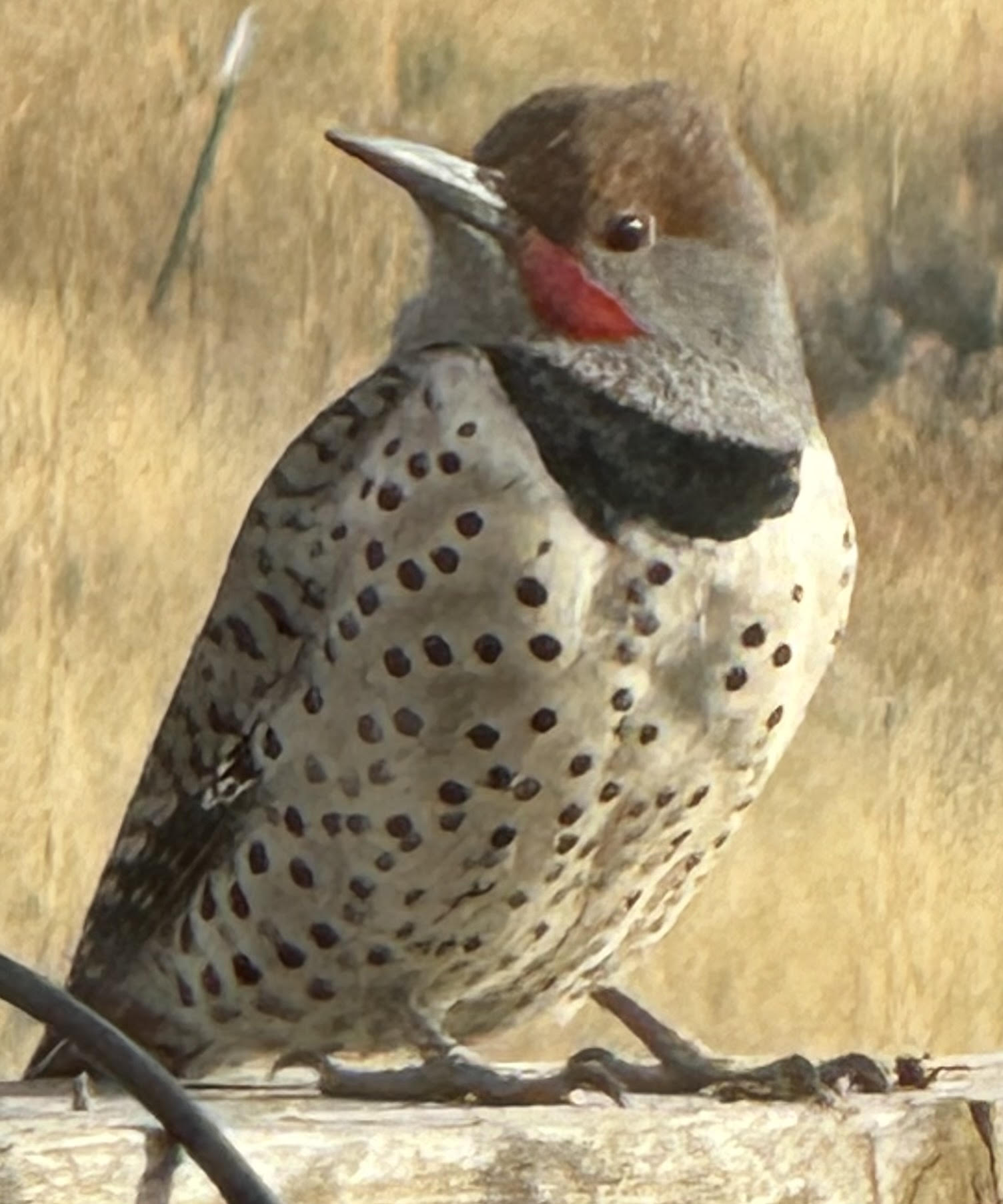
(The red is absent on females)
Courtesy & Copyright Hilary Shughart, Photographer
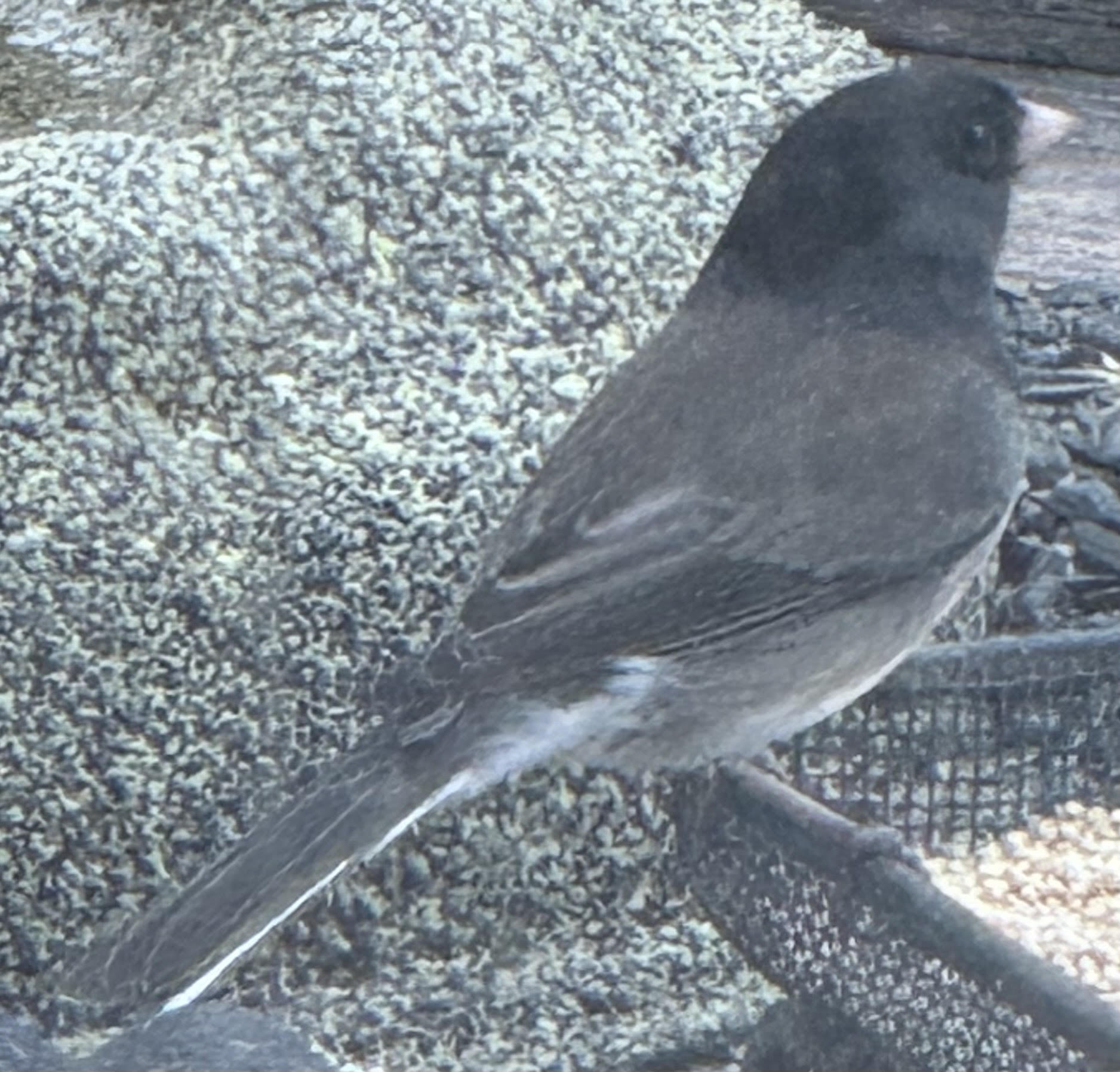 Rocky Mountain Junco (Junco hyemalis Cismontanus)
Photo, CBC 2025
Courtesy & Copyright Hilary Shughart, Photographer
One of the most important services of the Bridgerland Audubon Society is the engagement of the public in participatory science. Starting with the first Logan/Cache County Christmas Bird Count in 1955, we have encouraged novice and advanced birders within the designated 15-mile diameter Watch Circle to participate from home. Then in mid-February, everyone can participate in the Great Backyard Bird Count from anywhere. The great thing about bird watching from home is that it is so conducive to slow birding, which like slow gardening* has the tremendous advantage of allowing one to notice and savor more at a relaxed but productive pace.
Participatory Science used to be called Citizen Science, and then Community Science, but the emphasis on participation highlights that we are contributing to something large and impactful for which we don’t ask what science can do for us, but what we can do for science. There is a vast universe of participatory science programs which can be found at the SCISTARTER.ORG clearinghouse, including ZOONIVERSE.ORG, for which participants can help online by examining photos. Some of the most popular Apps include iNaturalist, which allows anyone anywhere to document plants and animals, and to get assistance with identification. The Cornell Lab of Ornithology’s eBird App is the world’s largest, free, online, and mobile-based participatory science project for recording and mapping bird sightings.
Recently I shared a story about noticing a Downy Woodpecker consistently taking black oil sunflower seeds from the hanging tube feeder and inserting them in a deck railing knothole for ease of opening. I learned that this is not considered to be tool-use, but it’s certainly clever problem solving by the wildlife right outside my window. Then, during the Christmas Bird Count I observed the second Rocky Mountain Junco to be included in our report, the first being in 2023, when National Audubon confirmed the subspecies identification from my photo. Bird watchers out in the field are less likely to have the right lighting or enough time to distinguish the Dark-eyed Junco subspecies, so it’s pretty exciting to realize that the Home Sector has one more to look for in addition to the Oregon, Slate, Pink-sided, and Gray-headed varieties.
The most interesting thing I noticed this year was that the Northern Flicker clearly has an understanding of gravity and a sense of object permanence: time and time again I noticed that they cling to the bottom of the hanging suet cage while pecking at the food, then they check their upturned belly for crumbs before flying down onto the deck to pick up the escaped crumbs! We already knew that corvids like crows are very clever tool making problem solvers, and we know that Chickadees have tremendous memories for the thousands of seeds stashed here and there (that’s 1,000 seeds in one day, and up to 80,000 seeds in a fall season!), and there’s a study in which Hornbills were taught to follow where a treat was hidden, thus revealing they have object permanence – they know the treat did not vanish just because it was hidden, but there’s just nothing like noticing something new right outside your window, and wondering if it’s been documented by scientists yet.
I hope you’ll consider participating in the Great Backyard Bird Count! The resources posted with this podcast include a free self-paced eBird class from the Cornell Lab.
I’m Hilary Shughart with the Bridgerland Audubon Society, and I am Wild About Slow Birding in Utah!
Credits:
Images: Courtesy & Copyright Hilary Shughart, Photographer
Featured Audio: Courtesy & Copyright © Kevin Colver, https://wildstore.wildsanctuary.com/collections/special-collections/kevin-colver & Friend Weller, https://www.upr.org/people/friend-weller
Text: Hilary Shughart, President, https://bridgerlandaudubon.org/
Additional Reading: Hilary Shughart and Lyle Bingham, https://bridgerlandaudubon.org/
Additional ReadingSupplemental food and water are important ways we can reduce stress for backyard birds
WildAboutUtah pieces by Hilary Shughart, https://wildaboututah.org/author/hilary-shughart/
Global Bird Count in February/Great Backyard Bird Count, https://www.birdcount.org/
Dark-eyed (Cassiar) Junco J. h. cismontanus, https://birds.outdoornebraska.gov/dark-eyed-junco/
Free eBird Essentials, Bird Academy, The Cornell Lab of Ornithology, https://academy.allaboutbirds.org/product/ebird-essentials/
Clearinghouse for Participatory Science, https://scistarter.org/
Online participation by examining photos, https://www.zooniverse.org/
EFTA WMBD 2026: Every Bird Counts – Your Observations Matter!, https://environmentamericas.org/theme-announcement-2026-wmbd/
Slow Gardening, https://felderrushing.blog/slow-gardening/
“Slow gardening was started by American horticulturist and garden author Felder Rushing, who was inspired by the Slow Food organization. Slow gardening is a philosophical approach to gardening which encourages participants to savor everything they do, using all the senses, through all seasons, regardless of garden type of style. It is intended to promote self-awareness, personal responsibility, and environmental stewardship.” (Wikipedia)
Slow Gardening, Wikipedia, https://en.wikipedia.org/wiki/Slow_gardening
Gravity Gives These Birds the Drop on Tough-to-Crack Foods, by Priyanka Runwal, Audubon, February 12, 2020, https://www.audubon.org/news/gravity-gives-these-birds-drop-tough-crack-foods
“Yet, aside from notoriously clever corvids and cheekily smart parrots, no other birds were previously known to have object permanence to the same extent as primates. While other bird species have been tested, they only made it to stage four of the six developmental stages seen in human children.
To see how advanced hornbills’ object permanence skills are, Yao and Garcia-Pelegrin put six of the large-beaked birds to the test.
They taught the hornbills to indicate where a visible treat is with a peck. Then, the birds were moved onto a series of challenges, which tested for increasingly difficult levels of object permanence. (ScienceAlert)”
These Birds Score as High as Primates in a Puzzling Cognitive Test : ScienceAlert, https://www.sciencealert.com/these-birds-score-as-high-as-primates-in-a-puzzling-cognitive-test