
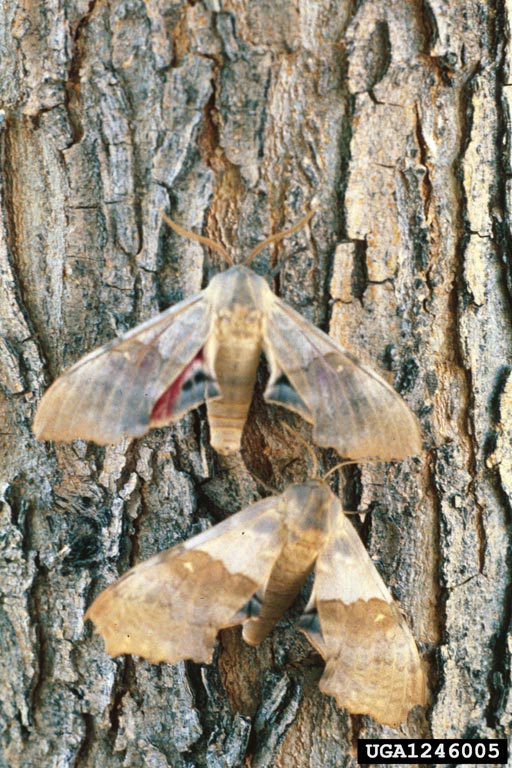
Sphinx Moths

Sphinx Moths; Big Poplar Sphinx, Pachysphinx occidentalis, Courtesy Whitney Cranshaw, Colorado State University, bugwood.org
Big Poplar Sphinx
Pachysphinx occidentalis
Courtesy Whitney Cranshaw
Colorado State University
bugwood.org
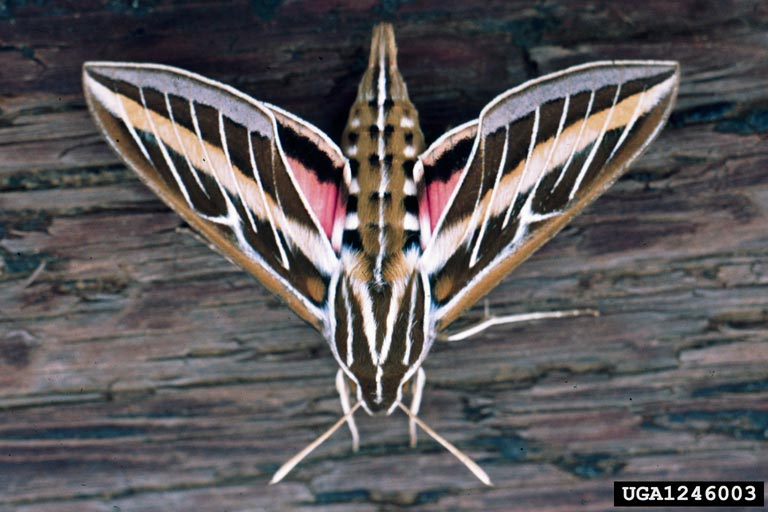
White-lined Sphinx
Hyles lineata
Courtesy Whitney Cranshaw
Colorado State University
bugwood.org
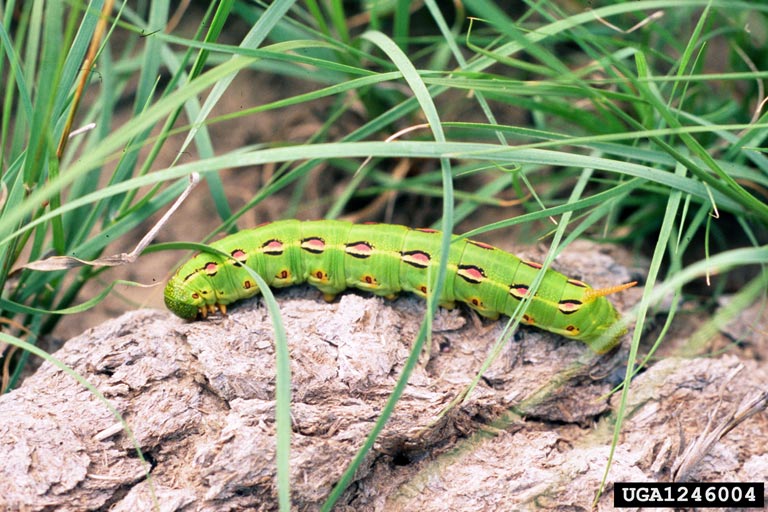
White-lined Sphinx Caterpillar
Hyles lineata
Courtesy Whitney Cranshaw
Colorado State University
bugwood.org

I vividly remember the first time I saw one – a small winged creature whirring from flower to flower in the evening light, its long tongue dipping for nectar within tube-shaped blooms. I was mesmerized, and struggled for a closer look.Sphinx Moths

If you’re thinking that I must have seen a hummingbird, you would be making a very common mistake. A mistake, in fact, that has given this critter one of its many nicknames. The winged wonder I saw that summer night was a sphinx moth, also called a hummingbird or hawk moth because of their large size and bird-like characteristics.

In all stages of their life, these insects are large. Caterpillars grow to a robust 4 inches in length and adult wingspans can measure more than 5 inches. Sphinx moths are also some of the fastest insects on earth and have been clocked flying at over 30 miles per hour. Their size, speed, and flying ability reflect those of the hummingbird so closely that they are commonly misidentified.

Sphinx moths are a beloved sight in many Utah gardens. However, they also hold a bit of a devious surprise. The larvae, or caterpillar, of one common species of sphinx moth are well known by vegetable gardeners. They are large and bright green with a distinctive horn near their hind end. Like the adults, these larvae go by many names, the most common being the tomato hornworm. Hornworm caterpillars, unlike their adult counterparts, are not beloved by gardeners. They are voracious beasts with the ability to strip the vegetation off a tomato or pepper plant in one day.

Aside from our garden plants, young hornworms of other species feed on a variety of vegetation including willow, poplar and cottonwood trees. Adult moths rely on a host of flowers such as columbine, honeysuckle, larkspur and evening primrose. Here in Utah you might come across one of a handful of different species in the sphinx moth family including the five-spotted hawk moth and the white-lined sphinx. Look for them in the late summer evenings as daylight begins to fade. But be sure to look twice to avoid mistaking them for something they’re not.

And the next time you find a hornworm on your tomatoes, maybe just relocate the little bugger so that you can enjoy it once metamorphosis changes the beast into a beauty.

For more information and pictures of our native sphinx moths, visit our website at www.wildaboututah.org. Thank you to Rocky Mountain Power Foundation for supporting the research and development of this Wild About Utah topic.

For the Stokes Nature Center and Wild About Utah, this is Andrea Liberatore.
Credits:

Theme: Courtesy & Copyright Don Anderson as performed by Leaping Lulu
Photos: Courtesy Whitney Cranshaw, Colorado State University, Bugwood.org
            Images licensed under Creative Commons Attribution 3.0 License
Text:    Andrea Liberatore, Stokes Nature Center, logannature.org

Additional Reading:

Cranshaw, W.S. 2007. Hornworms and “Hummingbird” Moths. Colorado State University Fact Sheet 5.517. Found online at: https://extension.colostate.edu/resource/hornworms-and-hummingbird-moths/

Buchman, Steve. 2010. Pollinator of the Month: Hawk Moths or Sphinx Moths (Sphingidae). US Forest Service. https://www.fs.usda.gov/wildflowers/pollinators/pollinator-of-the-month/hawk_moths.shtml

The Mud-Daubing Wasp

Female Sceliphron caementarium
completing nest cell
Courtesy and
Copyright © 2011 Jim Cane

Pupa of
Sceliphron caementarium
Courtesy and
Copyright © 2011 Jim Cane

The recession has slowed housing starts, but builders of clay dwellings remain busy. Millions of clay homes are built this and every summer in Utah. These dwellings can disintegrate in a summer cloudburst, so you’ll find them beneath overhangs like rock cliffs, or under bridges and the eaves of your house.

These free-standing mud homes are built by a few dozen species of solitary bees and wasps. Among them is the mud dauber, Sceliphron caementarium, a big leggy wasp found throughout Utah. The female wasp constructs hollow clay units one at a time, each the dimensions of a pitted date. The mother mud dauber gathers the wet clay in pellets. At the nest site, she draws the pellet into a ribbon of clay which becomes the next arch of the tubular nest. While working the clay, she audibly buzzes her flight muscles. This vibration visibly liquefies the clay for a few seconds. This strengthens its bond, much as workers in concrete do using large vibrating probes.

The mother wasp then collects spiders, often plucking them straight from their webs after a pitched battle. She permanently paralyzes each spider using her venomous sting. The venom is not lethal. Rather, it is paralytic, keeping the spider alive and fresh but helplessly immobile, a gruesome spider buffet for her grub-like larva to eat. Each hollow nest is packed with a half dozen spiders, one of which receives her egg. In a few weeks time, the growing wasp larva finishes eating its buffet and pupates, becoming dormant for the winter.

Nest building and provisioning by these wasps is a complex result of heritable instincts tailored to local circumstances by learning. It is also a rare trait among insects, most of whom simply lay their eggs and leave. Through observation and manipulative experiments, students of animal behavior have investigated mud-building wasps for well over a century. If you have mud daubers around your home, grab a cool drink, pull up a chair, and enjoy watching their home-making labors.

This is Linda Kervin for Bridgerland Audubon Society.

Credits:

Images: Courtesy & Copyright Jim Cane, Bridgerland Audubon Society
Text: Jim Cane, Bridgerland Audubon Society

Additional Reading:

“The Wasps”, Evans, Howard E. and Eberhard, Mary Jane West, 1970. Ann Arbor, University of Michigan Press. 265 p. illus. https://www.amazon.com/Wasps-Howard-Evans/dp/0715360604

“Bees, wasps, and ants : the indispensable role of Hymenoptera in gardens”, Grissell, Eric. 2010, 335 p. https://www.amazon.com/Bees-Wasps-Ants-Indispensable-Hymenoptera/dp/0881929883

The Native Bees of Utah

Male Melissodes Bees
Sleeping on Sunflower
Courtesy and
Copyright © 2010 Jim Cane

The industry and cooperation of honeybees have inspired many a philosopher and society, including the Mormons who settled along the Wasatch front. The hive, or more specifically a skep, was later chosen as the emblem for the new state of Utah. But the honeybee, like it’s pioneer admirers, is a recent European immigrant, brought over for the wax and honey that colonies produce.

Utah did not lack for pollinators, however, prior to European settlement. More than 1000 species of native bees inhabit Utah, with several hundred species in any given county. A few of these bees — bumblebees and sweat bees — are social. They produce annual colonies headed by a queen. However, the vast majority of our bees are not social. For these, each adult female makes her own nest with no help from her sisters or mate.

Most solitary bee species nest underground; others use old beetle burrows in deadwood. The resident female subdivides her tunnel into bee-sized cavities. Each cavity receives a cache of pollen moistened with nectar and a single egg. There each grub-like larva will feed and develop in solitude. Most solitary bees will spend the winter here in their natal home.

Bombus griseocollis Queen
Foraging on Hedysarum
Courtesy and
Copyright © 2008 Jamie Strange

Native bees pollinate many of Utah’s wildflowers, doing so inadvertently as they busily gather pollen for their progeny. Many solitary bee species are taxonomic specialists, focusing all of their pollen foraging efforts on one or a few related genera of flowering plants. Some common hosts for specialist bees in Utah include squashes, sunflowers, globemallows and penstemons. Sweet honey does not result from the labors of solitary bees, but fruits and seeds do. The industry of Utah’s native bees merits our attention and admiration.

This is Linda Kervin for Bridgerland Audubon Society.

Credits:

Text: Jim Cane, Bridgerland Audubon Society

Additional Reading:

USDA-ARS Pollinating Insects – Biology, Management and Systematics Laboratory, https://www.ars.usda.gov/main/site_main.htm?modecode=54-28-05-00

Crop domestication facilitated rapid geographical expansion of a specialist pollinator, the squash bee Peponapis pruinosa, Margarita M. López-Uribe, James H. Cane, Robert L. Minckley, Bryan N. Danforth
Proc. R. Soc. B 2016 283 20160443; DOI: 10.1098/rspb.2016.0443. Published 22 June 2016https://rspb.royalsocietypublishing.org/content/283/1833/20160443.abstract

Hager, Rachel, Bees, Bees And More Bees! Researchers Find Over 650 Bee Species In Grand Staircase-Escalante, UPR-Utah Public Radio, Nov 20, 2018, https://www.upr.org/post/bees-bees-and-more-bees-researchers-find-over-650-bee-species-grand-staircase-escalante

Bumblebee Watch, https://www.bumblebeewatch.org/
Bumble Bee Watch is a citizen science project through the partnership of The Xerces Society, the University of Ottawa, Wildlife Preservation Canada, BeeSpotter, The Natural History Museum, London, and the Montreal Insectarium.

Koch, Jonathan, Strange, James, Silliams, Paul, Bumble Bees of the Western United States, Pollinator Partnership, 2012, https://www.xerces.org/publications/identification-monitoring-guides/bumble-bees-of-western-united-states
Original https://www.pollinator.org/pollinator.org/assets/generalFiles/BumbleBee.GuideWestern.FINAL.pdf

Pollinating Fruit Trees with Blue Orchard Bees

Audio:  mp3 Listen to WildAboutUtah

Blue Orchard Bee
Copyright Jim Cane

Apricots, plums, apples, cherries, and pears all need bees to pollinate their flowers. Traditionally, we’ve used the European honey bee, but now we know how to pollinate our fruit trees using a steely blue native bee, the blue orchard bee (Osmia lignaria). These wild bees fly nationwide.

In Utah, they live in foothill and lower montane habitats. Blue orchard bees are not social; every female is fertile and tends to her own tiny nest. Adults are the size of a chunky honeybee and are active for only 3-4 weeks in the spring. These bees naturally nest in the tunnels chewed by large wood-boring beetles in tree trunks. Each female partitions her tunnel into a series of tiny bee-sized rooms. Each room is stocked with a pea-sized provision of pollen moistened with nectar, followed by a single egg. Nest cells are partitioned, and ultimately capped, with mud, hence their other common name: “mason bees”.

Blue Orchard Bee eggs
on pollen provision mass
in nest
Copyright Jim Cane

You can have your own backyard population of blue orchard bees. An easy way to begin uses a short fat log that is seasoned and dry. Take a 5/16 bit and drill 20 or more holes radially 5 to 6 inches deep. Stand the log on end, facing the holes towards the southeast.

On cold mornings, nesting females bask in the sun before taking flight. If bees colonize your log, you will see the steely blue females busily coming and going all day long during fruit tree bloom. They tote their loads of dry yellow pollen in a brush of hair beneath the abdomen. Unloading that pollen at the nest requires some charming acrobatics that are well worth watching. While collecting pollen, female blue orchard bees pollinate your trees with hundreds of fruits resulting from each bee’s lifetime of work. Successive generations will nest for you every spring, but you’ll want to switch to replaceable nesting materials to prevent the accumulation of pathogens and parasites.

Details and links can be found at our Wild About Utah website.

This is Linda Kervin for Bridgerland Audubon Society.
Credits:

Photos: Courtesy & Copyright Jim Cane

Text: Jim Cane, Bridgerland Audubon Society
Additional Reading:

Drill Log with 5/16 holes
5 to 6 inches deep
Copyright Jim Cane

Resources:

https://www.sare.org/publications/bob.htm

https://www.ars.usda.gov/Research/docs.htm?docid=18333

https://www.pollinatorparadise.com/Binderboards/Hornfaced_Bees.htm

A Colonized log
Copyright Jim Cane