Native Plants for Birds

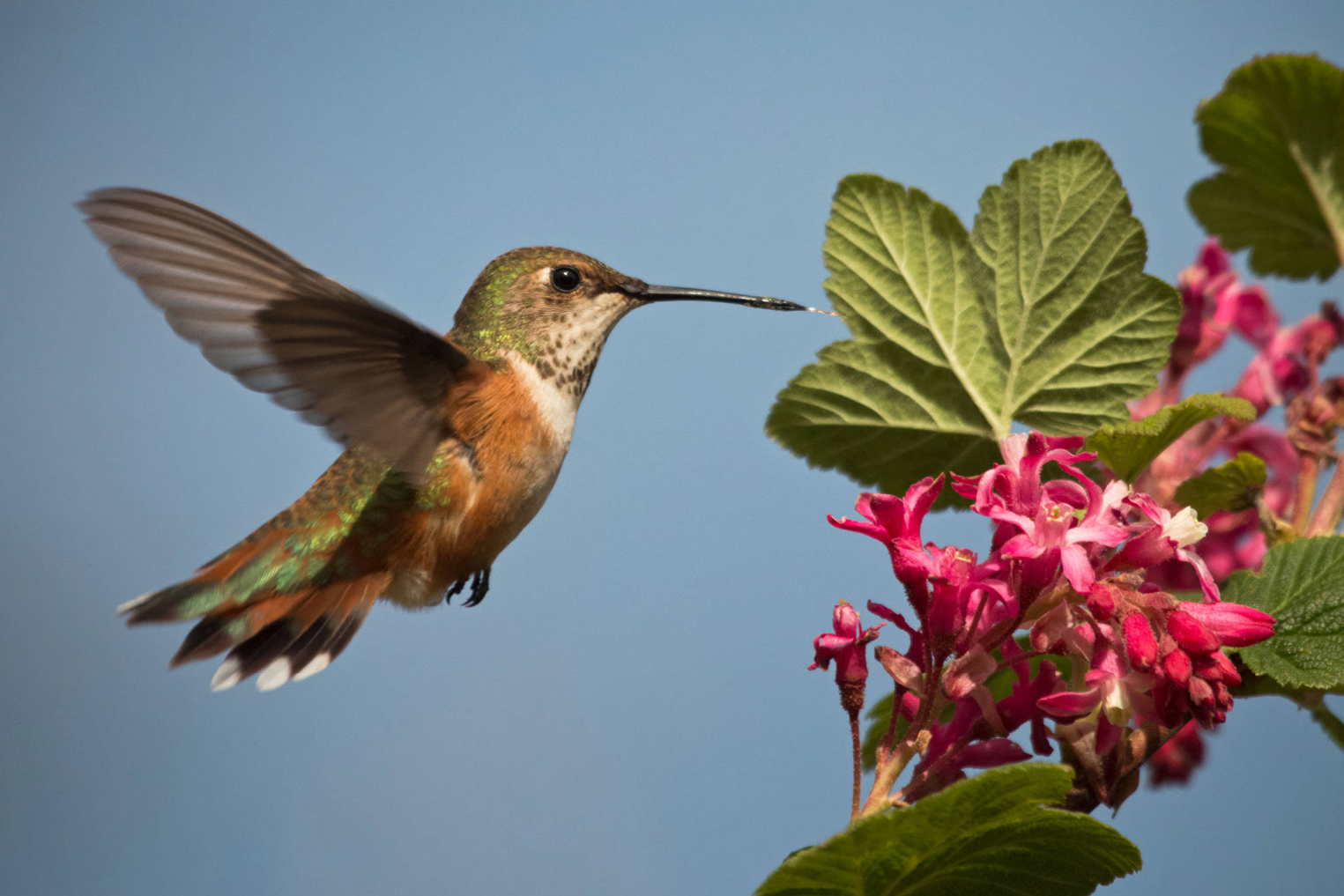
Native Plants for Birds: Female Rufous Hummingbird(Selasphorus rufus) on Red Flowering Current(Ribes sanguineum) Courtesy US FWS, Peter Pearsall, Photographer
Female Rufous Hummingbird(Selasphorus rufus) on Red Flowering Current(Ribes sanguineum)
Courtesy US FWS, Peter Pearsall, Photographer
When we are hungry, we head for the kitchen. When birds are hungry they head for plants. Native plants, in particular provide important sources of food for birds and other wildlife.

Native plants play an important role in an ecosystem, providing the best habitat for wildlife. They are species of plants that have grown naturally in an area and thrive in an environment that matches the soils, moisture, and weather of a particular locality.

Arrowleaf Balsamroot Hyde Park, UT Courtesy & Copyright Linda L'Ai
Arrowleaf Balsamroot
Hyde Park, UT
Courtesy & Copyright Linda L’Ai
There are mutually beneficial connections for plants and birds that have evolved together. Native plants are a veritable market place for birds offering them nuts, seeds, fruits, nectar, and tasty bugs. They have an important influence on a bird’s diet, feeding habits, and even migration patterns. And as birds feed on the local fare they spread pollen and seeds.

This data gathered by Audubon’s Plants for Birds Program supports the planting of native species whenever possible.

  • 96% of land birds feed insects to their chicks.
  • Native oak trees host over 530 species of caterpillars while non-native ginkgo trees host just 4.
  • To raise one nest of chickadee babies, parents must gather between 6,000 and 9,000 caterpillars.
  • Suburban yards planted with native species host 8 times more native birds.

Birds shape their migration patterns around native plants. Plants that produce fleshy fruit duirng the late summer and fall provide birds with the energy needed for long migrations.

Urbanization has resulted in a threat to native plants. According to Audubon, the continental United States has lost over 150 million acres of native habitat due to urban sprawl. Fragmentation of native plant habitat is believed to be due to the construction of cities, roads and river flow reservoirs. All of these, combined with a changing climate’s impact on timing of insect hatching and flowers opening, present many challenges to our birds.

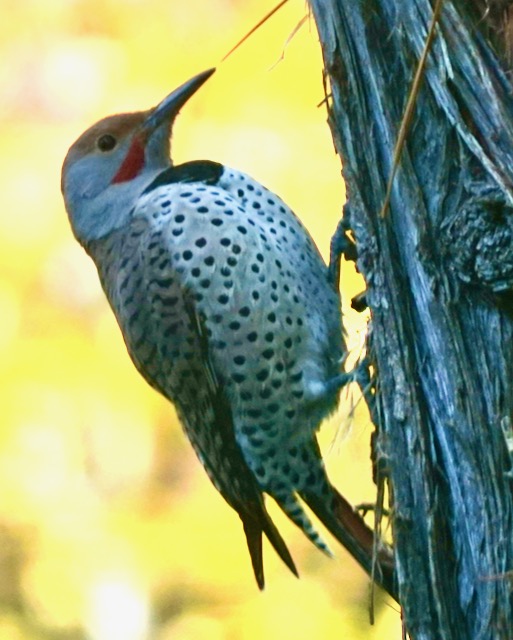
Northern Flicker Courtesy & Copyright Linda L'Ai
Northern Flicker
Courtesy & Copyright Linda L’Ai
You can help improve the connection between native plants and birds by adding native plants to your landscape. The native plants database developed by Audubon provides users with customized lists of native plants specific to your area, as well as the steps needed to evaluate which plants will find success in your soil. You can find the website at Audubon.org/plantsforbirds.  It’s as easy as putting in the area code, then clicking search. There are over 40 native plants listed for the Cache Valley area.

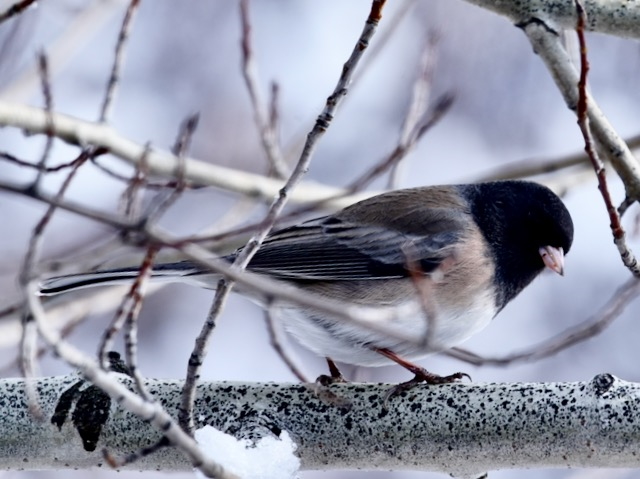
Dark-eyed Junco Courtesy & Copyright Linda L'Ai
Dark-eyed Junco
Courtesy & Copyright Linda L’Ai
Finches, sparrows, and chickadees are common birds to our area and are attracted to the seeds of the common sunflower.

The Wild plum, provides fleshy fruit for sparrows and chickadees and insects for woodpeckers.

Milkweeds attract hummingbirds and insect pollinators and serve as larval hosts for Monarch Butterflies.

Growing native plants is something we all can do in our yards or in the community to help bird populations increase now and in the future. Consider this: native plants that are adapted to the local region require less water, fertilizers and no pesticides.

Check out Audubon.org/plantsforbirds to find out more.
If you really dig birds, try digging native plants into your garden!

I’m Linda L’Ai with the Bridgerland Audubon Society, and I’m Wild About Utah!

Credits:

Photos: Courtesy US FWS, Peter Pearsall, Photographer, https://images.fws.gov/
Audio: Courtesy and Copyright Kevin Colver https://wildstore.wildsanctuary.com/collections/special-collections/kevin-colver
Text: Linda L’Ai, Bridgerland Audubon Society
Additional Reading: Lyle Bingham & Hilary Shughart, Bridgerland Audubon Society

Additional Reading

Grow Native For Birds, Bridgerland Audubon, https://bridgerlandaudubon.org/our-projects/grow-native-for-birds/

Plants For Birds, The Coleman and Susan Burke Center for Native Plants, National Audubon Society, https://www.audubon.org/plantsforbirds
“Plants for Birds,” National Audubon, https://vimeo.com/163864388

Native Plants for the Utah Landscape, Center for Water-Efficient Landscaping, Utah State University Extension, https://cwel.usu.edu/native-other

Native Plants, The Coleman and Susan Burke Center for Native Plants, National Audubon Society, https://www.audubon.org/native-plants/

Native Plant List-Utah and Western Colorado, PlantNative, Portland, OR, https://www.plantnative.org/rpl-ut.htm?fbclid=IwAR1nnlQUQ680x_SpwrKH_Fvtt2J2mtF7cqwZeUW8XAzzvlObs4K-kMPMIg0

Utah Native Plant Society, https://www.unps.org/

Tallamy, Doug, Sustainable Landscaping, Research, University of Delaware, May 2, 2013, 2.26 min, https://youtu.be/NTbPNwNIoLs

Tallamy, Doug, Eierman, Kim, EcoBeneficial Interview: Dr. Doug Tallamy In His Garden on the Importance of Native Plants, EcoBeneficial!, Nov 22, 2013, 29:30 min https://www.youtube.com/watch?v=w39g_f7BMUk


Sego Lily

Sego lily bulbs are edible, either raw or cooked, and were used as food by the Cheyenne. The sweet-tasting bulbs were often dried for later use. Caption & Photo Courtesy US NPS,  Michael Wheeler, Photographer
Sego lily bulbs are edible, either raw or cooked, and were used as food by the Cheyenne. The sweet-tasting bulbs were often dried for later use.
Caption & Photo Courtesy US NPS,
Michael Wheeler, Photographer
With Pioneer Day’s a few weeks away, it’s time to honor a very special plant that saved many Utah pioneers.

It’s been a banner year for our state flower. The sego lily has graced our meadows since early June, now in its late stages at lower elevations. It has generated many stories in our state. Before I launch them, I must compliment it’s delicate beauty and love for adverse conditions- the dry, rocky soils in which it’s found. The sego lily personifies the tough, resilient, beautiful pioneer spirit.

Brigham Young declared the sego lily “a heaven sent source of food.” Friendly Native Americans taught Mormon settlers how to harvest and prepare the bulbs for much needed survival food when a devastating cricket infestation destroyed crops.

From pioneer journals:

Sego Lily Courtesy US NPS, Nancy Julian, Photographer
Sego Lily
Courtesy US NPS, Nancy Julian, Photographer
“”In the spring of 1848, our food was gone. Along the month of April we noticed all the foothills were one glorious flower garden. The snow had gone, the ground was warm. We dug thousands of sego roots, for we heard that the Indians had lived on them for weeks and months. We relished them and carried them home in bucketful’s. How the children feasted on them, particularly when they were dried, for they tasted like butternuts.”
Elizabeth Huffaker, Salt Lake City

And here is another one:
“In my childhood our whole group of children used to go east of town, each carrying a sego digger. It was a piece of wood sharpened on one end, and flat on the other. We would just go out of town and look for segos, which were plentiful. When we found them we each went to digging by putting the sharp end of the stick into the ground close beside the sego, and pressing down on the flat end of the digger until it was a few inches in the ground. Sometimes we pounded on the top of the digger with a rock…when the stick was far enough into the ground to suit us, we just pushed it to one side and up came the segos. Then we ate them, and oh how we enjoyed hunting them.”
Lorena Washburn Larsen, 1868, Manti, UT

Native Americans considered the sego lily a sacred plant and developed culinary uses for its bulbs, seeds, and flowers. Many tribes created a healthful porridge from roasted or boiled sego lily bulbs. Several tribes considered it sacred. For the Navajo it was one of the “Life Plants” used for ceremonial purposes. Sego was derived from the Indian word Sego. Many Indian women were named Sego or Sego-go-chee. The Spanish named it mariposa, their word for butterfly for these beautiful mountainside flowers looked like butterflies.

The sego lily was formally designated as the Utah State Flower in 1911 chosen for its natural beauty as well as its historical significance.

The lily gets its scientific name Calochortus Nuttalli, from Thomas Nuttall, a naturalist, who collected the sego lily in 1811 while traveling along the Missouri River. It’s found throughout the western states. Please do not disturb this iconic beauty. Photos are encouraged!

Jack Greene for Bridgerland Audubon Society, I continue to be infatuated with Utah’s wildness!

Credits:

Images: Courtesy US NPS, Michael Wheeler, Photographer
      Courtesy US NPS, Nancy Julian, Photographer
Audio: Courtesy & Copyright Friend Weller, Utah Public Radio
Text:     Jack Greene, USU Sustainability Program Volunteer, Bridgerland Audubon Society

Additional Reading:

Sego Lily, Cedar Breaks National Monument, National Park Service, U.S. Department of the Interior, https://www.nps.gov/cebr/learn/nature/sego-lilly.htm

Utah State Facts and Symbols, Utah.com, Deseret Digital Media, https://utah.com/things-to-do/plan-your-trip/state-facts-and-symbols/

Utah State Flower – Sego Lily, Pioneer-Utah’s Online Library, Utah State Library Division, Utah Department of Heritage and Arts, https://www.utah.gov/about/state-symbols.html

Sego Lily, Calochortus nuttallii Torr. & A. GrayShow https://plants.sc.egov.usda.gov/plant-profile/CANU3 [updated Feb 19, 2025]

Liliaceae Calochortus nuttallii, Arches National Park, US National Park Service, US Department of the Interior, https://www.nps.gov/arch/learn/nature/liliaceae_calochortus_nuttallii.htm

Sego Lily and Friends, Wikimedia Commons, https://commons.wikimedia.org/wiki/File:Sego_Lily_and_Friends_(14368043194).jpg

LORENA EUGENIA WASHBURN, Autobiography, Published by her Children, Brigham Young University Press, 1962, [Abandoned & misappropriated link removed Feb 19, 2025]

Young, Levi Edgar, The Sego Lily (See quote from Mrs. Elizabeth Huffaker, a pioneer of 1847, p.7), The Great West in American History, Bulletin of the University of Utah, Volume 11, Issue 9, Department of Western History, University of Utah, https://books.google.com/books?id=4LfOAAAAMAAJ

Sagers, Larry A., Utah Sego Lily Thrives In Dry, Sandy Hillsides – Not Gardens, Deseret News July 25, 1990, Larry A. Sagers, https://www.deseret.com/1990/7/25/18873035/utah-sego-lily-thrives-in-dry-sandy-hillsides-not-gardens

Ancient Native Plant Relationships Reviewed

Ephedra, Ephedra viridis Coville
Ephedra
Ephedra viridis Coville
Courtesy USDA, NRCS. 2016. The PLANTS Database (https://plants.usda.gov, 6 February 2016). National Plant Data Team, Greensboro, NC 27401-4901 USA., BLM Photographer

Hi I’m T.J. Knudson and I’m Gilbert Young.

Stretching from the snowy peaks of the Wellsville Mountains, south to the sandstone shadows of Beaver Dam Wash, an ancient, native relationship provided unity to the diverse landscape. It is admired in the haunting tune of a wind pipe, it comports like a wool blanket; and its tapestry goes beyond the cliff art at Potash, and preceded John Wesley Powell and Brigham Young.

The Ute, Shoshone, Piute, Goshute, and Navajo cultures each echo today an enduring sustaining relationship bonded to the reliable plant life in a diverse land. this relationship sustained our state’s ancient culture, but little is understood about these gifted craftsmen in utilizing the materials and fibers.

In southeast Utah, the shepherd Navajo nation found a companion in the Prickly-Pear Cactus. Despite his short stature and sharp countenance, this ally was able to provide a fleshy, refreshing fruit. After rolling repeatedly through the direct to lose his spines, and soaking in water; there sparks a reaction of the most spectacular die; which was often orchestrated into many shades of red. Despite his stature on the lonely desert floor, the prickly pear creates a color that epitomizes the Navajo beauty and lives on to future generations.

As our ancient travelers would ascend upward into the hills, they would spend time in the Pinyon/Juniper woodland to collect pine nuts. Natives would also search for three other valuable resources: pine pitch, firewood and shelter materials. Underneath the pines and junipers plentiful sumac, can be found; the sumac branches provide the means to develop a midnight-black die and was also an essential basketry material. The third element needed to create this black color was ocher (okerr), a yellow mineral abundant in Navajo territory. The Pinyon-Juniper woodland met the needs of native people, much like modern superstores. Like these plants working together as a team, we all have an opportunity to join others in creating a unified community.

Prickly Pear Cactus, Opuntia ficus-indica
Prickly Pear Cactus
Opuntia ficus-indica
Courtesy US FWS

Across the canyons, a lone plant is found that nursed and comforted tribes long before the hospitals and prescriptions. Ephedra was a medicinal hero, when sharp cold winds swept the valleys. It could be boiled into a delicious tea that combated the common cold, allowing airways freedom of congestion. Also known as Brigham Tea, Natives shared this knowledge to the early Utah Pioneers in their time of need. The evergreen stems of Ephedra offer healing and a comfort that aided the native people and settlers. We also have the ability to heal our souls by intimately connecting ourselves to nature’s bounteous gifts. We can also provide healing to those who are in need of comfort and guidance.

If the past could speak to us today, it would remind us of connections and relationships that have been forgotten. Our hope today is that you may connect with these ancient relationships for yourselves. For more information, check out the Wild About Utah website.

For Wild About Utah this is T.J. Knutson and Gilbert Young.

Credits:
Images: Courtesy , Photographer
Text:     T.J. Knutson and Gilbert Young.


Additional Reading:

Permaculture

Click to view Rain Water Storage Tank, Photo Courtesy & © Roslynn Brain, Photographer
Rain Water Storage Tank
Private Residence in New Mexico
Installed by Jeff Adams of Terrasophia
Photo Courtesy & © Roslynn Brain, Photographer


Have you ever looked at a healthy forest and wondered “how do those trees, shrubs, and smaller plants thrive without fertilizer inputs, pest control, consistent watering, tilling, thinning, and being overtaken by unwanted species?” Many in Utah, in striving for alternative ways to grow food and landscapes in general, are turning away from conventional practices and experimenting in a relatively new design process called “permaculture.”

But what exactly does permaculture mean? Permaculture is a design philosophy for producing sustainable landscapes and buildings that work as a system and have the diversity, stability, and resilience of natural ecosystems.

Although concepts included in permaculture design have been in practice for millennia by indigenous cultures worldwide, the term “permaculture” was first coined in Tasmania in the mid 1970s by Bill Mollison and David Holmgren. They describe permaculture as “consciously designed landscapes which mimic the patterns and relationships found in nature, while yielding an abundance of food, fiber, and energy for provision of local needs.”

As Utahns lean toward water conservation and self-sufficiency, many are incorporating permaculture into their lifestyles. The first, and most important, principle in permaculture design is “observe and interact.” Watch your landscape during different weather events – in heavy rain, regular rain, high winds, and more. Where do storms come in from? Which way do the high winds normally blow? Which areas receive full sun? Where do you hear consistent noise and do you like or dislike what you hear? How does water flow on your property in a rain event? These observations will serve as the foundation guiding how you will eventually design your landscape.

Following “observe and interact” are 11 additional principles, which can be found in most introductory texts about permaculture design, and in USU Extension’s permaculture fact sheet. After making long and slow observations, you may decide you wish to block noise coming in from a certain part of your property, or capture rainwater from your south-facing roof. This is where various tools and techniques come into play, such as harvesting rainwater and stacking functions. Rainwater is a clean, free resource that falls on our roof and properties. Are you effectively using this free resource by building basins and swales to better capture and infiltrate water instead of mounds where water would easily runoff? Are you capturing and storing water from your roof for drier periods? Stacking functions is the practice of considering the entire spectrum of benefits various elements (such as plants or structures) on your landscape could provide, and then grouping elements in a way that works as system. A common example includes the Native American “Three Sisters Garden” of corn, beans, and squash. Nitrogen-fixing beans provide a stable, slow-release nitrogen source for the corn, whereas corn provides a pole for the beans to grow. Squash forms a natural ground cover to reduce weeds and retain soil moisture, while the prickly hairs help deter pests. The gardener can reap a higher yield through stacking functions like this.

To find out more, search for USU Extension’s permaculture fact sheet.

For Utah State University Extension Sustainability, this is Roslynn Brain.

Credits:

Photos: Courtesy and Copyright Roslynn Brain
Text: Roslynn Brain, Utah State University Extension Sustainability

Sources & Additional Reading:

YCC Team, Lush Utah garden makes the most of a small amount of rain, Yale Climate Connections, July 25, 2022, https://yaleclimateconnections.org/2022/07/lush-utah-garden-makes-the-most-of-a-small-amount-of-rain/