Mourning Cloaks and Witchy Skies

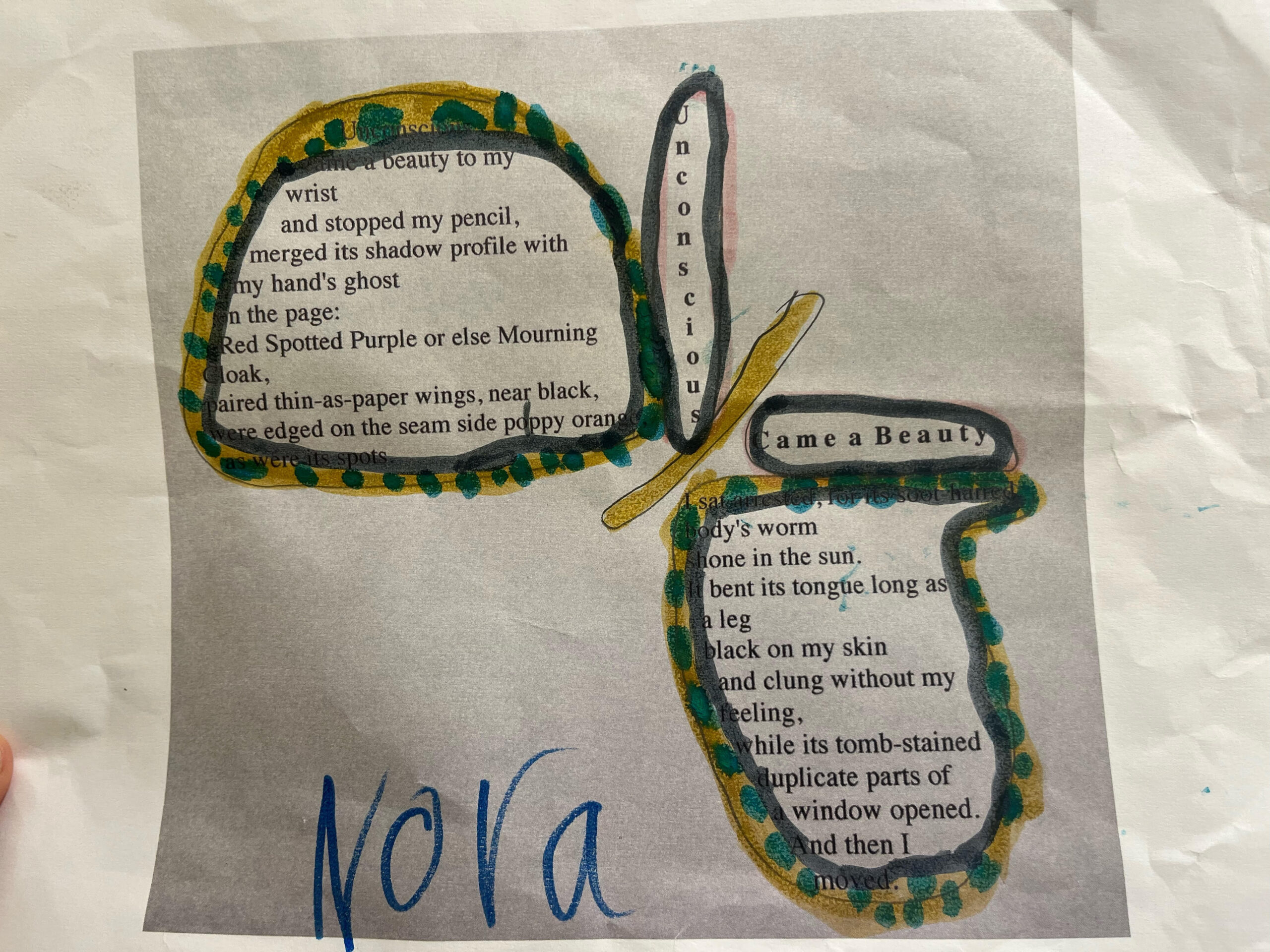
Nora's embellished May Swenson poem: "Unconscious Came a Beauty," as a butterfly-A means to emphasize the butterfly poem subject. Poem copyright acknowledged-Photo Courtesy Shannon Rhodes
Nora’s embellished May Swenson poem: “Unconscious Came a Beauty,” as a butterfly
A means to emphasize the butterfly poem subject.
Poem copyright acknowledged
Photo Courtesy Shannon Rhodes
I’m sitting here today with first grader Nora Baggaley and USU student teacher Ashlyn Prince. Just steps away from where we spend our days at Edith Bowen Laboratory School on the campus of Utah State University, we find Swenson Park, built on the lot where May’s childhood home once stood. She spent her elementary school days here, she was a student at Utah State Agricultural College, and she moved east to become a writer. During her lifetime May Swenson wrote her way into fame by recording memories riding her willow horse, enjoying strawberry juice dripping down her chin, and describing the relationships that develop when a baseball bat, ball, and mitt meet. Eventually she became Chancellor of the Academy of American Poets. I love that she wrote shape poems about simple things like insects.

Insects? Did you say bugs? Coming into student teaching, I wasn’t too thrilled when I heard about the focus we have on bugs. From the beginning of the school year, we were already in the Logan River, digging out stonefly larva. By the second week, I was already writing a book for my students about why I do not like bugs. Here’s some of my book “Definitely NOT the Bug Girl.” I loved butterflies; they had beautiful wings. That was until I saw them closer. They looked an awful lot like grasshoppers with wings, and if you were paying attention, I hate grasshoppers! Why did I never think they were big, sticky, scary insects too? They did come from caterpillars…I should’ve known!”

Throughout the semester, from katydids flying at my head to being chased at recess with grasshoppers, I’ve grown to love the stories and discoveries the children have with bugs. Now today, I see a bug and instantly start to wonder: How did it get here? Where is it going? What would my students think about this? I could almost say I love bugs…

Mourning cloak butterfly (pinned), Courtesy & Copyright Don Rolfs 2010
Mourning cloak butterfly (pinned)
Courtesy & Copyright Don Rolfs 2010 https://wildaboututah.org/springs-earliest-butterflies/
Well, I love bugs.

Swenson’s “Unconscious Came a Beauty” captures an encounter with a butterfly. She isn’t certain about which kind of butterfly, so she offers two choices based on her descriptors. She must have been outside writing when one landed on her hand long enough for her to notice it, know it well enough to describe it.

I like how her words are in the shape of a butterfly and the wiggly way she typed the title.

When I wrote “Definitely NOT the Bug Girl,” Nora and her classmates encouraged me to include even more chapters about different kinds of insects. They wanted chapters of how I felt about roly polys, katydids, and ladybugs. I never really had an opinion about ladybugs. They were cute but a little frightening when they would fly. Finding them at recess became not so scary to me. Did you know they start their life as black and orange larvae?

How’s this for a poem inspired by May’s shape poem?
Hungry crawls a lady bug larva
To our recess rock riddled with yellow aphids dots
And stopped our games
Orange-striped black
Alligator-wiggling on its six legs
We sat wondering, and Asher brought one to class
Where it crept out overnight as a familiar friend.
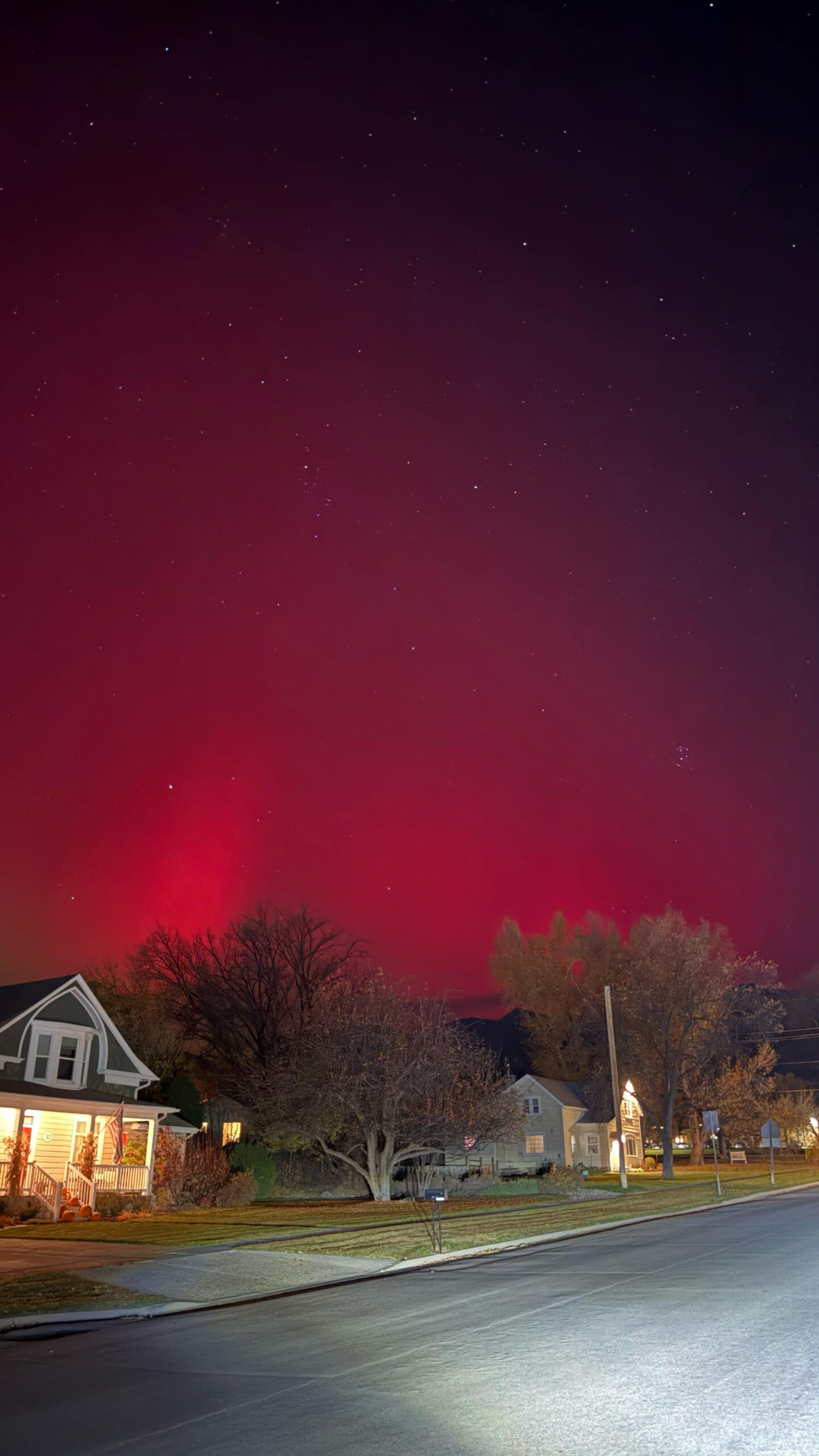
Aurora Borealis from Logan Utah
Courtesy & Copyright Shannon Rhodes, Photographer
Aurora Borealis from Logan Utah
Courtesy & Copyright Shannon Rhodes, Photographer
Besides bugs, did you know May also wrote about space topics we know, like astronaut landings, gibbous moons, shadows, and her ghost moon? She called it, “the albino bowl on cloth of jet.”

In November, every student, and teacher, was given a nature journal paper to observe the full moon that night. Sadly, the sky was full of clouds and only a faint glow was visible. Amazingly enough though, we could see the northern lights a few days later! It was a beautiful sight, and made up for missing the November Beaver Moon.
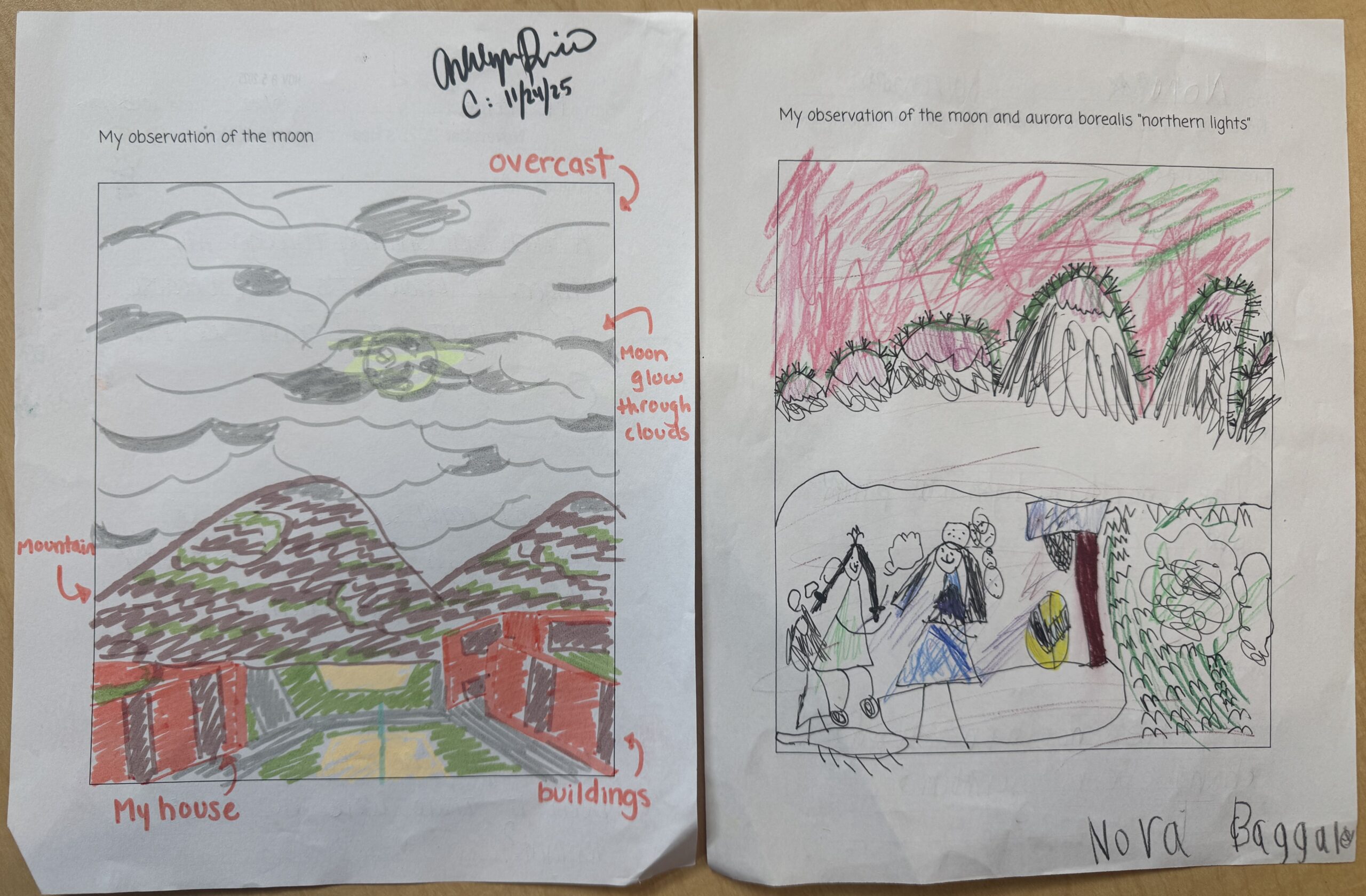


Night Sky Nature Journal Entries by Ashlyn and Nora
Courtesy & Copyright Shannon Rhodes, Photographer
Night Sky Nature Journal Entries by Ashlyn and Nora
Courtesy & Copyright Shannon Rhodes, Photographer

This is a two-voice poem we call “Witchy Sky.”
The beaver moon reminds me of cotton candy in the dark.
         It reminds me of a flashlight shining through my finger.
The northern lights are Glinda and Elphaba.
         I notice a lot of thick clouds.
I can’t really see the shape of the moon in the clouds but still it glows through them.
I wonder what does the moon feel like?
         How bright would the sky have been if there were no clouds tonight?

May Swenson remembered classmates folding paper airplanes and releasing them in the classroom when their teachers’ backs were turned. In a clip from a 1969 recording “Poetry Is Alive and Well and Living in America,” she says, “My poems sail away like that, I don’t know who picks them up, who may be reading them. It’s lovely to think that people are reading my things, especially that they are being stimulated to write their own poems.”

Don’t worry, May. We are inspired by your Mourning Cloak, Ashlyn’s aphid-eaters, Nora’s night sky auroras, and students, young adult and age 6, immersed in words every day.

This is Nora Baggaley, Ashlyn Prince, and Shannon Rhodes, and we are Wild About Utah, May Swenson, night sky poetry, and of course, bugs.
Well, maybe bugs.
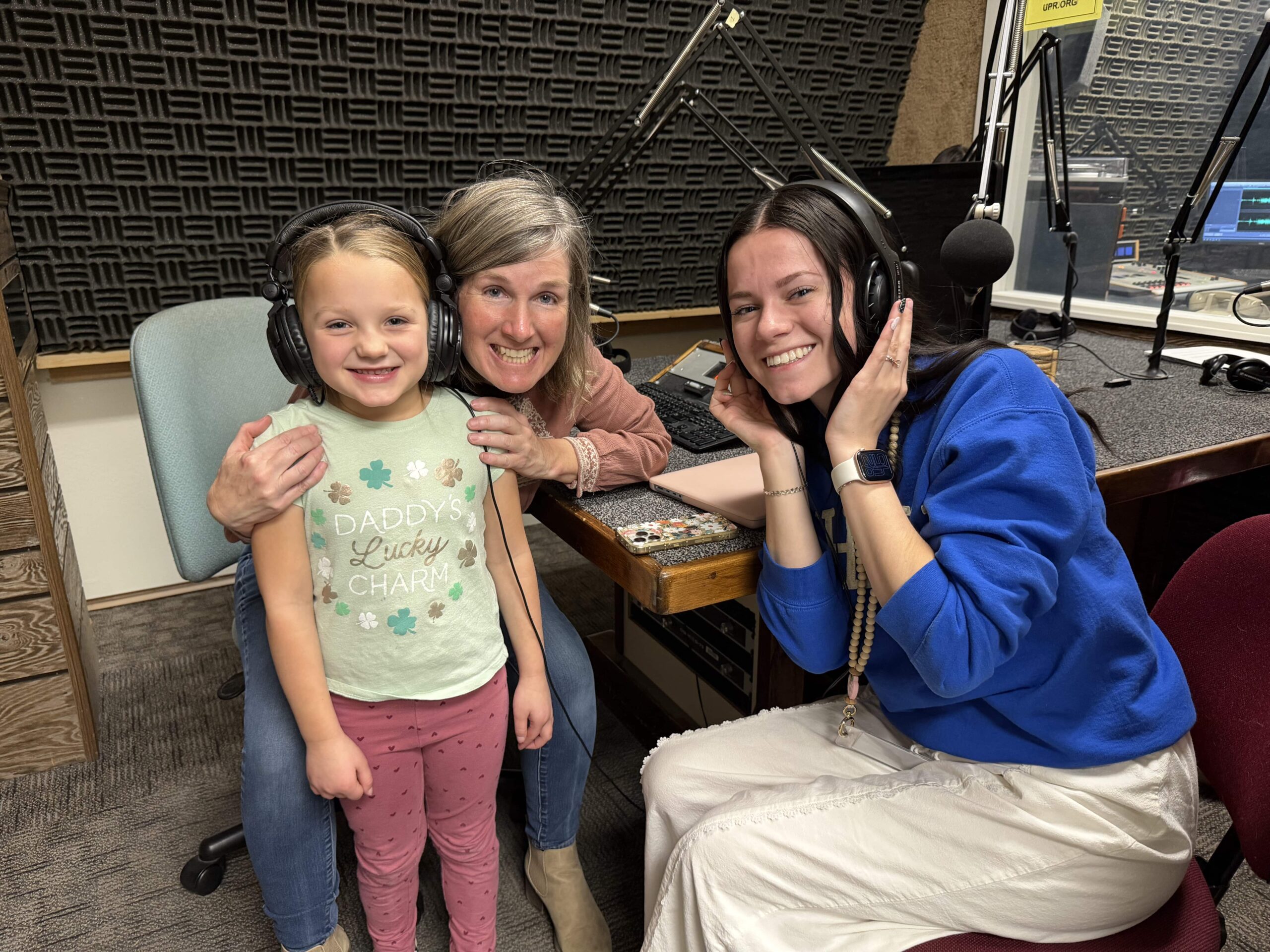
Nora, Shannon & Ashlyn in the Studio
Courtesy & Copyright Stu Baggaley, Photographer
Nora, Shannon & Ashlyn in the Studio
Courtesy & Copyright Stu Baggaley, Photographer

Credits:

Images: Classroom art Courtesy & Copyright Shannon Rhodes, Photographer
         Mourning cloak butterfly (pinned), Courtesy & Copyright Don Rolfs
         Nora, Shannon and Ashley in the UPR Studio, Courtesy & Copyright Stu Baggaley
Audio: Courtesy & © Friend Weller, https://upr.org/
Text & Voice:     Shannon Rhodes, Nora Baggaley, and Ashlyn Prince, Edith Bowen Laboratory School, Utah State University https://edithbowen.usu.edu/
Additional Reading Links: Shannon Rhodes

Additional Reading:

BEETLES Project, The Regents of the University of California, https://beetlesproject.org/resources/for-field-instructors/notice-wonder-reminds/

Hellstern, Ron. June Fireflies, Wild About Utah, June 19, 2017, https://wildaboututah.org/june-fireflies/

Ross, Fran, 1969. Poetry is Alive and Well and Living in America. https://www.youtube.com/watch?v=TaKRjiqGizQ&t=1s

Spencer, Sophia with Margaret McNamara. Bug Girl: A True Story. https://www.amazon.com/Bug-Girl-True-Story/dp/0525645934

Strand, Holly. May Swenson, Wild About Utah, April 14, 2009, https://wildaboututah.org/may-swenson-a-utah-poet-and-observer-of-nature/

Swenson, May. Unconscious Came a Beauty. Poets Speak, https://www.youtube.com/watch?v=VO6LSVzBTKs&t=6s

Tevela, Irina. May Swenson in Space, Washington University in St. Louis, July 19, 2019, https://library.washu.edu/news/may-swenson-in-space/

April Light by May Swenson

May Swenson, 1965 in Tucson
Copyright © L.H. Clark
Courtesy Utah State University Press

Hi, I’m Holly Strand from Stokes Nature Center in beautiful Logan Canyon.

In Logan Cemetery a granite bench marks the grave of May Swenson, a native Utahn and eminent poet. She was born in Logan in 1913 and attended Utah State University where she published her first poem. She moved east in 1936, and eventually, she became one of America’s most inventive and recognized poets, She won many awards including Guggenheim and Rockefeller grants, the Yale Bollingen Prize, and the MacArthur Foundation Fellowship. Utah State University conferred an honorary doctorate on Swenson in 1987. Despite her many achievements and her years living away from Utah, Swenson never forgot her Mormon heritage or her identity as a Westerner.

Nature played a prominent role in Swenson’s work. In fact, she published a collection of poetry called Nature: Poems Old and New which is brimming with imagery that evokes the beauty and complexity of the natural world.

An example is a poem called April Light. Here it is read by Dr. Paul Crumbley, a professor of English at Utah State University.

April light

Lined with light
the twigs are stubby arrows.
A gilded trunk writhes
Upward from the roots,
from the pit of the black tentacles.
In the book of spring
a bare-limbed torso
is the first illustration.
Light teaches the tree
to beget leaves,
to embroider itself all over
with green reality,
until summer becomes
its steady portrait
and birds bring their lifetime
to the boughs.
Then even the corpse
light copies from below
may shimmer, dreaming it feels
the cheeks of blossom.

To learn more about May Swenson and her work, come to Stokes Nature Center on May 1st at 10 AM. Paul Crumbley will present a program entitled “May Swenson’s Poetics of Natural Selection.” For more information, see www.wildaboututah.org

For Wild About Utah and Stokes Nature Center, I’m Holly Strand.

Credits:

Readings: Paul Crumbley, English Department, Utah State University, April Light by May Swenson

Text: Stokes Nature Center: Holly Strand

Sources & Additional Reading

Knudson, R.R. and Suzzanne Bigelow. 1996. May Swenson: A Poet’s Life in Photos. Logan, UT: Utah State University Press, https://www.jstor.org/stable/43021931

Swenson, May, Nature: Poems Old and New, Mariner Books (fmr: Houghton Mifflin Harcourt), April 19, 2000, https://www.amazon.com/Nature-Poems-Old-May-Swenson/dp/0618064087

The life of Utah poet May Swenson, with Margaret Brucia, Access Utah with Tom Williams, https://www.upr.org/show/access-utah/2025-07-14/the-life-of-utah-poet-may-swenson-on-access-utah

May Swenson: A Utah poet and observer of nature

May Swenson, 1965 in Tucson
Copyright © L.H. Clark
Courtesy Utah State University Press

Hi, I’m Holly Strand from Stokes Nature Center in beautiful Logan Canyon.

In Logan Cemetery a granite bench marks the grave of May Swenson, a native Utahn and eminent poet. She was born in Logan in 1913 and attended Utah State University where she published her first poem. She moved east in 1936, and eventually, she became one of America’s most inventive and recognized poets, She won many awards including Guggenheim and Rockefeller grants, the Yale Bollingen Prize, and the MacArthur Foundation Fellowship. Utah State University conferred an honorary doctorate on Swenson in 1987. Despite her many achievements and her years living away from Utah, Swenson never forgot her Mormon heritage or her identity as a Westerner.

Nature played a prominent role in Swenson’s work. In fact, she published a collection of poetry called Nature: Poems Old and New which is brimming with imagery that evokes the beauty and complexity of the natural world.

Here’s an example: a poem called April Light read by Paul Crumbley, a professor of English at Utah State University who specializes in Swenson’s work.

April light

Lined with light
the twigs are stubby arrows.
A gilded trunk writhes
Upward from the roots,
from the pit of the black tentacles.
In the book of spring
a bare-limbed torso
is the first illustration.
Light teaches the tree
to beget leaves,
to embroider itself all over
with green reality,
until summer becomes
its steady portrait
and birds bring their lifetime
to the boughs.
Then even the corpse
light copies from below
may shimmer, dreaming it feels
the cheeks of blossom.

Another of Swenson’s poems describes a well-known natural feature in Utah.

Listen to this excerpt of Above Bear Lake:

A breeze, and the filtered light makes shine
A million bristling quills of spruce and fir
Downslope, where slashes of sky and lake
Hang blue—windows of intense stain. We take
The rim trail, crushing bloom of sage,
Sniffing resinous wind, our boots in the wild,
Small, everycolored Rocky Mountain flowers.
Suddenly, a steep drop-off: below we see the whole,
the whale of it—deep, enormous blue—
that widens, while the sky slants back to pale
behind a watercolored mountain.

Listening to this makes me feel like I’m standing on the scenic outlook at the summit of Logan Canyon. That is, of course, where Swenson wrote it.

For more on the Utah poet May Swenson, see our website www.wildaboututah.org
Thanks to Paul Crumbley and Maria Melendez of the English Dept. at Utah State University.
And thanks to the Rocky Mountain Power Foundation for supporting the research and development for today’s program.

For Wild About Utah and Stokes Nature Center, I’m Holly Strand.

Credits:

Readings: Paul Crumbley and Maria Melendez of the English Dept, Utah State University

Text: Stokes Nature Center: Holly Strand

Sources & Additional Reading

Knudson, R.R. and Suzzanne Bigelow. 1996. May Swenson: A Poet’s Life in Photos. Logan, UT: Utah State University Press, https://www.jstor.org/stable/43021931

Swenson, May, Nature: Poems Old and New, Mariner Books (fmr: Houghton Mifflin Harcourt), April 19, 2000, https://www.amazon.com/Nature-Poems-Old-May-Swenson/dp/0618064087

The life of Utah poet May Swenson, with Margaret Brucia, Access Utah with Tom Williams, https://www.upr.org/show/access-utah/2025-07-14/the-life-of-utah-poet-may-swenson-on-access-utah