A Trip to the Utah Museum of Natural History

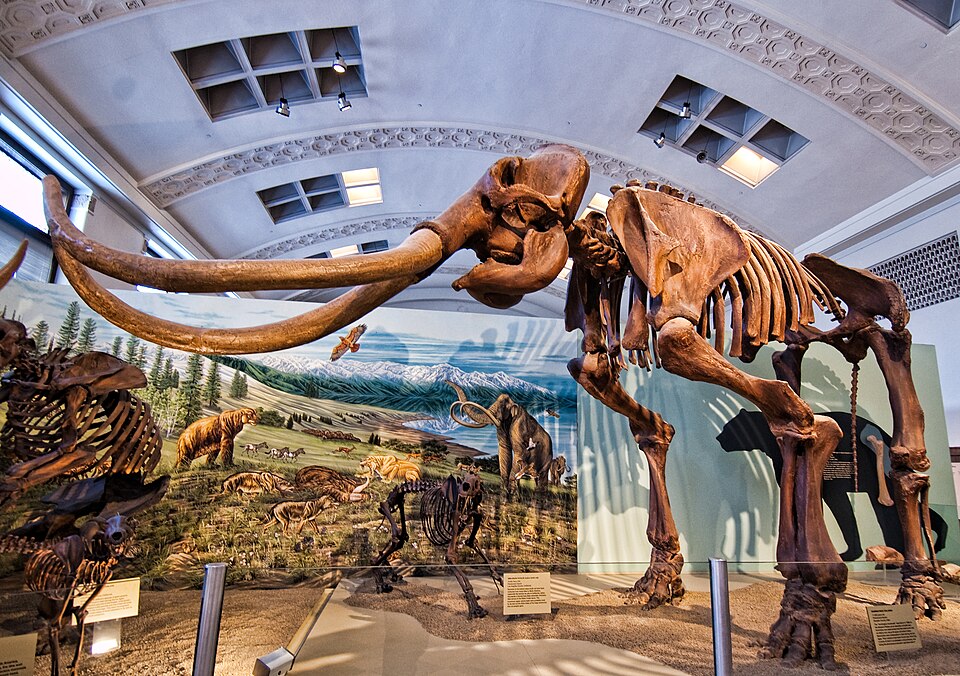
Mounted cast of a Columbian mammoth (Mammuthus columbi) in the old building of the "Utah Museum of Natural History" Courtesy Wikimedia, Brett Neilson, Photographer, Licensed under the Creative Commons, https://en.wikipedia.org/wiki/en:Creative_Commons, Attribution 2.0 Generic license, https://creativecommons.org/licenses/by/2.0/deed.en
Mounted cast of a Columbian mammoth (Mammuthus columbi) in the old building of the “Utah Museum of Natural History”
Courtesy Wikimedia, Brett Neilson, Photographer
Licensed under the Creative Commons Attribution 2.0 Generic license.
When I opened the door to the special exhibit on the Ice Age at Salt Lake’s Natural History Museum, I found myself face to face with the long, looping tusks of a wooly mammoth. Once I caught my breath, I could see the mammoth’s head was painted on a piece of wood, but the tusks were 3 dimensional and towered above me – about 10 feet in the air and stretching out to about 9 feet. This magnificent mammal, now extinct, was well adapted to living on an icy planet. Its hair grew as long as 35 inches and its skin was slightly over 3 inches thick. By comparison, the museum pointed out, the modern Asian elephant has little or no hair and its skin is less than an inch thick.

The special ice age exhibit has left Salt Lake, but a visit to the Museum of Natural History is always a treat. Its skeleton of a mammoth clearly conveys a feeling for its massive size. Also looking huge is their skeleton of a giant sloth, standing 8 feet high and sporting a hand claw over 12 inches long. Back when Thomas Jefferson was president of the United States, some explorers found a similar claw in a cave in Virginia and sent it to him.. Jefferson quickly sent off an urgent message to Lewis and Clark on their trek west to keep an eye out for this fiercesome beast. As it turns out, the giant sloth was extinct and had just been a vegetarian who lived mostly in the trees. The giant sloth used the claw to pull tree branches closer so he could eat the leaves.

If you walk down the museum ramp leading away from the giant sloth, you leave the Ice Age and go deeper back in time to the Age of Dinosaurs. You pass by a prehistoric crocodile and a giant birdlike creature standing on large, three toed claw feet. This bird would run down its prey at speeds as high as 30 mph. Soon you arrive at a section of glass flooring, exposing a massive jumble of bones underfoot. You have arrived at the exhibit on Utah’s unique Cleveland-Lloyd quarry. In the early 1900’s, some cowboys and sheepherders noticed some large bones sticking out of a hillside about 30 miles away from the current town of Price. The scientific community was alerted, and digging at the site began. To this day, over 10,000 bones have been unearthed, and the majority identified as belonging to predator dinosaurs. But we still don’t know how or why this massive bone yard was created.

Four paleontologists have stepped forward and offered their best guess as to why so many dinosaur bones are here. One by one these four men appear on video screens along the museum path. The first one says this was once a watering hole. The dinosaurs came to drink, but the watering hole dried up. The dinosaurs died of thirst.

Oh no, said the second. There was actually too much water. The mud surrounding the watering hole became so deep the dinosaurs got stuck in the mud.

The third agreed that the dinosaurs came to the site to drink. But somehow the water had become contaminated. The dinosaurs drank and died of poison.

The fourth simply said the dinosaurs had died somewhere else, and the bones had been washed down to this site.

It’s still a mystery waiting to be solved.

In the meantime, the work of discovery goes on. Fossils are being found, and the promising ones are wrapped in plaster casts and sent to the lab. You can look in the lab windows as you exit the museum. A crew of staff and volunteers in white lab coats are picking up small hammers, picks and dentist drills. Slowly, carefully, they are cutting back the layers of time.

The answer to the question about the origin of Utah’s dinosaur bone yard seems to still lie just around the corner.

This is Mary Heers and I’m Wild About Utah

Credits:
Photos: Courtesy Wikimedia and US Bureau of Land Management
Featured Audio: Courtesy & Copyright © Anderson, Howe, and Wakeman Utah Public Radio upr.org
Text: Mary Heers, https://cca.usu.edu/files/awards/art-and-mary-heers-citation.pdf
Additional Reading: Lyle Bingham, https://bridgerlandaudubon.org/

Additional Reading

Wild About Utah, Mary Heers’ Wild About Utah Postings

Natural History Museum of Utah, University of Utah, http://nhmu.utah.edu
301 Wakara Way, Salt Lake City, UT 84108

Cleveland Lloyd Dinosaur Quarry, US Bureau of Land Management (BLM), US Department of the Interior, https://www.blm.gov/visit/cleveland-lloyd-dinosaur-quarry

Cleveland Lloyd Dinosaur Quarry, Jurassic National Monument, US Bureau of Land Management (BLM), US Department of the Interior, https://www.blm.gov/programs/national-conservation-lands/utah/jurassic-national-monument/photos

Cleveland Lloyd Dinosaur Quarry: Paleontological Resource Management, https://yout-ube.com/watch?v=YotsxDLDMSE

Cleveland Lloyd Dinosaur Quarry: The Interpretive Center, US Bureau of Land Management (BLM), US Department of the Interior, https://yout-ube.com/watch?v=YotsxDLDMSE
Galloping Thru Time

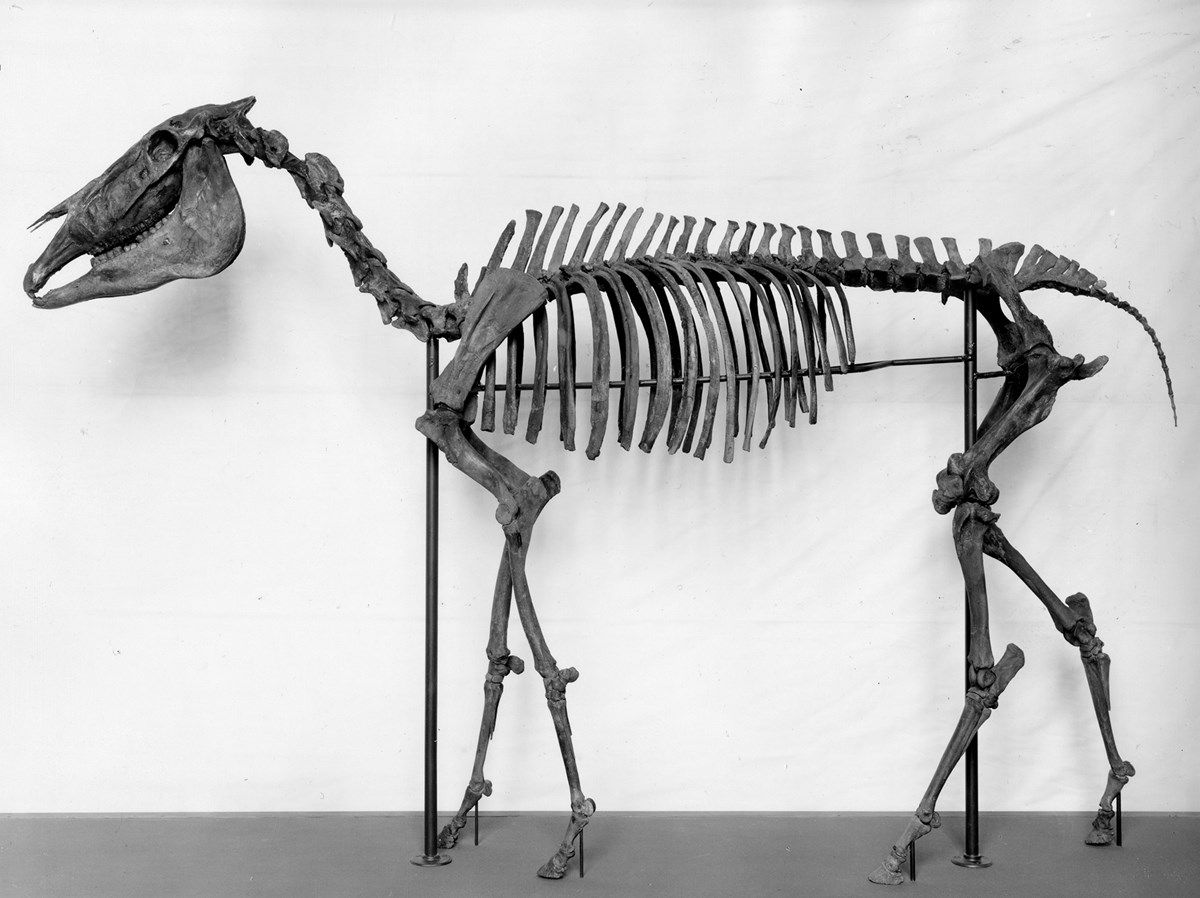
Gallop Thru Time: The Hagerman Horse (Equus simplicidens), Hagerman Fossil Beds National Monument, Courtesy US NPS
The Hagerman Horse (Equus simplicidens), Hagerman Fossil Beds National Monument, Courtesy US NPS

Elmer Cook Recognition Plaque Hagerman Fossil Bed National Monument Courtesy & © Mary Heers, Photographer Elmer Cook Recognition Plaque
Hagerman Fossil Bed National Monument
Courtesy & © Mary Heers, Photographer

Mary Heers' Selfie with the Hagerman Horse Hagerman Fossil Bed National Monument Courtesy & © Mary Heers, Photographer Mary Heers’ Selfie with the Hagerman Horse
Hagerman Fossil Bed National Monument
Courtesy & © Mary Heers, Photographer

Three Toes on the Kemmerer Horse Utah Museum of Natural History Courtesy & © Mary Heers, Photographer Three Toes on the Kemmerer Horse
Utah Museum of Natural History
Courtesy & © Mary Heers, Photographer

Metacarpal Toe, Hoof Hagerman Horse Equus simplicidens Hagerman Fossil Bed National Monument Courtesy & © Mary Heers, Photographer Metacarpal Toe, Hoof Hagerman Horse
Equus simplicidens
Hagerman Fossil Bed National Monument
Courtesy & © Mary Heers, Photographer

Metacarpal Toe, Hoof Domestic Horse Equus ferus caballus Hagerman Fossil Bed National Monument Courtesy & © Mary Heers, Photographer Metacarpal Toe, Hoof Domestic Horse
Equus ferus caballus
Hagerman Fossil Bed National Monument
Courtesy & © Mary Heers, Photographer

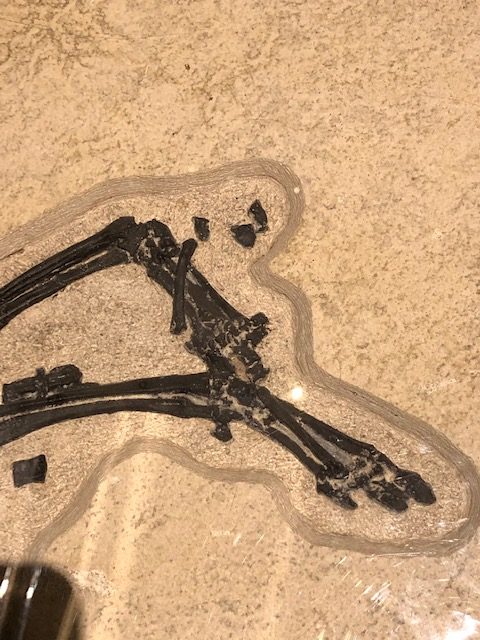
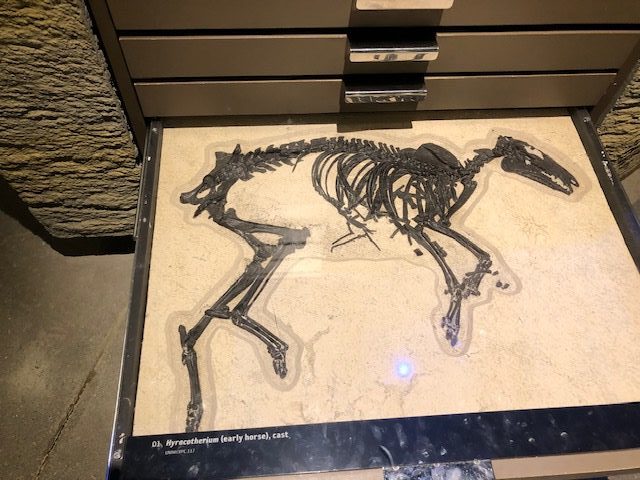
Cast of Kemmerer Early Horse Utah Museum of Natural History Courtesy & © Mary Heers, Photographer Cast of Kemmerer Early Horse
Utah Museum of Natural History
Courtesy & © Mary Heers, Photographer

In 1928 Elmer Cook, a rancher in Hagerman, Idaho, noticed an interesting bone sticking our of the hillside on his land overlooking the Snake River. Intrigued, he started to dig around and discovered it was a fossilized bone and there were plenty more like it. Elmer alerted the National Smithsonian Museum, who sent out a team. This team determined the bones were ancestors of the modern horse. They were 3½ million years old. In the end, after digging into the hillside for 2 years, they took over 200 fossils, including 12 complete horse skeletons, back to Washington D.C.

My own fascination with horse fossils actually began a few years ago when I was giving tours at the Utah Museum of Natural History in Salt Lake City. A fossil hunter near Kemmerer, Wyoming, had been quite surprised to find a small mammal while digging through layers of fossilized fish in an ancient seabed. This skeleton is now also in the Smithsonian Museum in D.C., but the Utah museum owns a copy.

When giving tours, I always paused my group as we entered the dinosaur floor. “I’m going to pull a whole horse out of here,” I’d say as I pulled a sliding drawer out of a chest with a flourish.

It was a fully grown horse about the size of a small dog – 24 inches long and 20 inches high.

It was over 50 million years old. In that time, the Intermountain West was a lush, swampy place. Fierce predators like the Utah Raptor roamed the land, and the mammals that survived were small and stayed hidden in the dense forested undergrowth.

Over the next 50 million years, the dinosaurs went extinct and the terrain dried out The Hagerman Horse (dating back 3 ½ million years ) stood about 4 ½ feet high. Most notably, it now stood on four hooves. The 3 toes on the Kemmerer Horse had evolved into a single dominant toe, perfectly adapted to running away from predators over dry terrain.

Unfortunately, this remarkable adaptation was not enough to save the horse. The horse went extinct in the Americas (along with other large mammals like the mammoth and giant sloth) about 10,000 years ago. It was the Spanish Conquistadors that reintroduced the horse to North America. When Hernan Cortez and his 200 soldiers landed in Mexico in 1519, they brought 16 horses with them. Over time, some of these horses got away to form wild bands, and others fell into the hands of the Native Americans.

This summer I made a small archeological pilgrimage into Idaho, to see the Hagerman Fossil Beds, now a National Monument. In the newly opened visitor center I found a life size replica of the Hagerman Horse. As I stood next to it, admiring its shapely hoof, I remembered one more remarkable fact about the horse. The bows now used to play violins are made from horse hair It takes 5 horse tails to make a violin bow. To this day, absolutely nothing has been found that makes the strings of a violin sing as sweetly.

This is Mary Heers and I am Wild About Utah.

Credits:
Photos: Courtesy & Copyright © Mary Heers
Photos: Courtesy
Featured Audio: Courtesy & Copyright © Kevin Colver, https://wildstore.wildsanctuary.com/collections/special-collections/kevin-colver
Text: Mary Heers, https://cca.usu.edu/files/awards/art-and-mary-heers-citation.pdf
Additional Reading: Lyle Bingham, https://bridgerlandaudubon.org/

Additional Reading

Wild About Utah, Mary Heers’ Wild About Utah Postings

Hagerman Fossil Beds National Monument, History, National Parks Service, US Department of the Interior, https://npshistory.com/publications/hafo/index.htm

The Hagerman Horse (Equus simplicidens), Hagerman Fossil Beds National Monument, National Parks Service, US Department of the Interior, https://www.nps.gov/articles/000/equus_simplicidens.htm

Hagerman Fossil Beds, National Parks Service, US Department of the Interior, https://www.nps.gov/hafo/index.htm

The Horse (Exhibit), Natural History Museum of Utah, July 21, 2014 – January 4, 2015, https://nhmu.utah.edu/horse#:~:text=The%20Natural%20History%20Museum%20of,and%20spiritual%20connections%20with%20them.
Natural History Museum of Utah,https://nhmu.utah.edu/

Fossil Horse Quarry Near Hagerman, Idaho, Worked by National Museum, Smithsonian Libraries and Archives, The Smithsonian Institution, https://www.si.edu/object/fossil-horse-quarry-near-hagerman-idaho-worked-national-museum:siris_arc_367758

Plesippus shoshonensis Gidley, 1930, National Museum of Natural History, The Smithsonian Institution, https://www.si.edu/object/plesippus-shoshonensis-gidley-1930:nmnhpaleobiology_3590445


Gallop Thru Time

Gallop Thru Time: The Hagerman Horse (Equus simplicidens), Hagerman Fossil Beds National Monument, Courtesy US NPS
The Hagerman Horse (Equus simplicidens), Hagerman Fossil Beds National Monument, Courtesy US NPS

Elmer Cook Recognition Plaque Hagerman Fossil Bed National Monument Courtesy & © Mary Heers, Photographer Elmer Cook Recognition Plaque
Hagerman Fossil Bed National Monument
Courtesy & © Mary Heers, Photographer

Mary Heers' Selfie with the Hagerman Horse Hagerman Fossil Bed National Monument Courtesy & © Mary Heers, Photographer Mary Heers’ Selfie with the Hagerman Horse
Hagerman Fossil Bed National Monument
Courtesy & © Mary Heers, Photographer

Three Toes on the Kemmerer Horse Utah Museum of Natural History Courtesy & © Mary Heers, Photographer Three Toes on the Kemmerer Horse
Utah Museum of Natural History
Courtesy & © Mary Heers, Photographer

Metacarpal Toe, Hoof Hagerman Horse Equus simplicidens Hagerman Fossil Bed National Monument Courtesy & © Mary Heers, Photographer Metacarpal Toe, Hoof Hagerman Horse
Equus simplicidens
Hagerman Fossil Bed National Monument
Courtesy & © Mary Heers, Photographer

Metacarpal Toe, Hoof Domestic Horse Equus ferus caballus Hagerman Fossil Bed National Monument Courtesy & © Mary Heers, Photographer Metacarpal Toe, Hoof Domestic Horse
Equus ferus caballus
Hagerman Fossil Bed National Monument
Courtesy & © Mary Heers, Photographer

Cast of Kemmerer Early Horse Utah Museum of Natural History Courtesy & © Mary Heers, Photographer Cast of Kemmerer Early Horse
Utah Museum of Natural History
Courtesy & © Mary Heers, Photographer

In 1928 Elmer Cook, a rancher in Hagerman, Idaho, noticed an interesting bone sticking our of the hillside on his land overlooking the Snake River. Intrigued, he started to dig around and discovered it was a fossilized bone and there were plenty more like it. Elmer alerted the National Smithsonian Museum, who sent out a team. This team determined the bones were ancestors of the modern horse. They were 3½ million years old. In the end, after digging into the hillside for 2 years, they took over 200 fossils, including 12 complete horse skeletons, back to Washington D.C.

My own fascination with horse fossils actually began a few years ago when I was giving tours at the Utah Museum of Natural History in Salt Lake City. A fossil hunter near Kemmerer, Wyoming, had been quite surprised to find a small mammal while digging through layers of fossilized fish in an ancient seabed. This skeleton is now also in the Smithsonian Museum in D.C., but the Utah museum owns a copy.

When giving tours, I always paused my group as we entered the dinosaur floor. “I’m going to pull a whole horse out of here,” I’d say as I pulled a sliding drawer out of a chest with a flourish.

It was a fully grown horse about the size of a small dog – 24 inches long and 20 inches high.

It was over 50 million years old. In that time, the Intermountain West was a lush, swampy place. Fierce predators like the Utah Raptor roamed the land, and the mammals that survived were small and stayed hidden in the dense forested undergrowth.

Over the next 50 million years, the dinosaurs went extinct and the terrain dried out The Hagerman Horse (dating back 3 ½ million years ) stood about 4 ½ feet high. Most notably, it now stood on four hooves. The 3 toes on the Kemmerer Horse had evolved into a single dominant toe, perfectly adapted to running away from predators over dry terrain.

Unfortunately, this remarkable adaptation was not enough to save the horse. The horse went extinct in the Americas (along with other large mammals like the mammoth and giant sloth) about 10,000 years ago. It was the Spanish Conquistadors that reintroduced the horse to North America. When Hernan Cortez and his 200 soldiers landed in Mexico in 1519, they brought 16 horses with them. Over time, some of these horses got away to form wild bands, and others fell into the hands of the Native Americans.

This summer I made a small archeological pilgrimage into Idaho, to see the Hagerman Fossil Beds, now a National Monument. In the newly opened visitor center I found a life size replica of the Hagerman Horse. As I stood next to it, admiring its shapely hoof, I remembered one more remarkable fact about the horse. The bows now used to play violins are made from horse hair It takes 5 horse tails to make a violin bow. To this day, absolutely nothing has been found that makes the strings of a violin sing as sweetly.

This is Mary Heers and I am Wild About Utah.

Credits:
Photos: Courtesy & Copyright © Mary Heers
Photos: Courtesy
Featured Audio: Courtesy & Copyright © Kevin Colver, https://wildstore.wildsanctuary.com/collections/special-collections/kevin-colver
Text: Mary Heers, https://cca.usu.edu/files/awards/art-and-mary-heers-citation.pdf
Additional Reading: Lyle Bingham, https://bridgerlandaudubon.org/

Additional Reading

Wild About Utah, Mary Heers’ Wild About Utah Postings

Hagerman Fossil Beds National Monument, History, National Parks Service, US Department of the Interior, https://npshistory.com/publications/hafo/index.htm

The Hagerman Horse (Equus simplicidens), Hagerman Fossil Beds National Monument, National Parks Service, US Department of the Interior, https://www.nps.gov/articles/000/equus_simplicidens.htm

Hagerman Fossil Beds, National Parks Service, US Department of the Interior, https://www.nps.gov/hafo/index.htm

The Horse (Exhibit), Natural History Museum of Utah, July 21, 2014 – January 4, 2015, https://nhmu.utah.edu/horse#:~:text=The%20Natural%20History%20Museum%20of,and%20spiritual%20connections%20with%20them.
Natural History Museum of Utah,https://nhmu.utah.edu/

Fossil Horse Quarry Near Hagerman, Idaho, Worked by National Museum, Smithsonian Libraries and Archives, The Smithsonian Institution, https://www.si.edu/object/fossil-horse-quarry-near-hagerman-idaho-worked-national-museum:siris_arc_367758

Plesippus shoshonensis Gidley, 1930, National Museum of Natural History, The Smithsonian Institution, https://www.si.edu/object/plesippus-shoshonensis-gidley-1930:nmnhpaleobiology_3590445


Petrified

Petrified: Shannon Woods by Petrified Wood Courtesy & © Shannon Rhodes, Photographer
Shannon Woods by Petrified Wood
Courtesy & © Shannon Rhodes, Photographer
“Charlie climbed onto the bed and tried to calm the three old people who were still petrified with fear. “Please don’t be frightened,” he said. “It’s quite safe. And we’re going to the most wonderful place in the world!”

Author Roald Dahl uses the word petrified as being motionless, stonelike, frightfully frozen, as he describes Charlie Bucket’s puzzled grandparents and his own excitement about a trip to Mr. Willy Wonka’s Chocolate Factory. Utah’s San Rafael Swell rates as one of the most wonderful places in my world, and not because of an abundance of chocolate or gleeful oompa loompas. Beneath the towering spires on my bucket list-quest to see desert bighorn sheep in the wild, I’ve wandered among the petrified wood fragments scattered in the desert sand, so many that I almost forget to appreciate them for what they are. Petrified wood is a fascinating fossil, colorful evidence that what is now desert was once lush forest. We’ve set aside places like Petrified Forest National Park in Arizona, and Utah’s own Escalante Petrified Forest State Park boasts something like five and a half million tons of fossil wood.

When I adventure through and research Utah’s geologic history, it makes sense that the Chinle layer is a major host rock for petrified wood and uranium in the San Rafael Swell. Let’s go back in time to find out why: Over 100 million years ago, an ancient sea covered much of Utah. The San Rafael Swell was a large island where tall conifers lined its riverbanks and dinosaurs slogged through its swamps. Evidently, as understood by radiation specialist Ray Jones in a 1997 Deseret News feature titled “Hot Spot,” “Uranium isotopes dissolved in water tend to bond chemically with decaying material, like branches and logs.” Uranium prospectors in the early 1900s would follow petrified branches in the San Rafael Swell to uranium ore-bearing larger stumps buried with almost Geiger-counter precision. It’s no wonder that uranium mines dot the hills and debate continues about mineral resource rights in the area.

Petrified Wood Courtesy & © Shannon Rhodes, Photographer
Petrified Wood
Courtesy & © Shannon Rhodes, Photographer
The Greek root petro means “rock,” so petrified wood is prehistoric vegetation “turned to stone.” Permineralization is this process when minerals replaced the organic tree material when the organism was buried in water-saturated sediment or volcanic ash. Without oxygen, the logs, stumps, tree rings, knots, and even bark were preserved, giving paleobotanists clues to relationships between prehistoric plants and those we have today. According to Dr. Sidney Ash, we even find evidence of busy bark beetles in the petrified specimens in the Wolverine Petrified Wood area of Grand Staircase-Escalante National Monument.

In “Petrified Wood: Poetry Written by the Earth” released by the Myanmar Geosciences Society, I learn there are sacred shrines erected in Thailand’s petrified forests attracting visitors praying for protection. Thai legend states that touching petrified wood will give a person long life. Charles Darwin also mentioned his fascination with prehistoric plants and upright fossilized tree stumps in his naturalist journals during his expeditions, and we know he gathered and catalogued specimens. It may be bad luck, however, to move a petrified fossil from where it lies, a superstition shared by many Escalante Petrified Forest State Park visitors who have ignored the “leave only footprints, take only photographs” warnings. It seems that the park rangers receive packages from petrified offenders returning the fossil shards with apologetic notes, wishing they’d just admired the artifacts in their natural Utah settings. I’ll admit that, had I been able to lift the massive specimen I stumbled upon while I was Behind the Reef this spring, I might have been tempted to take it home. The magic for me, though, is imagining a dense forest once where cactus and rabbit brush now thrive. Whether one uses the word to mean frozen as stone from fear or geologic processes over time, and whether one is searching for uranium or a glimpse into prehistoric biomes, petrified wood is a symbol of long-lasting wonder.

I’m Shannon Rhodes, and I am wild about petrified Utah.

Credits:

Images: Courtesy & Copyright Shannon Rhodes, Photographer
Audio: Courtesy & ©
Text:     Shannon Rhodes, Edith Bowen Laboratory School, Utah State University https://edithbowen.usu.edu/
Additional Reading Links: Shannon Rhodes

Additional Reading:

Ash, Sidney. (August 2003). The Wolverine Petrified Forest. Utah Geological Survey. https://ugspub.nr.utah.gov/publications/survey_notes/snt35-3.pdf

Bartsch-Winkler, Susan, et al. (1990). Mineral Resources of the San Rafael Swell Wilderness Study Areas, including Muddy Creek, Crack Canyon, San Rafael Reef, Mexican Mountain, and Sids Mountain Wilderness Study Areas, Emery County, Utah. U.S. Geological Survey Bulletin 1752. https://pubs.usgs.gov/bul/1752/report.pdf

Bauman, Joe. (Nov. 26, 1997). Hot spot. Deseret News. https://www.deseret.com/1997/11/26/19347933/hot-spot

Gordon, Greg. (2003). Landscape of Desire. Logan, Utah: University Press of Colorado. https://muse.jhu.edu/book/10431/

Hollenhorst, John. (May 26, 2014). Fossil-theft phenomenon has petrified forest visitors returning ‘keepsakes.’ KSL News. https://www.ksl.com/article/30052683/fossil-theft-phenomenon-has-petrified-forest-visitors-returning-keepsakes

Htun, Than. (March 6, 2020). P. Wood (Ingyin Kyauk): Poetry Written by the Earth. The Global New Light of Myanmar. https://www.gnlm.com.mm/petrified-wood-ingyin-kyauk-poetry-written-by-the-earth/

Mickle, D. G. et al. (1977). Uranium favorability of the San Rafael Swell Area, East-Central Utah. https://www.osti.gov/servlets/purl/5292653

Rawson, Peter and Aguirre-Uretta, M. (2009). Charles Darwin: Geologist in Argentina. https://www.geolsoc.org.uk/Geoscientist/Archive/October-2009/Charles-Darwin-geologist-in-Argentina

Van Wyhe, John. (2002). The Complete Work of Charles Darwin Online. (https://darwin-online.org.uk/) https://darwin-online.org.uk/content/frameset?viewtype=side&itemID=NHM-408865-1001&pageseq=1

Viney, Mike. (2015). The Anatomy of Arborescent Plant Life Through Time. https://petrifiedwoodmuseum.org/PDF/AnatomyVineyRevOct2013.pdf