
Mourning Cloaks and Witchy Skies

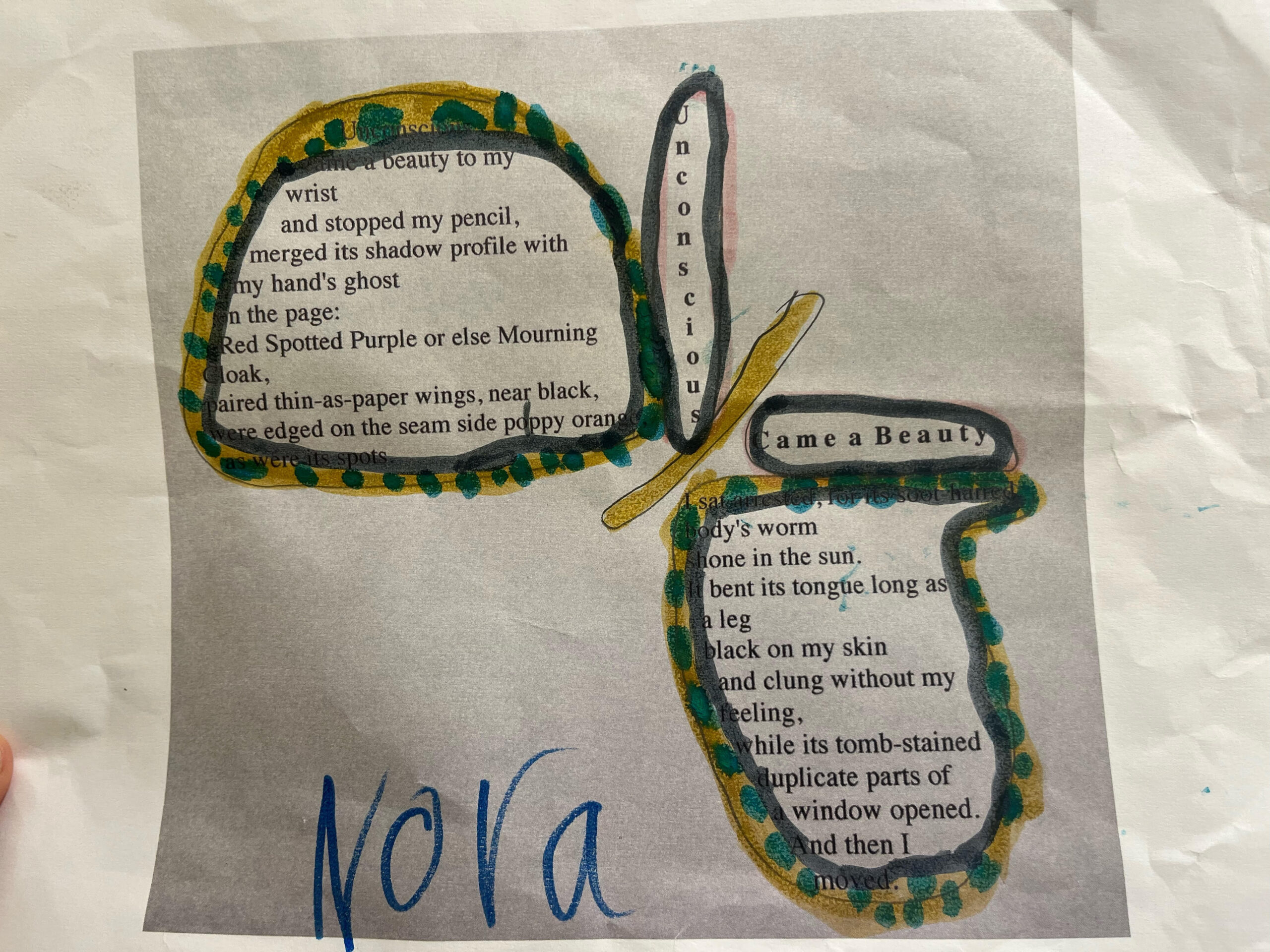
Nora's embellished May Swenson poem: "Unconscious Came a Beauty," as a butterfly-A means to emphasize the butterfly poem subject. Poem copyright acknowledged-Photo Courtesy Shannon Rhodes
Nora’s embellished May Swenson poem: “Unconscious Came a Beauty,” as a butterfly
A means to emphasize the butterfly poem subject.
Poem copyright acknowledged
Photo Courtesy Shannon Rhodes
I’m sitting here today with first grader Nora Baggaley and USU student teacher Ashlyn Prince. Just steps away from where we spend our days at Edith Bowen Laboratory School on the campus of Utah State University, we find Swenson Park, built on the lot where May’s childhood home once stood. She spent her elementary school days here, she was a student at Utah State Agricultural College, and she moved east to become a writer. During her lifetime May Swenson wrote her way into fame by recording memories riding her willow horse, enjoying strawberry juice dripping down her chin, and describing the relationships that develop when a baseball bat, ball, and mitt meet. Eventually she became Chancellor of the Academy of American Poets. I love that she wrote shape poems about simple things like insects.

Insects? Did you say bugs? Coming into student teaching, I wasn’t too thrilled when I heard about the focus we have on bugs. From the beginning of the school year, we were already in the Logan River, digging out stonefly larva. By the second week, I was already writing a book for my students about why I do not like bugs. Here’s some of my book “Definitely NOT the Bug Girl.” I loved butterflies; they had beautiful wings. That was until I saw them closer. They looked an awful lot like grasshoppers with wings, and if you were paying attention, I hate grasshoppers! Why did I never think they were big, sticky, scary insects too? They did come from caterpillars…I should’ve known!”

Throughout the semester, from katydids flying at my head to being chased at recess with grasshoppers, I’ve grown to love the stories and discoveries the children have with bugs. Now today, I see a bug and instantly start to wonder: How did it get here? Where is it going? What would my students think about this? I could almost say I love bugs…

Mourning cloak butterfly (pinned), Courtesy & Copyright Don Rolfs 2010
Mourning cloak butterfly (pinned)
Courtesy & Copyright Don Rolfs 2010 https://wildaboututah.org/springs-earliest-butterflies/
Well, I love bugs.

Swenson’s “Unconscious Came a Beauty” captures an encounter with a butterfly. She isn’t certain about which kind of butterfly, so she offers two choices based on her descriptors. She must have been outside writing when one landed on her hand long enough for her to notice it, know it well enough to describe it.

I like how her words are in the shape of a butterfly and the wiggly way she typed the title.

When I wrote “Definitely NOT the Bug Girl,” Nora and her classmates encouraged me to include even more chapters about different kinds of insects. They wanted chapters of how I felt about roly polys, katydids, and ladybugs. I never really had an opinion about ladybugs. They were cute but a little frightening when they would fly. Finding them at recess became not so scary to me. Did you know they start their life as black and orange larvae?

How’s this for a poem inspired by May’s shape poem?
Hungry crawls a lady bug larva
To our recess rock riddled with yellow aphids dots
And stopped our games
Orange-striped black
Alligator-wiggling on its six legs
We sat wondering, and Asher brought one to class
Where it crept out overnight as a familiar friend.
Aurora Borealis from Logan Utah
Courtesy & Copyright Shannon Rhodes, Photographer
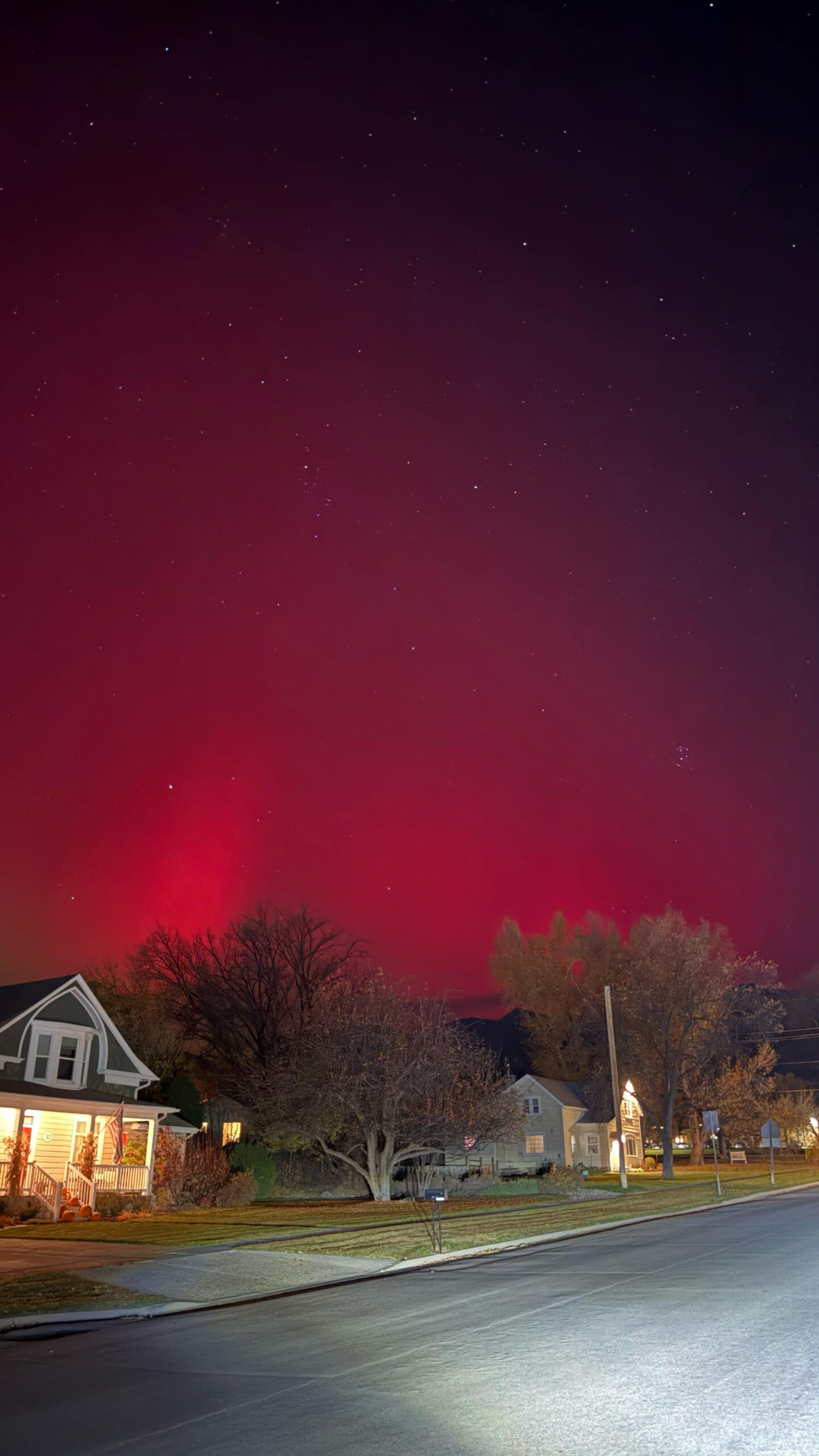
Aurora Borealis from Logan Utah
Courtesy & Copyright Shannon Rhodes, Photographer
Besides bugs, did you know May also wrote about space topics we know, like astronaut landings, gibbous moons, shadows, and her ghost moon? She called it, “the albino bowl on cloth of jet.”

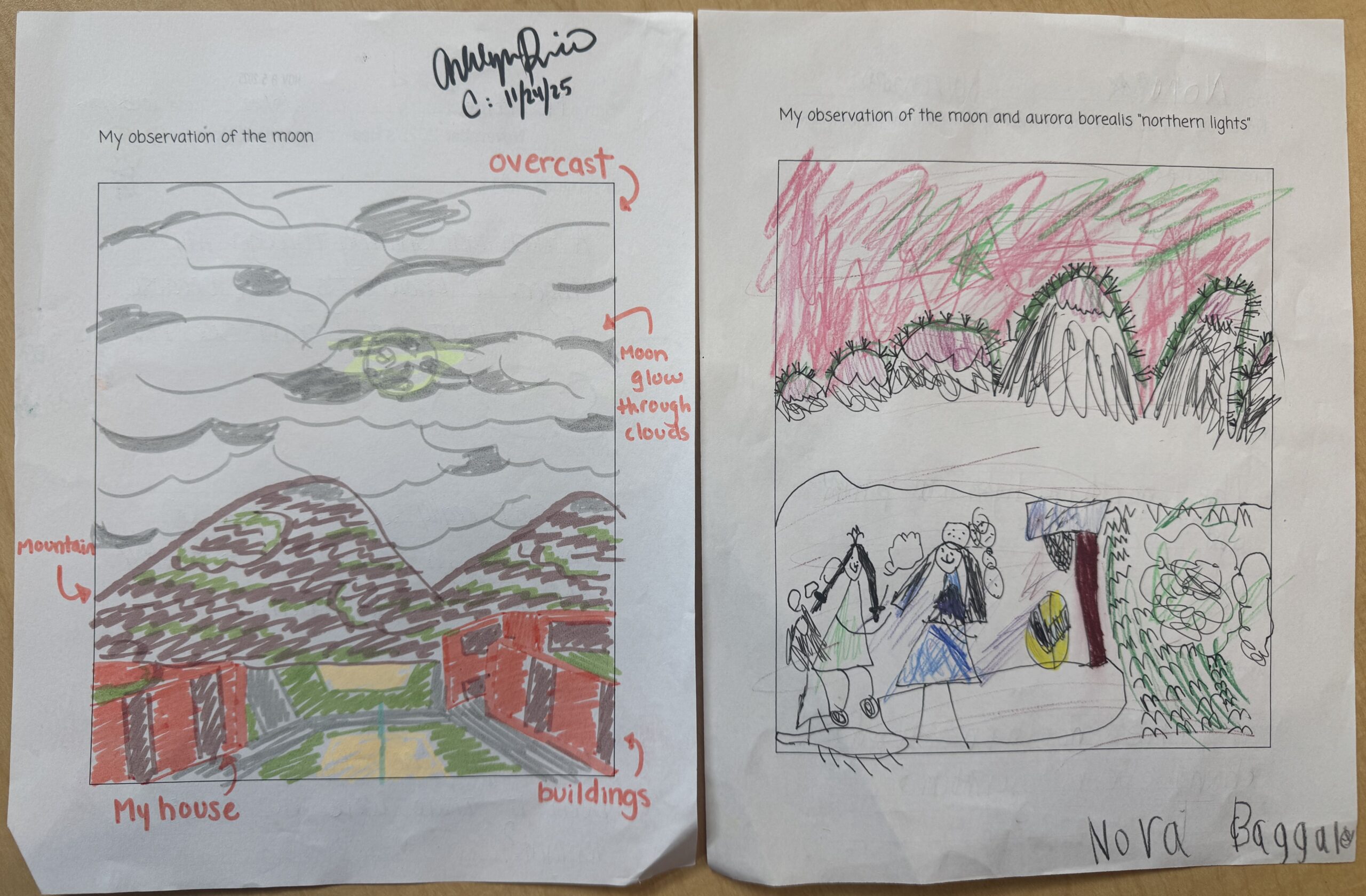
In November, every student, and teacher, was given a nature journal paper to observe the full moon that night. Sadly, the sky was full of clouds and only a faint glow was visible. Amazingly enough though, we could see the northern lights a few days later! It was a beautiful sight, and made up for missing the November Beaver Moon.


Night Sky Nature Journal Entries by Ashlyn and Nora
Courtesy & Copyright Shannon Rhodes, Photographer
Night Sky Nature Journal Entries by Ashlyn and Nora
Courtesy & Copyright Shannon Rhodes, Photographer

This is a two-voice poem we call “Witchy Sky.”
The beaver moon reminds me of cotton candy in the dark.
         It reminds me of a flashlight shining through my finger.
The northern lights are Glinda and Elphaba.
         I notice a lot of thick clouds.
I can’t really see the shape of the moon in the clouds but still it glows through them.
I wonder what does the moon feel like?
         How bright would the sky have been if there were no clouds tonight?

May Swenson remembered classmates folding paper airplanes and releasing them in the classroom when their teachers’ backs were turned. In a clip from a 1969 recording “Poetry Is Alive and Well and Living in America,” she says, “My poems sail away like that, I don’t know who picks them up, who may be reading them. It’s lovely to think that people are reading my things, especially that they are being stimulated to write their own poems.”

Don’t worry, May. We are inspired by your Mourning Cloak, Ashlyn’s aphid-eaters, Nora’s night sky auroras, and students, young adult and age 6, immersed in words every day.

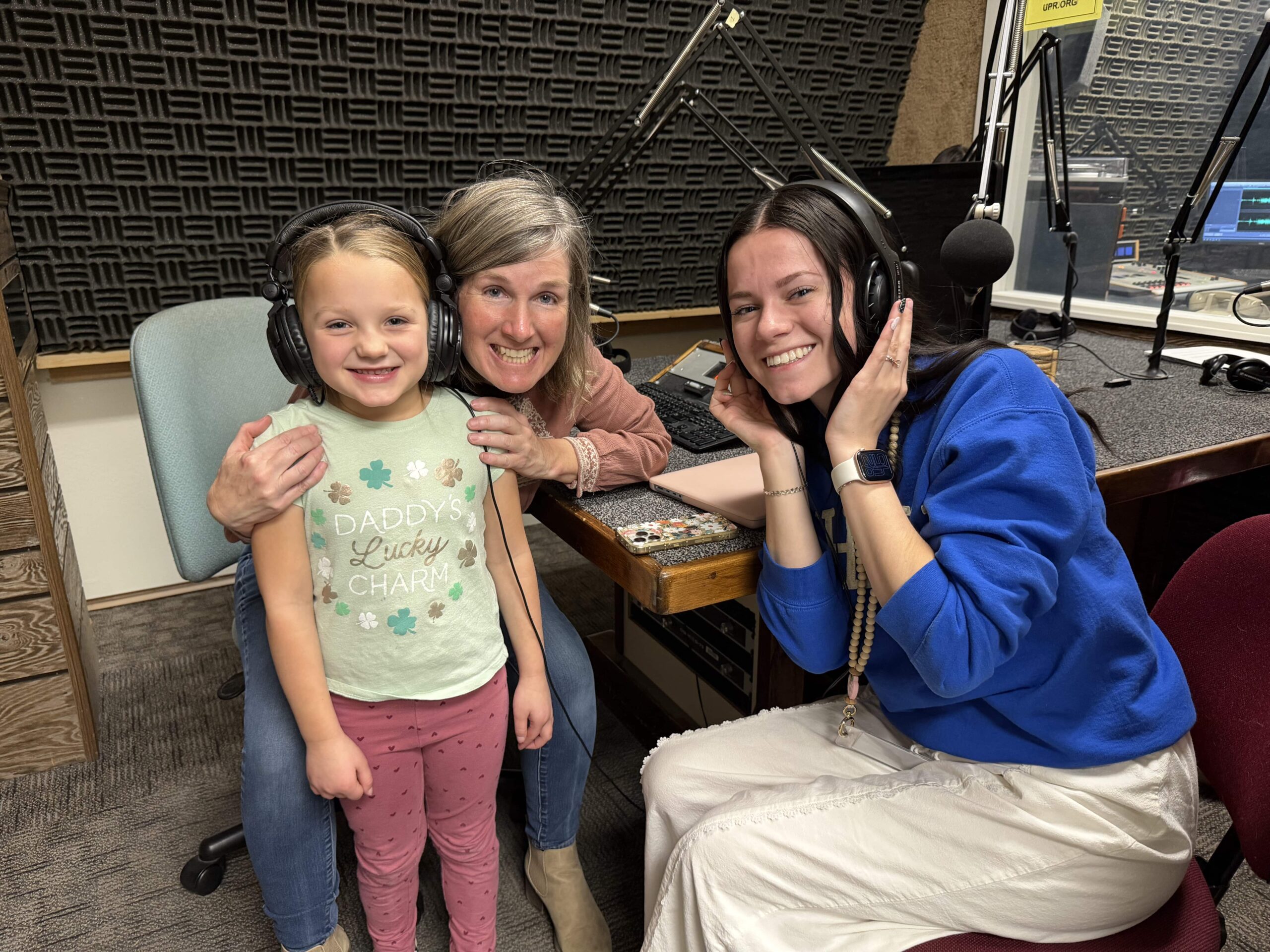
This is Nora Baggaley, Ashlyn Prince, and Shannon Rhodes, and we are Wild About Utah, May Swenson, night sky poetry, and of course, bugs.
Well, maybe bugs.
Nora, Shannon & Ashlyn in the Studio
Courtesy & Copyright Stu Baggaley, Photographer
Nora, Shannon & Ashlyn in the Studio
Courtesy & Copyright Stu Baggaley, Photographer

Credits:

Images: Classroom art Courtesy & Copyright Shannon Rhodes, Photographer
         Mourning cloak butterfly (pinned), Courtesy & Copyright Don Rolfs
         Nora, Shannon and Ashley in the UPR Studio, Courtesy & Copyright Stu Baggaley
Audio: Courtesy & © Friend Weller, https://upr.org/
Text & Voice:     Shannon Rhodes, Nora Baggaley, and Ashlyn Prince, Edith Bowen Laboratory School, Utah State University https://edithbowen.usu.edu/
Additional Reading Links: Shannon Rhodes

Additional Reading:

BEETLES Project, The Regents of the University of California, https://beetlesproject.org/resources/for-field-instructors/notice-wonder-reminds/

Hellstern, Ron. June Fireflies, Wild About Utah, June 19, 2017, https://wildaboututah.org/june-fireflies/

Ross, Fran, 1969. Poetry is Alive and Well and Living in America. https://www.youtube.com/watch?v=TaKRjiqGizQ&t=1s

Spencer, Sophia with Margaret McNamara. Bug Girl: A True Story. https://www.amazon.com/Bug-Girl-True-Story/dp/0525645934

Strand, Holly. May Swenson, Wild About Utah, April 14, 2009, https://wildaboututah.org/may-swenson-a-utah-poet-and-observer-of-nature/

Swenson, May. Unconscious Came a Beauty. Poets Speak, https://www.youtube.com/watch?v=VO6LSVzBTKs&t=6s

Tevela, Irina. May Swenson in Space, Washington University in St. Louis, July 19, 2019, https://library.washu.edu/news/may-swenson-in-space/

Tigers

Tigers: Western Tiger Swallowtail Butterfly
Courtesy US FWS, Thomas Maurer, Photographer
Western Tiger Swallowtail Butterfly
Courtesy US FWS, Thomas Maurer, Photographer

Tiger Swallowtail, Papilio rutulus Lucas, Courtesy & Copyright Shalayne Smith-Needham, Photographer Tiger Swallowtail, Papilio rutulus Lucas,
Courtesy & Copyright Shalayne Smith-Needham, Photographer

Western Swallowtail Butterfly Seeking Salt From Soil, 6/24/2017 Courtesy & Copyright Hilary Shughart, Photographer Western Swallowtail Butterfly Seeking Salt From Soil, 6/24/2017
Courtesy & Copyright Hilary Shughart, Photographer

The year of the tiger. Our mountains, canyons, and valleys are replete with tigers-there’s no escaping them, tiger swallowtail butterflies! Even my grandkids captured one, which entertained them for days. It had a damaged wing and preferred crawling to flying. It’s angelic beauty transfixed the onlookers. Although injured, it hung on for a week- about the average life span of an adult butterfly.

The normal range of the western tiger swallowtail covers much of western North America, from British Columbia to North Dakota in the north to Baja California and New Mexico south. Individuals occasionally turn up in eastern North America, though it is generally replaced by the similar eastern tiger swallowtail.

Western tigers emerge from winter chrysalids between February and May, the date depending on the temperature. They are seen earlier in the more southerly and coastal parts of their range. These are high energy butterflies, rarely seen at rest.

The females lay up to a hundred eggs on a wide variety of host plants including willows, aspens, ashes, poplars, alders, and cottonwood. The eggs are deep green, shiny, and spherical. They are laid singly, on the undersides of leaves. The caterpillars emerge about four days later.

The caterpillars molt five times, eventually reaching a length up to 2 inches before pupating to adults. In summer, the butterfly can emerge as quickly as 15 days after the caterpillar’s pupated, but when the caterpillar pupates in the fall, the butterfly does not emerge until the spring. For camouflage, the young caterpillars, strangely resemble bird poop as they hatch. Once they begin to molt, they turn bright green in color, with large, yellow eyespot marks studded with black and blue pupils. These fake eyes may frighten predators, along with retractable, iridescent, horn-like structures on their head.

To harvest nectar, a butterfly unfurls its proboscis, a tube that functions like a straw and is coiled below the head when not in use. It inserts the proboscis into the flower and sucks up nectar by rhythmically contracting the muscles in its head. Sugars in the nectar provide energy for flight, defense, reproduction, and other daily activities.
Tigers also obtain nutrients and replenish fluids through “puddling,” where they congregate in large groups on mud or wet sand around puddles, streambanks, or on piles of fresh manure. I’ve observed puddling many times, always a levitating experience! Here they take up salts, proteins, and minerals. Salt is scarce in the butterfly diet, but is essential for reproduction and flight.

Puddling is primarily a male behavior, and during mating, a male butterfly transfers salt to the female in a sperm package, which she incorporates into her eggs. Researchers have found that sodium increases reproductive success in some butterfly species. During puddling, groups of males are conspicuous to females seeking mates. Males also patrol at treetop level looking for mates, swooping down to intercept females.

Thus, if you see a tiger, don’t be alarmed, just relax and enjoy their exquisite beauty and fascinating behaviors.

This is Jack Greene for Bridgerland Audubon Society, and I’m wild about Utah, and its puddling tigers!!

Credits:
Image: Courtesy US FWS, Thomas Maurer, Photographer, https://www.fws.gov/media/western-tiger-swallowtail
Audio: Courtesy & © Kevin Colver, https://wildstore.wildsanctuary.com/collections/special-collections
Text: Jack Greene, Bridgerland Audubon, https://bridgerlandaudubon.org/
Additional Reading: Lyle W Bingham, Webmaster, Bridgerland Audubon, https://bridgerlandaudubon.org/

Additional Reading:

Jack Greene’s Postings on Wild About Utah, https://wildaboututah.org/author/jack/

Agyagos, Janie, Attracting Butterflies, USDA Forest Service, https://www.fs.usda.gov/Internet/FSE_DOCUMENTS/fseprd899349.pdf

Backyards for Butterflies, Division of Wildlife, Ohio Department of Natural Resources, State of Ohio, Publication 5089, January 2020, https://ohiodnr.gov/static/documents/wildlife/backyard-wildlife/Backyards%20for%20Butterflies%20pub089.pdf

Carroll, James, 2006, Eastern Tiger Swallowtails gathered at mineral trace along Blackwater River tributary in Western Florida, BugGuide.net, https://bugguide.net/node/view/79626

Canadian Tiger Swallowtail – Papilio canadensis, [Click to second picture to view puddling], Montana Field Guide. Montana Natural Heritage Program, https://fieldguide.mt.gov/speciesDetail.aspx?elcode=IILEP94250

Malacomosa Dance

Malacomosa Dance: Caterpillar Distraction Courtesy & Copyright Shannon Rhodes, Photographer
Caterpillar Distraction
Courtesy & Copyright Shannon Rhodes, Photographer
My father’s first caterpillar encounter has always been a bedtime favorite. The story goes that a plump fuzzy one was crawling on his picnic blanket one afternoon. I would imagine him watching its five pairs of prolegs innocently undulating along. Then, Dad ate it, hairy bristles and all. My first encounter was almost as tasty but longer-lasting because it came from the pages of Eric Carle’s picture book classic, The Very Hungry Caterpillar. A recent New York Times article reporting the author’s passing reveals that Carle’s interest in crickets, fireflies, and other insects was sparked as a child by peeking under bark or stones walking in the wild with his father.

Western Tent Caterpillars Malacosoma californicum, Courtesy & Copyright Shannon Rhodes, Photographer
Western Tent Caterpillars
Malacosoma californicum
Courtesy & Copyright Shannon Rhodes, Photographer
There’s nothing like a caterpillar, green or woolly, slinking along in the dirt or hanging by a thread from overhead branches, to distract a group of young outdoor learners. I resist the urge to caution them that there are poisonous caterpillars in the world, and we play. Yet, how many times have I encountered a silky mass in the limbs of a chokecherry, stopped and watched the caterpillars wiggle and twitch, and wished that I knew more about them? The magic for me of being out in the forest meadows this time of year is coming home with more questions than answers. So, becoming a novice lepidopterist, I focused this week on learning about caterpillars, butterflies, and moths. The frenzied dance of this caterpillar, what I think is known by the lyrical name Malacomosa, is not to draw me in for a closer look; the tent caterpillar senses a predator is near and gets the whole gang going. Soon these gorging wigglers will be settling into silky cocoons and emerging as moths. According to Eric Carle’s website, he intentionally had his butterfly come from a cocoon rather than a scientifically-accurate chyrsalis because it sounds more poetic, and my budding readers appreciate being able to more easily stretch and blend cocoon sounds anyway. We do use the word caterpillar, though, for both moth and butterfly larvae, but that is where many of the similarities end.

Drab Moth, Courtesy & Copyright Shannon Rhodes, Photographer
(Not so) Drab Moth
Courtesy & Copyright Shannon Rhodes, Photographer
Butterflies get noticed because they flutter during the day, while moths are typically more active by night. In fact, when I am outside I turn to my Kaufman Field Guide to Butterflies because I never thought to purchase a book on identifying moths. The first thing it says to do is look at the antenna. A butterfly antenna has a club tip, and often a moth has thick and feathery antennae to help it pick up scents flying around at night. Butterflies have names like swallowtail, fritillary, metalmark, and checkerspot, and moths just rhyme with sloths. Compared to butterflies, moths are generally smaller and drab in color. Drab? I met a moth resting on a twig once that was anything but drab. Its chunky abdomen was striped black and the most vibrant tangerine orange imaginable, and I was mesmerized. Moths should get more love, especially when you know that there are so many more kinds of moths than butterflies to enjoy. Consider getting out to notice the wonder of moths with other citizen scientists for National Moth Week 2021 this July 17-25.

Writing from the Central Utah Writing Project, I am Shannon Rhodes and I’m wild about Utah.

Credits:
Images: Courtesy & Copyright Shannon Rhodes, Photographer
Additional Audio: Courtesy & ©
Text:     Shannon Rhodes, Edith Bowen Laboratory School, Utah State University https://edithbowen.usu.edu/
Additional Reading Links: Shannon Rhodes

Additional Reading:

Brock, Jim. Kaufman Field Guide to Butterflies of North America. https://www.kaufmanfieldguides.com/butterflies.html

Carmel, Julia. Eric Carle, Author of ‘The Very Hungry Caterpillar,’ Dies at 91., The New York Times, May 26, 2021. https://www.nytimes.com/2021/05/26/books/eric-carle-dead.html

Eric Carle Official Website. https://eric-carle.com/

Florida Museum of Natural History. Butterflies and Moths. https://www.floridamuseum.ufl.edu/wp-content/uploads/sites/16/2017/02/Butterfly-Educators-Guide.pdf

Forest Health Protection. Western Tent Caterpillars. 2011. https://www.fs.usda.gov/Internet/FSE_DOCUMENTS/stelprdb5303047.pdf

National Moth Week. https://nationalmothweek.org/

Wild About Utah Posts by Shannon Rhodes https://wildaboututah.org/author/shannon-rhodes/

Monarch Butterflies

Click to view a closer view of Andrea Liberatore's photograph of a Monarch butterfly (Danaus plexippus).  Courtesy and Copyright 2009 Andrea Liberatore, Photographer
Monarch Butterfly
Danaus plexippus
Courtesy & Copyright 2009
Andrea Liberatore, Photographer


Click to view a closer view of a Monarch butterfly caterpillar, (Danaus plexippus), Courtesy US FWS, images.fws.govMonarch Butterfly Caterpillar
Danaus plexippus
Courtesy US FWS, images.fws.gov

Click to view a closer view of a Monarch butterfly chrysalis (Danaus plexippus).  Courtesy NASA JPL, climate.nasa.gov, Plant a butterfly garden!, Climate Kids: Earth NowMonarch Butterfly Chrysalis
(Enlarged)
Danaus plexippus
Courtesy NASA JPL, climate.nasa.gov
Plant a butterfly garden!
Climate Kids: Earth Now


Click to view a closer view of Andrea Liberatore's photograph of Gene Nieminen's photograph of Monarch butterflies resting during migration.  Courtesy US FWS, Gene Nieminen, PhotographerA Rest Stop During the
Monarch Butterfly Migration
Courtesy US FWS, images.fws.gov
Gene Nieminen, Photographer

One sure sign that the end of the summer is near are the holes that appear in milkweed leaves this time of year. Take a peek underneath and you might find a great treasure – a chubby caterpillar boldly dressed in yellow, black, and white stripes.

We are currently playing host to two of these voracious larvae at the Stokes Nature Center, satiating their appetites with fresh milkweed leaves in the hopes of witnessing their transformation into a Monarch butterfly.

The incredible story of a Utah monarch begins in southern California in spring. After being dormant throughout winter, an adult female will rouse itself, mate, and begin flying. Monarchs are gliders, meaning they don’t flap their wings much when traveling. Instead they rely on thermal air currents to keep them aloft and moving – traveling up to 80 miles per day. The female flies until she finds habitat suitable for reproduction. There she will lay up to 400 eggs, exclusively on milkweed plants, which contain a toxin that makes caterpillars and adults inedible, or at least unpalatable, to predators.

Eggs of the second generation hatch in April or May. Larvae eat, undergo metamorphosis and keep traveling until they find an ideal place to mate and lay eggs. The adults then die within a few weeks. The third generation hatches in June and July, traveling still farther north and east. This group’s offspring, the fourth generation of the year, are the caterpillars and butterflies we are currently seeing. And this fourth generation does things a little differently.

Once in their adult stage, eating is priority number one. As temperatures turn cool, migration is triggered and the butterflies head for southern California, back to the same place from which their great-grandparents set out in spring. These butterflies live significantly longer than their parents and grandparents, for successful individuals will survive the winter, and start the entire four-generation process over again next year.

Much of a monarch’s migration remains a mystery, and not just how they know when and where to go, but also what routes they use, what habitats they need along the way, and how humans are affecting their movements.

A number of citizen science projects have been established to try and answer these questions. The Monarch Program monitors migration in the western U.S. each fall. Adults are fitted with a small, sticky tag on their right forewing with a color code specific to the tagging site. As these butterflies are spotted again either during migration or at their final destination, data is collected that can help us better understand their journey.

Recent declines in monarch populations make this research all the more important. You can help by cultivating milkweed in your garden to provide habitat to resident monarchs. Anyone with information on the location of caterpillars or chrysalises can contact local Monarch Program volunteer Ron Hellstern for tagging. For more information on tagging and how you can help monarch butterflies, visit our website at www.wildaboututah.org.

For the Stokes Nature Center and Wild About Utah, this is Andrea Liberatore.

Credits:

Images: Courtesy &
Copyright 2009 Andrea Liberatore
Courtesy NASA JPL, climate.nasa.gov
Courtesy US Fish and Wildlife Service,
images.fws.gov
Text:     Andrea Liberatore,
Stokes Nature Center in Logan Canyon.
For Information On Tagging:

The Monarch Program: https://www.monarchprogram.org

To tag butterflies found in Cache Valley, please contact Monarch Program volunteer Ron Hellstern at 435-245-9186. Please note that captive caterpillars or chrysalises are easiest to tag, as capturing adults can harm their wings.

Growing milkweed:

Monarch Watch, Propagation (Growing Milkweeds). https://www.monarchwatch.org/milkweed/prop.htm


Additional Reading:

Pyle, Robert Michael. 1981. National Audubon Society: Field Guide to Butterflies, North America. Alfred A. Knopf: New York.

Monarch Watch: Monarch Life Cycle. https://monarchwatch.org/biology/cycle1.htm

National Geographic: Monarch Butterfly (Danaus plexippus). https://animals.nationalgeographic.com/animals/bugs/monarch-butterfly/

NRCS Partners with Farmers, Ranchers to Aid Monarch Butterflies, Posted by Jason Weller, Chief, Natural Resources Conservation Service, on November 12, 2015, USDA Blog, https://blogs.usda.gov/2015/11/12/nrcs-partners-with-farmers-ranchers-to-aid-monarch-butterflies/

NRCS Working Lands for Monarch Butterflies, https://arcg.is/0TjueO