Courtesy & Copyright Mary Heers, Photographer
“Bigger than the redwoods in California?” I asked. He said, “Yes! Not taller, but bigger.”
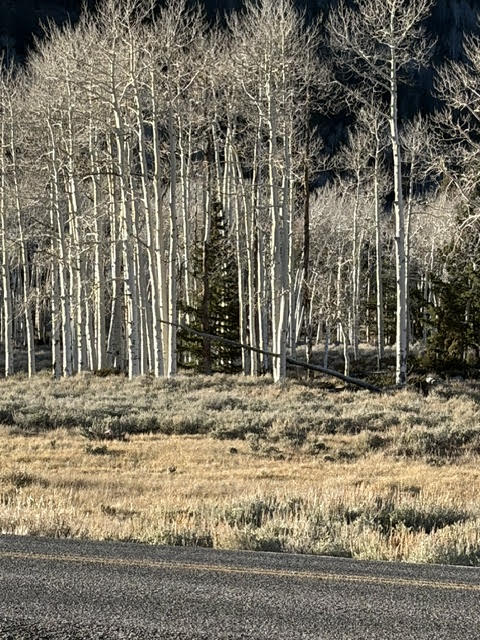
He was talking about an aspen tree — a tree that started its life close to the shores of Fish Lake in central Utah.
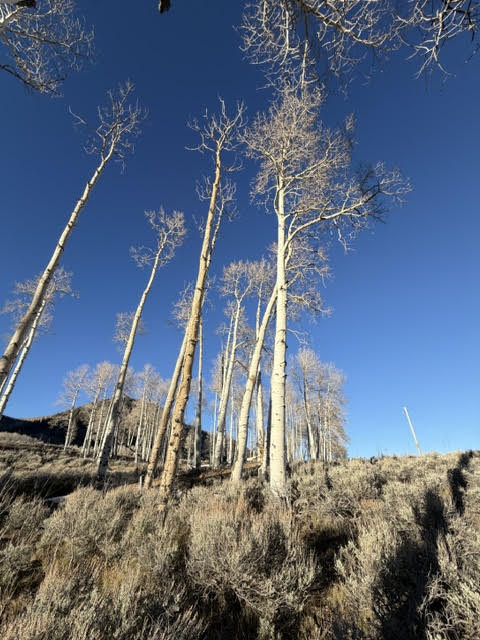
Years and years ago, this aspen tree reproduced itself by sending out a horizonal stem from its roots. This underground stem then sent up a shoot aboveground that grew into a tree trunk. And so it continued, the root system sending up more and more shoots that grew into trees. It’s estimated today that this ONE root system supports 47,000 genetically identical aspen trees! It covers over 106 acres.
Courtesy & Copyright Mary Heers, Photographer
Courtesy & Copyright Mary Heers, Photographer
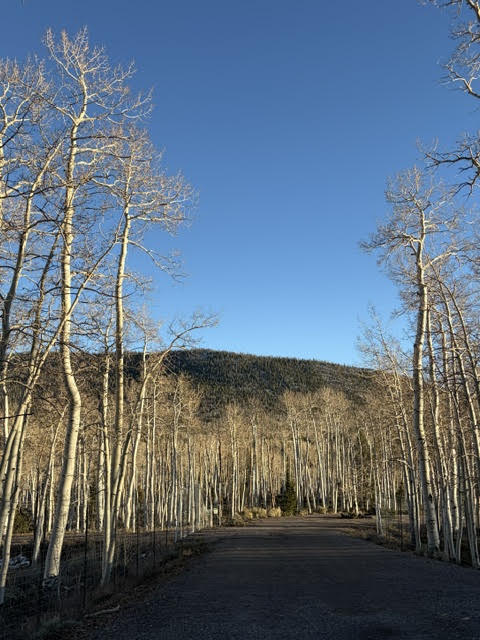
There were some historical footsteps to follow here as well. These paths were once part of the a 1,200 mile pack trail that linked Santa Fe to Los Angles. It allowed traders to carry Mexican woolen blankets to California to trade for mules and horses. Traders took the Fish Lake cut-off in summer for the cooler temperature and abundant water and grass. Just off the parking lot there were life sized metal silhouettes of a man mounted on a horse leading a string of pack mules through the trees.
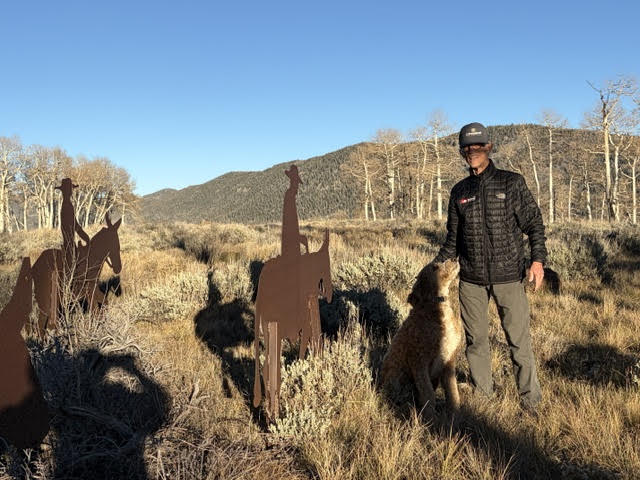
Courtesy & Copyright Mary Heers, Photographer
Over 2,000 years ago, the Greek writer Hippocrates stated that chewing on the bark of an aspen tree would relieve fever and pain. It wasn’t until the 1800’s that European chemists isolated salicin as the chemical pain reliever contained in the bark. In 1899 the German pharmaceutical company Bayer paid tribute to the aspen tree by naming its new pain relieving drug “Aspirin.”
In 1976, the plant scientist Burton Barnes reminded us that the Utah aspen with its magnificent root system that supported 47,000 trees and covered 106 acres still needed a name. Another plant scientist, Michael Grant remembered his Latin studies and suggested the Latin verb “to spread.” “Pando, pandis, pandit, pandimus, panditis, pandunt.” He suggested the tree speak for itself: “I spread” – “Pando”
The Latin name stuck. Pando is now on the map in Utah.
This is Mary Heers and I’m Wild About Utah.
Credits:
Images: Mary Heers
Audio: Courtesy & © Anderson, Howe, and Wakeman
Text: Mary Heers
Voice: Mary Heers, https://cca.usu.edu/files/awards/art-and-mary-heers-citation.pdf (As found on Archive.org)
Additional Reading: Lyle Bingham, Bridgerland Audubon Society, https://bridgerlandaudubon.org/
Additional Reading:
Strand, Holly, Pando-The World’s Largest Organism, Wild About Utah, September 3. 2010, https://wildaboututah.org/pando-the-worlds-largest-organism/
Beck, Russ, Pando the World’s Largest Discovered Organism, Wild About Utah, January 9, 2017, https://wildaboututah.org/pando-worlds-largest-discovered-organism/