Don’t Tread on Me!

Don't tread on me! Great Basin Rattlesnake Courtesy & Copyright © 2009 Holly Strand
Great Basin Rattlesnake
Courtesy & Copyright © 2009 Holly Strand
Holly: Hi, I’m Holly Strand from Stokes Nature Center in beautiful Logan Canyon. Don’t Tread on Me!

Rattlesnakes are pit vipers with heavy bodies and broad heads. There are about 30 species and 40 more subspecies found in North and South America. They aren’t found anywhere else. All possess rattles and all are venomous.

Here in Utah we have 5 species plus 2 subspecies. The Great basin rattlesnake is the most widespread, living all across Western Utah at elevations up to 9000 feet. Another subspecies of western rattler–the midget faded rattlesnake –is dominant in the eastern part of the state. The Hopi rattlesnake and the greenish colored prairie rattlesnake are found in southeastern Utah. And the Mojave rattlesnake, speckled rattlesnake, and sidewinder are found only in the extreme southwest corner of Utah.

The rattle itself is a unique biological feature. It’s a loose, but interlocking series of nested segments—actually modified scales– at the end of the tail. When vibrated, the rattle produces a hissing sound. Kevin Colver– an expert in natural sound recordings –provided this clip of a Mojave rattlesnake.

A snake gets a new rattle segment every time it sheds—and it sheds from one to four times a year. 15 or 16 rattles are common in captive snakes, but in wild snakes six to eight are more common. In wild snakes, rattles are subject to a lot of wear and tear. So they break off before they get very long.
The rattle sound is the reaction of a startled or threatened snake. You’ll often see the rattling snake in a defensive S-shaped coil—but not always!

Aggression and venom in rattlesnakes vary by both species type and by individual. The western diamondback rattlesnake is the archetypal large, aggressive and very dangerous species, responsible for the majority of human fatalities in America. But it’s northern range limit is south of the Utah border. However, the Mojave rattler found in southeastern Utah is extremely toxic, excitable and its venom attacks both the nervous system and circulatory system.

But rattlesnakes aren’t out to get us—mainly they just want to be left alone. You’ll generally be fine if you stay aware of what might be in or around rocks, and don’t walk barefoot or in open-toed shoes in their habitat. Also, use a flashlight after dark –most rattlesnakes are active at night too!

Thanks to the Rocky Mountain Power Foundation for supporting the development of this Wild About Utah topic.
And to Kevin Colver for the sound of the rattlesnake. Additional nature sound recordings can be found at westernsoundscape.org

For Wild About Utah and Stokes Nature Center, I’m Holly Strand.

Credits:

Sound: Courtesy and Copyright 2006 Kevin Colver
Image: Courtesy and Copyright 2009 Holly Strand
Text: Holly Strand, Stokes Nature Center

Sources & Additional Reading

Klauber, Laurence M. 1982. Rattlesnakes. Their Habits, Life Histories, and Influence on Mankind. Berkeley: University of California Press, https://www.amazon.com/Rattlesnakes-Habits-Histories-Influence-Mankind/dp/0520210565 (1997 Version)

Utah Division of Wildlife Resources. Utah Conservation Data Center. https://dwrcdc.nr.utah.gov/ucdc/ (Accessed July 17, 2009)
Utah Paper Wasps

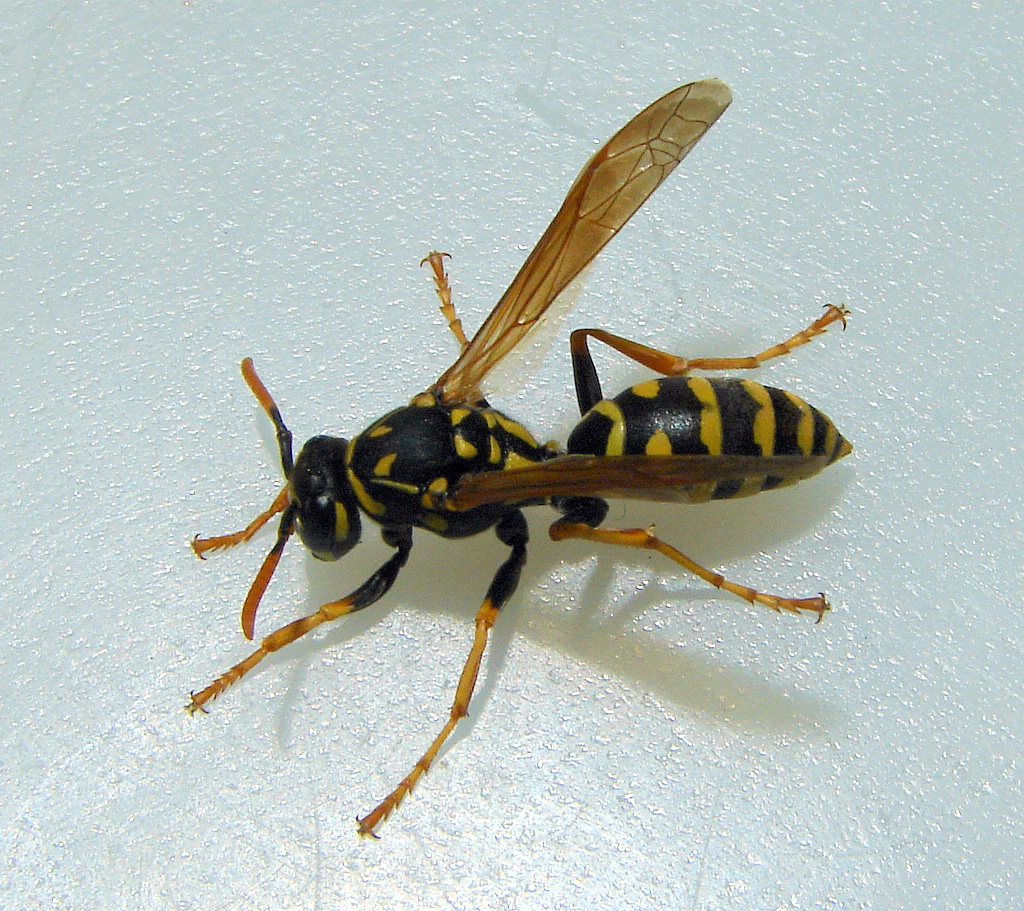
Adult Poliste Paper Wasp
Copyright © 2009 Jim Cane

We credit the Chinese with inventing paper 2000 years ago, but some social wasps have been making their paper nests for eons. Species of paper wasps are found throughout Utah.

The burly bald-faced hornet workers are patterned in black and white. They place their grey, basketball sized paper nests in tree branches.

Bold yellow and black striped Yellowjackets are the persistent unwelcome guests at summer picnics. They too wrap their round nests in an envelope of paper, but typically place it in a shallow underground chamber. Within the paper envelope, both hornets and yellowjackets have a muti-tiered stack of paper honeycombs, like an inverted pagoda.

Open-faced nest of Polistes
paper wasp with grub-like larvae
Copyright © 2009 Jim Cane

Our most familiar paper wasps belong to the genus Polistes. These are the reddish-brown spindly looking wasps. They make their simple paper nests under your home’s roof eaves and deck railings. A Polistes nest consists of a single inverted paper honeycomb suspended from a stiff, short stalk. There is no paper envelope, so you can readily see the hexagonal paper cells. Around your yard, look for the workers scraping fibers from weathered wood surfaces. Workers mix the chewed fibers with saliva and water, carry the ball of wood pulp home, and add it to the thin sheets of their paper nest. The nest is their nursery, where you can see the queen’s tiny sausage shaped eggs and the fat white grubs. The grubs are fed by their sisters, the workers, who scour the surrounding habitat for insect prey or damaged fruit.

The enclosed nest of the
bald-faced hornet
Copyright © 2009 Jim Cane

Utah has been invaded by the European species Polistes dominula. These interlopers are displacing our native Polistes. Where these European Polistes wasps are a stinging nuisance, you can easily dispatch them at their nests with a sprayed solution of dishwashing detergent and water. Thus stripped of its clever defenders, take the opportunity to admire their homes of paper.

This is Linda Kervin for Bridgerland Audubon Society.

Credits:

Photo: Courtesy and © Copyright 2009 Jim Cane

Text: Jim Cane, Bridgerland Audubon Society

Additional Reading:

https://extension.usu.edu/files/publications/factsheet/yellowjackets-hornets-wasps09.pdf

https://ohioline.osu.edu/hyg-fact/2000/2077.html

https://insects.tamu.edu/fieldguide/cimg348.html


Of Shooting Stars

Audio:  mp3 Listen to WildAboutUtah

The Fallen Sky: An Intimate History of Shooting Stars
Cover Courtesy & Copyright © 2009 The Penguin Group

Holly: Hi, I’m Holly Strand from Stokes Nature Center in beautiful Logan Canyon.

Christopher Cokinos is the author of a new book, The Fallen Sky, published by the Penguin Group Press. It’s the story of meteorites and the impressions that meteorites make on the Earth and in the people who seek them out. Here’s Chris talking about falling stars:

Chris: On any clear night, under a dark enough sky, we can see shooting stars. We wish upon them even if we may not know what they are. It’s as if we’re eager to pin our chances on something strange and sudden.

A shooting star is not a star; it’s a meteor—the bright passage of a small grain or rock burning up through the air as it descends from space. If it’s big enough, it may drop a rock on the Earth itself—then it becomes a meteorite. In space, these objects are called meteoroids.

Every mid-August, our skies are graced by a shower of shooting stars—the Perseids. This is when Earth intersects the spindrift tail of the disintegrated Comet Swift-Tuttle, and we see these dusty grains streaking through the sky, too small to ever reach us.

They’re called the Perseids because the meteors appear to originate from the constellation Perseus, but these shooting stars can appear in any part of the sky.

Meteors travel very fast, from between 7 miles per second to 44 miles per second, and even one the size of a raisin can produce a huge fireball.

But if you see one that big during the Perseids, it’s not a Perseid—it’s a random meteor, originating from the asteroid belt or even the Moon or Mars.

This year, the moon will interfere with viewing the shower, but you can still see quite a few Perseids from the late evening of August 11 through the morning of August 12.

The best way to watch is to recline on the ground or on a chaise so you have a wide view of the sky, preferably away from city lights. Have snacks, water and appropriate clothing and maybe some bug spray. Don’t use binoculars or a telescope as they restrict your field of view.

To learn how to make simple but scientifically useful observations, go to the American Meteor Society website at www.amsmeteors.org.

Of course, though it may not be scientifically useful, when you see a shooting star—feel free to make a wish.

Holly: Thanks, Chris. For listeners in the Logan area, check out the Star Party at the American West Heritage Center on August 14th. For more details see awhc.org

For Wild About Utah and Stokes Nature Center, I’m Holly Strand.

Credits:

Image: Book Cover Courtesy & Copyright © 2009 The Penguin Group

Text: Chris Cokinos

Sources & Additional Reading:

Theme: Courtesy & Copyright Don Anderson Leaping Lulu
Cokinos, Christopher. 2009. The Fallen Sky: An Intimate History of Shooting Stars. Penguin Group, Inc.

“Weaving natural history, memoir, and the stories of maverick scientists, daring adventurers, and stargazing dreamers, this epic work takes us from Antarctica to outer space to tell the tale of how the study of meteorites became a scientific passion.”

https://www.amazon.com/Fallen-Sky-Intimate-History-Shooting/dp/1585428329 (Accessed August 11, 2009)

https://www.amazon.com/Fallen-Sky-Intimate-History-Shooting/dp/1585427209

The Eyes Have It

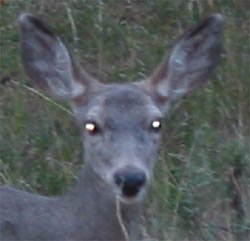
The Eyes Have It: Deer Eyeshine Courtesy of National Park Service, US Department of the Interior
Deer Eyeshine Courtesy of National Park Service
US Department of the Interior

Hi, this is Holly Strand for Stokes Nature Center located in beautiful Logan Canyon.

A few years ago, I was working for World Wildlife Fund in eastern Montana. One night, we were doing a nocturnal survey of the black footed ferret, the most endangered mammal species in North America. We were counting reintroduced ferrets by riding around in a truck with a large spotlight mounted on top. When the spotlight hit a ferret, we could see the emerald green glow of its eyes as the animal looked back at the light. We’d stop the truck, walk toward the green points, and confirm the presence of a curious ferret for our census count. If the glowing eye color was something other than green we kept on driving. It was during this nocturnal safari that I learned about animal eye-shine and how it can be used by hunters as well as naturalists in finding target species.

Eyeshine occurs when light enters the eye, passes through the rods and cones strikes a special membrane behind the retina, and is reflected back through the eye to the light source. This special mirror-like membrane, called the tapetum (ta-PEA-tum), is not present in the human eye. The light-capturing system allows light to pass through the eye twice, and it is one way a nocturnal animal increases its ability to see in dim light. It’s the tapetums cause the eerie glow that we see in a housecat’s eyes caught in a light or when our car headlights surprise a deer, or badger.

The color of eyeshine varies from species to species. Most owls have red eyeshine. Coyotes as well as mountain lion shine greenish-gold. Elk and deer – varies from silver white to a light silvery green or light silvery yellow. Desert cottontails’ are red. Tiny pricks of light may signify the presence of wolf spiders or moths. Even certain fish have eyeshine.

To see eyeshine in the wild, just take a walk on a relatively dark night, and hold a flashlight on top of your head so that you are looking down the beam. Direct the beam at bushes or low vegetation. Chances are, you’ll see the pink-tinted eyeshine of spiders. Near water, look for the greenish glow of frogs’ eyes. Keep the beam directed at the eyeshine and move closer until you can spot its owner. Bigger animals like deer or raccoons will be farther away so you may want to use binoculars in combination with a light, lining up the field of view with the light beam, and then moving the two in unison. Searching for eyeshine is the perfect summer night activity, so grab your flashlight and go out and experience some real Utah night life.

This is Holly Strand for Wild About Utah.

Credits:

Photo: Courtesy of National Park Service, US Department of the Interior Wind Cave Resource Ramblings 2007 – 11

Text: Stokes Nature Center: …

Sources & Additional Reading

2001, Corben, Chris and Gary Fellers. A Technique for Detecting Eyeshine of
Amphibians and Reptiles. Herpetological Review, 32(2): 89-91.
https://www.werc.usgs.gov/pt-reyes/pdfs/spotlighting.pdf

Eyeshine. Electronic Naturalist. Roger Tory Peterson Institute of Natural History. https://www.enaturalist.org/unit/171/qr (accessed June 2008)

Texas Parks and Wildlife. Eyeshine in Young Naturalist Series. https://www.tpwd.state.tx.us/publications/nonpwdpubs/young_naturalist/animals/eyeshine/ (accessed June 2008)

Thanks to Eric Gese, USDA National Wildlife Research Center, Department of Forest, Range, and Wildlife Sciences, for his expertise.