Gall Insects

Gall Insects: Click to view Rabbit Brush Galls made by a tephritid fly (Aciurina trixa.) Image courtesy and copyright Jim Cane
Rabbit Brush Galls
made by a tephritid fly Aciurina trixa
Image courtesy and Copyright Jim Cane
Fly identification courtesy Gary Dodson

Does Utah have more Gauls than Caesar conquered? Certainly not Gaulish peoples of the ancient Roman Empire, but yes, galls of the vegetal kind we have aplenty. Galls are small protuberant growths on plants that are induced hormonally by insects, nematodes, and microbes. For its resident juvenile insect, the gall is a sort of edible fortress.

Some plant galls made by insects persist into winter, when they are more apparent to the naturalist’s eye. Looking at just rabbitbrush, you can find a menagerie of galls shaped like peas, pineapples and spindles that were formed from leaves, buds and stems. No growing tissue is immune to galling. The morphology of a gall is often diagnostic for the species of juvenile insect within. Gall-making insects are all tiny and include gall midges and tephritid flies, cynipid gall wasps, various nondescript moths, and any number of aphids and their kin.

One aphid causes the unsightly brown galls on branch tips of blue spruce, a bane to homeowners. Another aphid forms the pea-shaped galls that swell leaf petioles of aspens and cottonwoods. On sagebrush can be found a leaf gall whose soft surface surpasses that of a puppy’s ear. Oaks and willows host a remarkable diversity of galls. One oak gall was formerly used for tanning leather and making inks because it is rich in tannic acids. The Hessian fly is of grave agricultural importance today because its stem galls weaken wheat stems, causing them to lodge over.

Click to view Tephritid fly (Aciurina bigeloviae) galls on Rabbitbrush. Image courtesy and copyright Jim Cane
Tephritid fly Aciurina bigeloviae
galls on Rabbitbrush
Image courtesy and Copyright Jim Cane
Fly identification courtesy Gary Dodson

But these are exceptions; most galls are of little or no ecological or economic importance. For that reason, most galling insects remain understudied by all but a handful of passionate specialists. Finding plant galls is easy, and once you begin to notice them, you will find it hard to stop. There is no guide to Utah’s plant galls, but we list several starting references for you on our web site.

This is Linda Kervin for Bridgerland Audubon Society.

Credits:

Photos: Courtesy and Copyright Jim Cane
Text: Jim Cane, Bridgerland Audubon Society
Additional Reading:
Sagebrush Gall made by the fly Rhopalomyia pomum, https://bugguide.net/node/view/200946
Robert P. Wawrzynski, Jeffrey D. Hahn, and Mark E. Ascerno, Insect and Mite Galls, WW-01009 2005,
University of Minnesota Extension, https://www.extension.umn.edu/distribution/horticulture/dg1009.html

Click to view Willow Cone Gall Midge. Image courtesy and copyright Jim Cane
Willow Cone Gall Midge
Image Courtesy and Copyright Jim Cane

Field Guide to Plant Galls of California and Other Western States by Ron Russo
ISBN: 978-0-520-24886-1 https://www.amazon.com/California-Western-States-Natural-History/dp/0520248864
Gall, Wikipedia, Wikimedia Foundation, Inc., https://en.wikipedia.org/wiki/Gall (Accessed Dec 2010)
Gagné R (1989) The plant-feeding gall midges of North America. Cornell University Press, Ithaca
https://www.amazon.com/Plant-Feeding-Midges-North-America-Comstock/dp/0801419182

Phragmites-Utah’s Grassy Invader

Invasive Phragmites
Phragmites australis
Photo Courtesy
Plant Conservation Alliance
Alien Plant Working Group
As found on
nps.gov/plants/alien/fact/phau1.htm
Photographers credited on Factsheet

Invasive Phragmites vs. Native

Photo Courtesy
Plant Conservation Alliance
Alien Plant Working Group
As found on
nps.gov/plants/alien/fact/phau1.htm
See guide to distinguish
Invasive from Native plants
Photographers credited on Factsheet

Hi, this is Mark Larese-Casanova from the Utah Master Naturalist Program at Utah State University Extension.

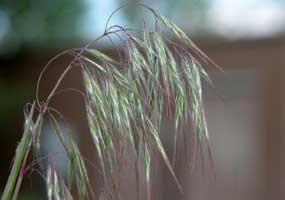
When exploring wetlands, streambanks, and the shores of Great Salt Lake this time of year, it’s common to see tall grasses, over ten feet high, blowing in the breeze. While it is very abundant, the common reed known as Phragmites australis is anything but normal.

Phragmites was introduced from Europe over a century ago, and is now found in all 50 states and on every continent except Antarctica. It can grow to more than 15 feet in height, with long blade-like leaves. It flowers from July to October, producing dense, feathery clusters of small flowers that are purple while flowering and turn light brown after producing seeds. Each stem can produce up to 2,000 wind-dispersed seeds that are particularly effective at colonizing new areas. Because of this, Phragmites can take over a disturbed area quickly and prevent native plants, such as bulrush and cattail, from becoming established.

Like other invasive plants, Phragmites is successful at outcompeting native plants. Once a plant is established from seed, Phragmites spreads quickly through rhizomes, or underground stems, that can produce many additional stalks. While Phragmites may start growing among other wetland plants, it quickly outcompetes them for nutrients and sunlight. However, the native “Phragmites australis subspecies americanus” does not grow nearly as dense or tall, and tends to not be invasive.

Because introduced Phragmites can quickly grow into solid stands, it can greatly reduce plant diversity in wetlands, ultimately reducing the quality of wildlife habitat. Wetlands along the shore of Great Salt Lake are particularly important habitat for many migratory birds species, some of which occur here in the largest populations in North America or the world. The rapid takeover by Phragmites in these wetlands could eventually have dramatic impacts to the entire Great Salt Lake ecosystem.

In order to combat this threat, wetland managers have tried several methods for controlling or removing Phragmites, including spraying with herbicide, burning, livestock grazing, and mowing. Dr. Karin Kettenring, a Utah State University researcher, and her graduate students are currently studying the effects of several of these Phragmites control methods along the shores of Great Salt Lake. By experimenting with the timing of mowing and herbicide treatment, as well as covering mowed Phragmites with heavy black plastic, Dr. Kettenring and her team hope to find the most effective combination of treatments. With the continual conversion of native wetland habitats to a monoculture of Phragmites, Dr. Kettenring’s research is of particular importance to maintaining the health of the Great Salt Lake ecosystem- one of our state’s greatest natural wonders.

For Wild About Utah, I’m Mark Larese-Casanova.

Credits:
Images: Courtesy & Copyright
            Jil M. Swearingen, National Park Service, Center for Urban Ecology, Washington, DC
            Dr. Kristin Saltonstall, Adjunct Research Scientist, Horn Point Laboratory,
                  University of Maryland Center for Environmental Science, Solomon, MD
            Robert Meadows, Environmental Scientist, North DE Wetland Rehabilitation Program,
                  DE Mosquito Control Section, Newark, DE
            As found on https://www.nps.gov/plants/alien/fact/phau1.htm
Text:     Mark Larese-Casanova, Utah Master Naturalist Program at Utah State University Extension.


Additional Reading:

Evans K, Martinson W (2008) Utah’s featured birds and viewing sites: a conservation platform for Important Bird Areas and Bird Habitat Conservation Areas. Salt Lake City, Utah

Kulmatiski A, Beard KH, Meyerson LA, Gibson JR, Mock KE (2010) Nonnative Phragmites australis invasion into Utah wetlands. Western North American Naturalist 70:541-552

Long, A.L., C.M.U. Neale, and K.M. Kettenring. 2012. Management of Phragmites in the Great Salt Lake watershed. Final report to the Utah Department of Natural Resources, Division of Forestry, Fire & State Lands. 15 pp.

Beavers: The Original Army Corps of Engineers

Beavers: The Original Army Corps of Engineers: Click for larger picture, Beaver with branch in water, Courtesy US FWS
Beaver with branch in water
Courtesy US FWS,
Steve Hillebrand, Photographer


Hi, I’m Holly Strand from Stokes Nature Center in beautiful Logan Canyon.

Beavers and beaver dams are a common feature of the Utah landscape. You’ll see the dams on smaller streams and side channels, constructed of branches, downed trees and mud. The still, deep water of the resulting pond creates ideal conditions for a beaver lodge. Beavers can escape and hide from predators by slipping into the pond and disappearing into the lodge. Beavers also use their ponds to cache their favorite
food—aspen and willow.

Because of their tree cutting and dam making skills, humans tend to have two divergent opinions of beavers: 60-pound nuisance or environmental engineer.

Click for larger picture, Beaver Lodge, Courtesy US FWS
Beaver lodge
Courtesy US FWS
Hans Stuart, Photographer

Beavers are considered a nuisance when they gnaw down trees that humans want to keep. Dams can flood roads or stop up irrigation canals. When beaver activity conflicts with human interests, they—the beavers–are likely to be trapped and killed.

However, beaver activity has many positive environmental consequences that we are just beginning to appreciate. Wetlands created by beaver dams help soak up sediments, improving downstream water quality. Because of beaver dams, the winter snowpack isn’t lost in a short spring pulse, This results in a more constant stream flow through the summer –and that’s important as Utah’s climate is predicted to become drier. Finally, beaver dams enhance habitat for many other fish and wildlife species and plants.

Click for larger picture, Beaver in pond, Courtesy US FWS
Beaver in pond
Courtesy US FWS
Steve Hillebrand, Photographer

According to Dr. Joe Wheaton, a geomorphologist at Utah State University, there’s a lot of untapped potential for employing beaver engineers in stream and floodplain restoration. Say you want to restore a stream by reconnecting it with its floodplain. You need to excavate channels, redirect stream flow, revegetate and nurture the
area for a long period of time. To accomplish this, you often need a
number of highly trained professionals and some large Tonka toys.

Alternatively –under the right conditions– you might transplant a
colony of beavers and let them apply their vigorous work ethic to your
landscape and get quite satisfying results.

Recognizing that nuisance beavers can be rehabilitated into hard
working wetland engineers and stream habitat restorationists, the Utah
Division of Wildlife Resources has rolled out the state’s first beaver
management plan in 2010. This plan encourages live trapping of entire
families of beavers in nuisance areas and moves them to specific sites where their
environmental services can be appreciated and put to use.

Click for larger picture, Beaver in snow, Courtesy US FWS
Beaver in snow
Courtesy US FWS

Thanks to the USU College of Natural Resources for supporting this Wild about Utah topic.

For Wild About Utah and Stokes Nature Center, I’m Holly Strand.

Credits:
Images:
Text: Stokes Nature Center: Holly Strand

Sources & Additional Reading


ARKive Images of Life on Earth, Information Sheet on Castor Canadensis (including some outstanding videos) https://www.arkive.org/ – (BBC Natural History Unit)

  • American Beaver – Overview
  • American Beaver in the Lodge with Young
  • American beaver felling trees and storing food for the winter
  • American beaver scaring moose away from its lodge
  • American beaver returning to its lodge with food

  • Collen, P. and R.J. Gibson. 2001. The general ecology of beavers (Castor spp.), as related to their influence on stream ecosystems and riparian habitats, and the subsequent effects on fish – a review. Reviews in Fish Biology and Fisheries 10: 439–461, 2001. https://web.archive.org/web/20230202160926/https://www.researchgate.net/publication/227028536_The_general_ecology_of_beavers_Castor_spp_as_related_to_their_influence_on_stream_ecosystems_and_riparian_habitats_and_the_subsequent_effects_on_fish_-_A_review [ Accessed May 1, 2010]

    Prettyman, B. 2009. Utah wildlife: Leave it to the beavers. Article in Salt Lake Tribune, October 16, 2009. https://www.sltrib.com/ci_13570110 [ Accessed April 29, 2010]

    Smithsonian Castor Canadensis Information Page https://www.mnh.si.edu/mna/image_info.cfm?species_id=32 [ Accessed April 29, 2010]

    Big Bend Habitat Restoration Project: A Natural Work of Heart, Open Spaces-A Talk on the Wild Side, US FWS, https://www.fws.gov/news/blog/index.cfm/2016/3/25/Big-Bend-Habitat-Restoration-Project-A-Natural-Work-of-Heart [Accessed March 31, 2016]

    Beaver Dams Strengthened by Humans Help Fish Rebound
    60-Second Science – July 25, 2016 – By Jason G. Goldman02:29 https://www.scientificamerican.com/podcast/episode/beaver-dams-strengthened-by-humans-help-fish-rebound/ Also available through the podcast https://itunes.apple.com/us/podcast/60-second-science/id189330872?mt=2

    Goldfarb, Ben, Eager: The Surprising, Secret Life of Beavers and Why They Matter, Chelsea Green Publishing, March 8, 2019, https://www.amazon.com/Eager-Surprising-Secret-Beavers-Matter/dp/1603589082/ref=asc_df_1603589082/

    Spider Silk

    Orb Spider Web
    Contains 3 Types of Silk

    Courtesy & Copyright 2011
    Terry Greene, Photographer

    Spider silk has long been of interest to scientists and engineers for its incredible strength. Silk can be, by weight, a stronger fiber than steel or Kevlar. But new research has discovered that the strength of the individual fibers does not explain the durability of a web, which can remain functional after sustaining extreme stress. The web’s overall design adds to silk’s durability to create a truly functional product.

    Spiders utilize silk for many different reasons – transportation, lining burrows, protecting and securing egg cases, and of course for catching prey. Amazingly, an individual spider has the ability to manufacture several different types of silk, which are used for different purposes. In a typical orb-style web there are at least three kinds of silk at work. One is strong and dry, making up the ‘spokes’ of the web. These are the strands upon which the spider itself moves around, so as not to get stuck in its own trap. The strands which create the characteristic spiral pattern are actually made of two types of silk – one is a fine, stretchy fiber, and the other a sticky, glue-like substance. Together, these two silks make up the part of the web responsible for snaring prey.

    Another important property of silk is that when stretched the fiber stiffens. As more pressure is applied, the properties of the silk change, allowing it to become stretchy and flexible. If still more pressure is added, the silk stiffens again, until finally it breaks. Originally, this stiff-stretchy-stiff response to stress was viewed as a weakness, but when analyzed as part of an interconnected web, that’s not the case. A team of scientists from MIT noted that webs could be subjected to a lot of force with only minimal damage. Whether the force was localized – for example while ensnaring a large insect – or more widespread over the entire surface – such as pressure from strong winds – the damage incurred by the web was minimal. Only the individual strands that endure the most pressure break, while others stiffen, flex, and remain intact.

    Localized damage allows the spider to more often than not simply repair a web instead of abandoning it and starting over. Creating silk and weaving a web is a costly process for a spider – it takes up a lot of the arachnid’s energy. The ability to simply patch the broken parts is a more efficient strategy which requires less energy expenditure and fewer materials than weaving a new web.

    Figuring out how to mimic this response to stress on a material could be infinitely useful in the human world. Imagine a skyscraper in an earthquake that fails in one small place where the forces are strongest – not in its entirety as is currently the case. That same earthquake-damaged building might also need only minimal repairs, saving time, money, and materials. Oh the lessons we could learn from one of nature’s smallest creatures…

    Thank you to the Rocky Mountain Power Foundation for supporting the research and development of this Wild About Utah topic. For the Stokes Nature Center and Wild About Utah, this is Andrea Liberatore.

    For the Stokes Nature Center and Wild About Utah, this is Andrea Liberatore.

    Credits:
    Images: Courtesy & Copyright 2011 Terry Greene
    Text:     Andrea Liberatore, Stokes Nature Center in Logan Canyon.

    Additional Reading:

    Chandler, David L. (2012) How Spider Webs Achieve Their Strength. MIT News Office. Available online at: https://web.mit.edu/newsoffice/2012/spider-web-strength-0202.html

    National Science Foundation press release (2012) A Spider Web’s Strength Lies in More Than its Silk. Available online at: https://www.nsf.gov/news/news_summ.jsp?cntn_id=123041

    Law, Steven (2012) Curious Things About Spider Webs. Available online at: https://www.ksl.com/?nid=968&sid=20488145