Til Death Do Us Part

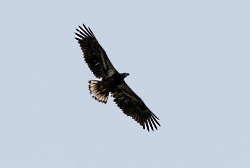
Tundra Swan Pair
Cygnus columbianus
Courtesy US FWS
Tim Bowman, Photographer

Hi, I’m Holly Strand.

Each year we celebrate Valentine’s Day by expressing our love and devotion to a significant other. While humans are the only species that actually celebrate it, we aren’t the only animals who bond together as couples. Monogamy–or long term pair bonding as animal behaviorists call it–is practiced by over 90 % of birds. Along with a modest number of mammals, including wolves, beavers, voles and gibbons. Even a few fish pair up.

Monogamy may have evolved for different reasons among different groups of animals. For some, female dispersal may have played a role. If females are few and far between–as is the case with white tail ptarmigans–there is a tendency to pair up. Perhaps additional potential mates are too far away too bother. For males, monogamy can save a lot of time and energy. Monogamous males don’t have to fight over females or bother with first time courtship rituals. And by closely guarding a single female , males can protect their genetic investment.

There are advantages for females too. With a mate, you can get a little assistance around the nest or den. Male partners can help incubate eggs, guard against predators and help feed the kids. The fact that male and females are equally suited to care for chicks may explain why monogamy is so much more common among birds. The male improves his chances for reproductive success by investing in just one female’s little ones. The situation is different in mammals. Mammal males just can’t step in and help as much with gestation and lactation. So perhaps that’s why only 3% of mammal species form pair bonds.

The offspring of monogamous pairs tend to be pretty helpless at birth. Having two caregivers means that the you can take more time to mature. This long, slow development leads to larger brain sizes. Humans demonstrate this phenomenon very well as we parent our children longer than any other species on earth!

The tundra swan is Utah’s best example of monogamy in the wild. Young tundra swans date around a bit when they are young, but they eventually settle down with a single mate for life. They build and defend a nest together and raise the kids. But then they stick together the rest of the year as well. Greetings and courtship rituals such as head bobbing and dipping and ritual bathing strengthen their commitment toward each other.

You can see these beautiful swans in massive numbers twice a year when they migrate through Utah. Tens of thousands of them stop by the Great Salt Lake on their way to either the Arctic tundra or to central California.

For sources, pictures, and archives of past programs, go to www.wildaboututah.org

For Wild About Utah, I’m Holly Strand.

Credits:

Image: Courtesy US FWS, images.fws.gov
Text: Holly Strand

Sources & Additional Reading

Limpert, R. J. and S. L. Earnst. 1994. Tundra Swan (Cygnus columbianus), The Birds of North America Online (A. Poole, Ed.). Ithaca: Cornell Lab of Ornithology; Retrieved from the Birds of North America Online: https://bna.birds.cornell.edu/bna/species/089

Mocka, Douglas, and Masahiro Fujiokab. 1990. “Monogamy and long-term pair bonding in vertebrates” Trends in Ecology & Evolution. Volume 5, Issue 2, February 1990, Pages 39–43

Reichard, Ulrich and Christoph Boesch. 2003. Monogramy: mating Strategies and Partnerships in Birds, Humans and Other Mammals. Cambridge University Press.

Schultz, Susanne and Robin I.M. Dunbar. 2010. “Bondedness and sociality”
Behaviour, Volume 147, Number 7, 2010 , pp. 775-803(29).

Schultz, Susanne and Robin I.M. Dunbar. 2010. Social bonds in birds are associated with brain size and contingent on the correlated evolution of life-history and increased parental investment. Biological Journal of the Linnean Society. Volume 100, Issue 1, pages 111–123, May 2010.

Those Howling East Winds

Those Howling East Winds: Normal Diurnal Wind Shift Along the Wasatch Front, Courtesy Utah Division of Air Quality
Normal Diurnal Wind Shift
Along the Wasatch Front
Courtesy Utah Division of Air Quality

Those Howling East Winds: Air Pressure at the Surface, A Bit of a Blow..., Utah Climate Notes, January 2012, Courtesy Utah Climate Center, Utah State University Air Pressure at the Surface, 1 Dec 2011
Blue=Low Pressure, Red=High Pressure
The spacing of the lines is a measure of the pressure gradient: the closer the lines, the higher the pressure gradient. https://climate.usurf.usu.edu/news/010512Utah%20Climate%20Update%20(Jan%2012).pdf[Feb 6, 2014]
Read: A Bit of a Blow…
Courtesy Utah Climate Center, Utah State University

Wind is inevitable on a spinning planet with an atmosphere and a sun. At our latitude, westerlies prevail, but east winds do occur now and then. Locally, canyons daily exhale denser, cooler mountain air that drains into valleys. In Logan, trees blown by these canyon winds tilt westward. Occasionally, though, the whole Wasatch front is whipped by howling gales from the east, leaving behind shredded shingles, snapped tree limbs and rolled tractor-trailers. These forceful east wind events have a regional weather origin that is intensified by local topography.

It begins with a strong high-pressure cell parked over southwestern Wyoming.  It’s descending dry air circulates clockwise. Somewhere to the south or southwest, a low-pressure cell is needed.  The strong air pressure gradient between high and low generates a wind that races westward from Wyoming. The surging wind pours over the entire Wasatch front like water over a flat boulder in rapids.  These winds then plunge down slope, blowing quickest where the descent is long, steep, and unobstructed. The down rushing air slams onto the flat benches and valley floors.  In November 2011, such winds ripped Centerville with 100 MPH gusts.

Where these so-called mountain wave events blow regularly they often have names.  The mistral and foehn winds howl down from the Alps, chinooks  race down the Rocky Mountain Front Range, and the Santa Anas blast Southern California. The steep altitudinal descent of these parched winds compressively heats the air. A spark or flame soon transforms to a raging wildfire when fanned by a drying foehn or Santa Ana wind.  Europe’s foehns are also known to spark short tempers and stress.

Perhaps the sporadic easterly gales that lash the Wasatch Front and Cache Valley deserve an evocative name too.  For now, you at least know the answer to what’s blowin’ in the east wind.

Thanks to Martin Schroeder at the Utah Climate Center for insights and the stream boulder analogy

This is Linda Kervin for Bridgerland Audubon Society.

Credits:
Diurnal Utah Winds Image: Courtesy Utah Division of Air Quality
Surface Air Pressure 1 Dec 2011 Image: Courtesy Utah Climate Center, USU
Text: Jim Cane

Additional Reading:

Martin Price, Alton Byers, Donald Friend, Thomas Kohler, Larry W. Price. 2013. Mountain Geography: Physical and Human Dimensions. Univ of California Press. pages 71­74. https://www.amazon.com/Mountain-Geography-Physical-Human-Dimensions/dp/0520254317

Mesmerizing live wind map of US at:  https://hint.fm/wind/

Forecast of damaging east winds along the Wasatch Front, end of November 2011, https://www.ksl.com/?sid=18282965

How Chinooks Occur, Wikipedia, https://en.wikipedia.org/wiki/Chinook_wind#How_Chinooks_occur

Citius, Altius, Fortius

Snowshoe Hare summer coat image courtesy US National Parks Service
Snowshoe Hare Summer Coat
Courtesy US National Parks Service

Snowshoe Hare winter coat image courtesy US Forest Service https://www.fs.fed.us Snowshoe Hare Winter Coat
Courtesy USDA Forest Service

Hi, I’m Holly Strand from the Quinney College of Natural Resources at Utah State University

The upcoming winter Olympics in Sochi bring back fond memories of Utah’s stint as host of the winter games. You may recall that “Powder,” a playful snowshoe hare was among Salt Lake City’s three Olympic mascots. Powder represented “faster” in the Olympic triumvirate (try-um-virate) motto of “Citius, Altius, Fortius” (or Faster, Higher Stronger). And the little snowshoe hare needs to be fast. For according to USU wildlife biologist Dustin Ranglack Snowshoe hares are the Snickers bars of the forest. They’re a popular treat for a host of carnivores, including coyotes, foxes, lynx, bobcats, bears and birds of prey.

Hares are fast in general. They can reach 40 miles per hour, and can leap more than ten feet (three meters). But this hare has extra-large, wide feet with more fur and larger toes. Like permanent snowshoes, these feet are ideally suited for racing from predators in deep mountain snow.

In spite of its speed, the snowshoe hare’s best mechanism of defense is camouflage. In winter, its soft, fine fur turns white to blend into the snowy terrain. As spring thaws the wintry landscape, the hare’s fur turns brown or reddish-brown to help it elude predators. Only the tips of the ears remain dark throughout the year.

Scientists have observed that climate change may affect the survival of animals that undergo seasonal coat color changes. For example, with a shortened winter, a white-coated snowshoe hare is a sitting duck on brown earth in full view of ravenous predators.

But interestingly there is already a lot of variability in the timing of individual hares camouflaged coat. Amount of sunlight may start the color change in a snowshoe hare population. But once the process starts, the timing of full coat transformation — which can take up to two months — is unique. Perhaps this is due to the fact that—even before climate change– there was always been some variability in the onset of winter snow cover. Anyway, this variability in color change gives scientists hope that the snowshoe hare will be able to adapt its timing to seasonal changes in the future.
For sources and pictures go to WWW.wildaboututah.org.

For the Quinney College of Natural Resources, I’m Holly Strand

Credits:

Images: Courtesy US Forest Service and US National Parks Service

Text: Mary-Ann Muffoletto, Holly Strand, Quinney College of Natural Resources

Sources & Additional Reading

Snowshoe Hare Lepus Americanus, National Geographic, https://animals.nationalgeographic.com/animals/mammals/snowshoe-hare.html

Mills, L. Scott, Marketa Zimovaa, Jared Oylerb, Steven Runningb, John T. Abatzoglouc, and Paul M. Lukacsa. 2013 Camouflage mismatch in seasonal coat color due to decreased snow duration. PNAS. https://www.pnas.org/content/early/2013/04/10/1222724110#aff-1

Rossner, Hillary. 2012. The Color of Bunny: Can snowshoe hares outrace climate change? Feb. 6, 2012. High Country News. https://www.hcn.org/issues/44.2/can-snowshoe-hares-adapt-to-climate-change

Utah’s Rich Skiing History

The ski lift at Snow Park (now Deer Valley) in the 1940s
The ski lift at Snow Park
(now Deer Valley) in the 1940s
Visit Summit County as found on
Ilovehistory.utah.gov

Hi, this is Mark Larese-Casanova from the Utah Master Naturalist Program at Utah State University Extension.

Since the early pioneers, Utah’s mountains have been the basis of important industry and a source of great wealth. Some of Utah’s better-known mountain towns, such as Park City, were originally established as mining camps in the late 1800s. While some silver and gold mining still occurs in Utah, these days we find wealth in the form of another color- white. Snow, that is.

Skiing in Utah is so popular that people travel from around the world to ski here. We’re well known for our light, dry powder, and steep terrain. Each year, Utah’s fourteen ski resorts record several million skier day visits.

But, before skiing was a popular recreational activity, it was an important mode of transportation. For trappers, miners, and other early winter inhabitants of Utah’s mountains, travelling by skis was a means of survival. It was Norwegian immigrants who first brought skis to Utah, and one of the earliest records of skiing comes from the town of Alta, where, in 1870, the postman delivered mail to the town on skis. Ski touring grew in popularity, and the Wasatch Mountain Club routinely led multi-day trips in the 1910’s and ‘20’s. Professional ski jumping events, drawing thousands of spectators, began along the Wasatch foothills around 1930.

Until the Great Depression caused the value of silver to plummet, Alta was a boomtown for silver mining. The abundant snow was troublesome for the miners, and a giant avalanche destroyed half of the town in 1873. It wasn’t until the early 1930s that the mayor (and sole inhabitant of the town at the time) began exploring the idea of promoting skiing at Alta. After all, Alta holds the state record for highest average annual snowfall of 516 inches!

Alf Engen, a native Norwegian who came to Alta in 1935 as a foreman with the Civilian Conservation Corps reforestation effort, was instrumental in helping the US Forest Service select suitable areas for developing skiing. Modern skiing was established in Utah when cable tows started running at Brighton in 1937, and the Collins chairlift fired up at Alta in 1939 and offered rides for only 25 cents each, or $1.50 for the day. The next decade saw development of several other ski resorts, including Snowbasin and Beaver Mountain.

Utah’s ski resorts and backcountry continue to offer wonderful opportunities to enjoy the wintry outdoors with family and friends, to learn a new sport, and to take part in Utah’s rich skiing history. Oh, and for 5th and 6th graders around the state, Ski Utah offers Ski Passports that include three free lift tickets at each of Utah’s ski resorts.

For Wild About Utah, I’m Mark Larese-Casanova.

Credits:

Photo: Summit County on Ilovehistory.utah.gov
Text:     Mark Larese-Casanova

Additional Reading:

Arave, J. Utah Skiing History. Utah Travel Center. https://utahtravelcenter.com/activities/skiing/utah_history.htm

Bowman, Anthony W., “From Silver to Skis: A History of Alta, Utah, and Little Cottonwood Canyon, 1847-1966” (1967). All Graduate Theses and Dissertations. Paper 1642.
 https://digitalcommons.usu.edu/etd/1642

Hullinger, J. Alf Engen. Utah History Encyclopedia. https://www.historytogo.utah.gov/people/alfengen.html

Notarianni, P.F. Mining. Utah History Encyclopedia. https://historytogo.utah.gov/utah_chapters/mining_and_railroads/mining.html

Utah Ski History FAQs. Alf Engen Ski Museum. https://www.engenmuseum.org/utah-ski-history-faqs