A Utah Public Radio production featuring contributors who share a love of nature, preservation and education
Podcast: Wild About Utah
Wild About Utah is a Utah Public Radio production featuring contributors who share a love of nature, preservation and education. Contributors include Bridgerland Audubon Society, Utah Public Radio, Stokes Nature Center, the Edith Bowen Laboratory School (EBLS) at USU and many other nature-related individuals and institutions. See WildAboutUtah.org for a list of authors, voices and contributors.
Our Winterless Winter: Drought conditions across the United States as of January 2, 2018. Moderate drought (peach) expanded in size across Arizona according to the first United States drought monitor of 2018. Overall, much of the Four Corners region of the southwestern United States is in some form of drought. Climate.gov map, based on data from the National Drought Monitor project. Courtesy: NOAA Climate.gov Data: NDMCI’ve been in this lovely valley over 30 years and have never experienced such a balmy January, and now February. The thaw began January first and never ended. As an avid cross country skier, I fear my days of low elevation skiing have ended over a month early.
And I’m well aware that my home state of Michigan is having an epic winter of extreme cold and snow. While we westerners are crying global warming, those across the Mississippi are saying “bring it on!”
So what do the computer models tell us about these phenomena as they predict our future in a warming climate? Our jet stream is acting might wimpy and limpey these days, which was what the climatologists saw coming in their modeling. I will attempt a brief explanation.
The jet streams are high-altitude, racing rivers of air that can influence the path of storms as they track over North America from the Pacific Ocean. The jet streams meander and shift from day to day, but during La Niña events, they tend to follow paths that bring cold air and storms into the Upper Missouri River Basin. Map based on original graphics from NOAA’s Climate Prediction Center. Courtesy NOAAThe jet stream is highly impacted by the temperature differences between the poles and the mid latitudes where we reside. The greater this difference, the more robust the jet stream. The poles have been warming at a crazy rapid pace- several times faster than the lower latitudes. This has reduced the temperature differences which has two profound effects on the jet stream. First, with less energy to move it along, it stalls out so to speak and its patterns linger longer over our continent. Thus the prolonged extreme warm temps in the west, and prolonged cold in the east. A month ago my son living in Atlanta, GA called to say he was walking his dog in a foot of snow, a new experience for that southern boy!
Jet streams also “follow the sun” in that as the sun’s elevation increases each day in the spring, the average latitude of the jet stream shifts poleward. (By Summer in the Northern Hemisphere, it is typically found near the U.S. Canadian border.) As Autumn approaches and the sun’s elevation decreases, the jet stream’s average latitude moves toward the equator. Courtesy NOAAThe second effect is the deep trough that allows the cold to reach well into those once toasty southern states. These sags can be shown with a jump rope. As you slow the energy, or rate of whip moving the rope, it begins to sag, creating a deeper, slower moving trough that even I can leap over!
So our western part of the jump rope is stuck in an inverted trough (the upward swing of the rope), creating a high pressure system that has dominated our state and much of the west with very warm temps and very little precip. This does not bode well for our ski industry nor our water supply, which is locked in our scant snow pack.
Many students from around the state have been working on a resolution with their state legislators which addresses this climate weirding. Bill HCR7 now resides in the House Natural Resources Committee, where it will probably be heard before you hear this. It may even have been on the House floor by then, and on to the Senate. The students are filled with hope that our state leaders will hear their testimonies in behalf of a future we all wish them to have.
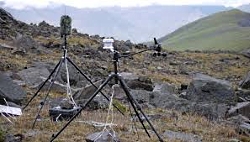
Scoundscape Recording Equipment Courtesy US NPSImagine yourself in your favorite place outside. What sounds do you expect to hear? The sound of water rushing over rocks? Crickets chirping? The wind softly blowing through the trees? These are some of the natural sounds you might expect to hear, but it might not always work out that way. Recreation areas are often filled with anthropogenic noises like vehicles, people talking, music playing, machinery, and more.
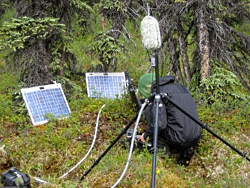
Checking sound equipment set up near the McKinley Bar Trail, Denali National Park Courtesy US NPSSoundscapes, or the acoustic environment, are not often thought of as a natural resource, but are actually an important part of the environment. A common reason people go to nature is for peace and quiet. Quiet is considered a valuable resource. Humans have grown accustomed to a constant background of noise, but it is not always good. Escaping to nature can potentially provide relief from noise pollution, but natural soundscapes are becoming less and less common.
Noise pollution significantly impacts human health. Physical and mental impacts can include hearing disorders, sleep disruption, and even interruptions in the cardiovascular and endocrine systems. Sound is more important than you might realize.
Soundscapes may be important to humans, but they are arguably even more important for wildlife. Many animals depend on hearing for warning them of danger, communicating with other animals, and locating prey. Birds and other animals can hear noises from very far away, and noise interference can disrupt them easily. Behavioral responses may include leaving an area for a brief time or leaving an area for good.
Through evolution, some animals have lost sight, because it was not a necessary trait in some situations. Up to this point, there has been no animal discovered that has lost its hearing through evolution. This illustrates how vital the acoustic environment is to wildlife and ecosystem health.
Barn Owl Courtesy US FWSThink of a Barn Owl. Hunting in the dark, they rely on the tiniest rustle to lead them to their prey. Their sense of hearing is fine-tuned and adapted specially for this purpose. One ear hole is slightly higher than the other, which allows them to perceive depth through hearing. Also, one ear hole can hear sounds below them on the ground, and the other can hear the sounds in the air. Just by listening, an owl can locate a mouse far below it on the ground. Noise pollution would make it nearly impossible for owls to hunt.
Owls are just one example of noise pollution negatively effecting wildlife. As soundscapes are disturbed, wildlife will be displaced or even die. Public land managers now have the challenge of managing soundscapes. This is a difficult, but soundscapes are important for humans recreating, wildlife, and whole ecosystems.
As William Shakespeare said, “The earth has music for those who listen.”
This is Aspen Flake and I am Wild About Utah.
Credits:
Photos: Courtesy US NPS ans US FWS
Audio: Courtesy and Copyright Kevin Colver
Text: Aspen Flake
Jeff Rice, Recording Artist:
Dobner, Jennifer, LISTENING TO THE NATURAL WEST
The U’s Western Soundscape Archive captures the animal and ambient music of the wild., CONTINUUM
THE MAGAZINE OF THE UNIVERSITY OF UTAH, Summer 2014, https://continuum.utah.edu/web-exclusives/listening-to-the-natural-west/
Vanderbilt, Tom, You Need to Hear This, Recording engineer Jeff Rice is on a mission to preserve the sounds of nature. Why? Listening to them might actually make us healthier., OutsideOnline.com, 20 Oct 2011, https://www.outsideonline.com/1887466/you-need-hear
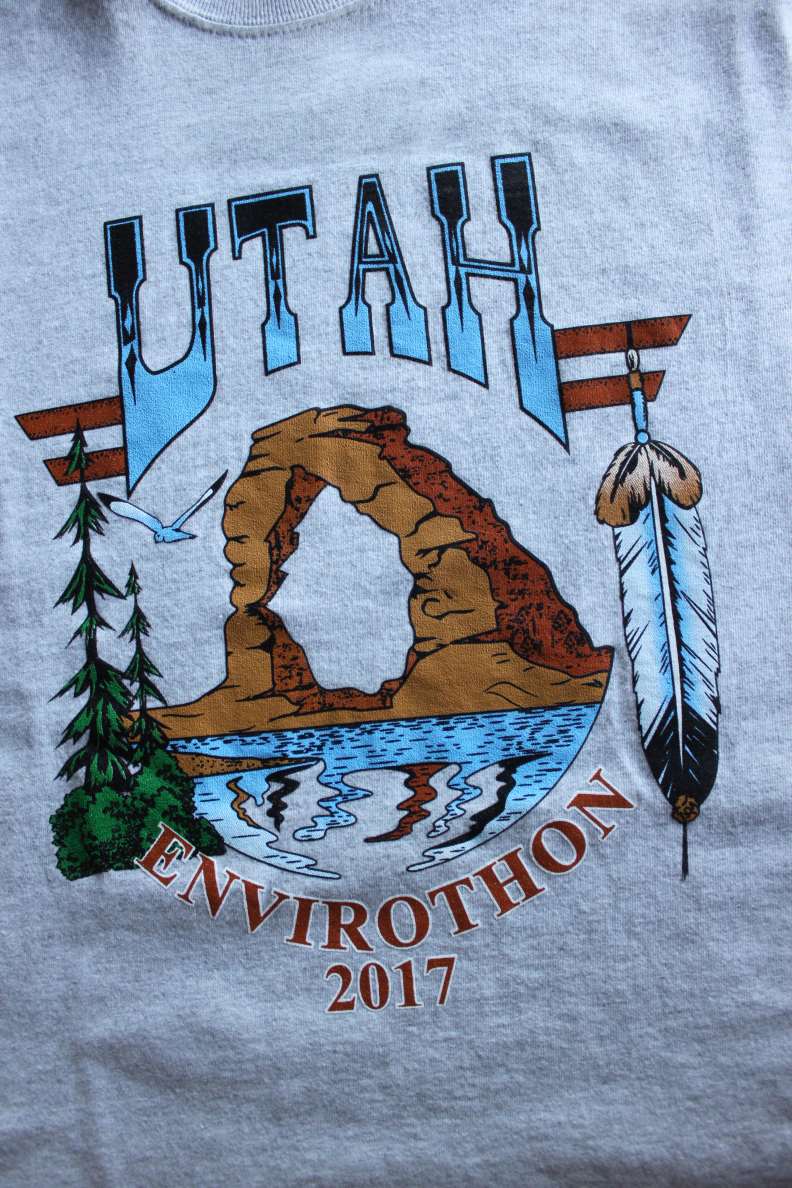
Utah Envirothon 2017 T-Shirt Courtesy Ron Hellstern, PhotographerNo matter where you live in the State of Utah, you are located in one of the 38 Conservation Districts managed by the Utah Conservation Commission. Each of those Districts sponsor and support a wonderful program for High School students called the Utah Envirothon (which simply means a marathon competition to understand Utah’s environments).
The program started in 1979 in Pennsylvania. In 1995 a handful of teachers from the Cache and Logan School Districts, Utah State University, and the Natural Resource Conservation Service in Logan started the program in Utah.
The Envirothon is unique in science and Ag contests because teams of five students from each school get to work together as they compete in the subjects of Forestry, Wildlife, Soils and Land Use, Aquatic Ecology, and a Current Issue which changes topics each year. This isn’t a typical Science Fair where a student displays a cardboard backdrop explaining an experiment they may have done. In the Envirothon, without teachers present, the students are given written tests AND all day outdoor field-tests where they use professional scientific equipment to understand the functions of the natural world around them. They are also given an actual current problem that deals with Utah’s wild lands or agricultural settings and they must produce an Oral Presentation regarding their solution to a panel of Agency Judges. The students also get to learn about dozens of outdoor careers in the Natural Resources, Forest Service, Agriculture, Wildlife Management, and the National Park Service
The Judges are not acquainted with any of the students, who are required to wear identical team T-Shirts, during the entire competition. Scores are compiled from tests, equipment use, and the oral presentation to determine the State Champion who is presented with Olympic-quality medals and scholarships to universities within our State, and then goes on to the North American Envirothon, which is held in a different location in the U.S. or Canada each summer. Last year, about 60 State and Provincial winning teams went to Maryland to compete for the North American Championship.
The Utah competition has been held the last weekend in April, in places ranging from Logan to Saint George, on university campuses, forests, rangelands, farms, and even in Zion National Park.
Currently, more than half a million students participate throughout all the United States, Canada, and China. Europe, Mexico, Japan and Australia are also investigating how to establish the program.
For more information contact your local Conservation Districts or online at utahenvirothon.org for the simple rules, learning resources, and training videos about each topic. The North American website has even more detailed information at www.envirothon.org.
This is Ron Hellstern and I’m Wild About Utah!
Credits:
Images: Courtesy & Copyright Ron Hellstern, Photographer
Text: Ron Hellstern, Cache Valley Wildlife Association
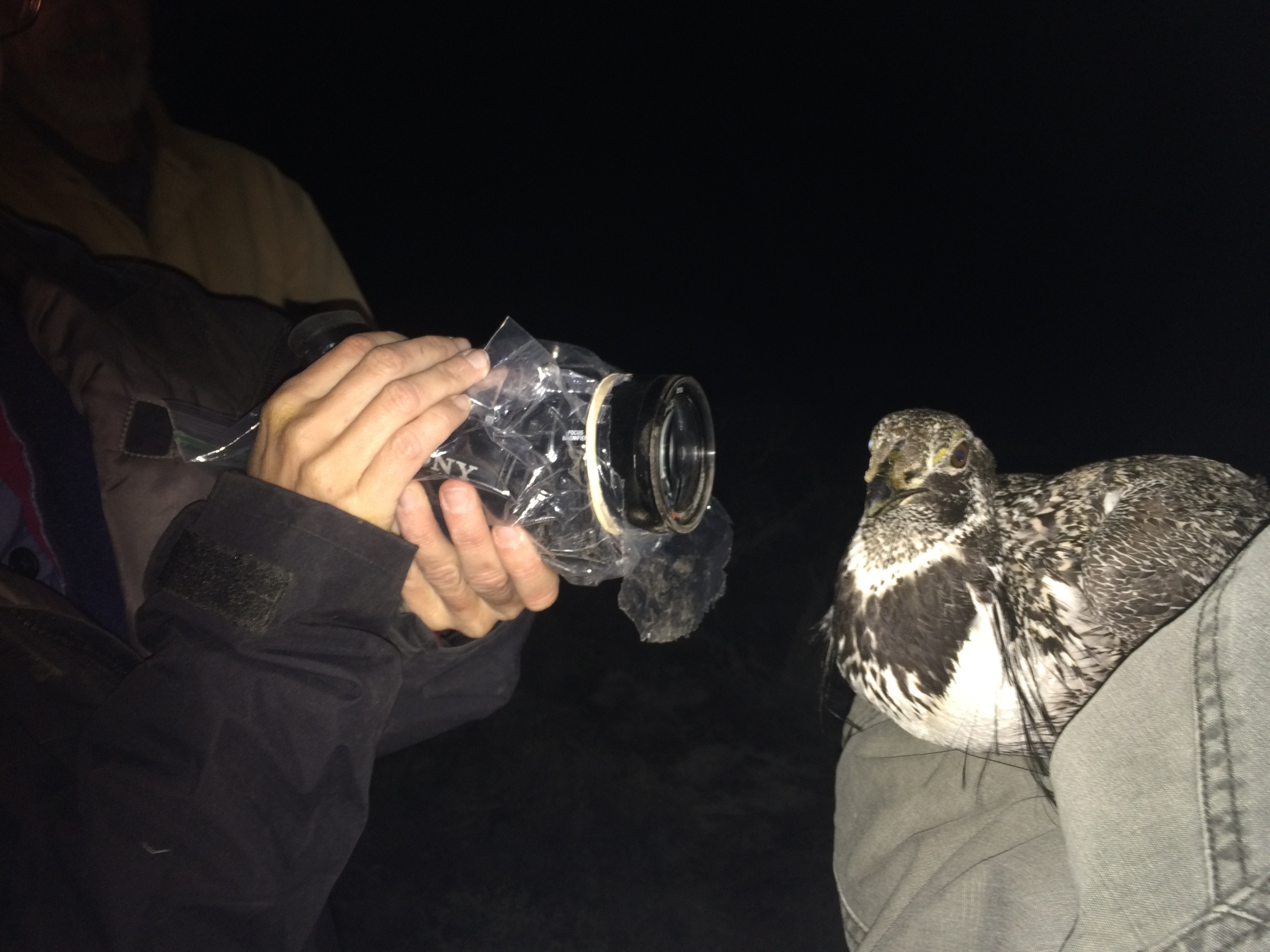
Male Grouse Closeup Courtesy & Copyright Nicki Frey, PhotographerAt 3:00 a.m. on a frigid winter morning Nicki Frey, an Extension Associate Professor in the Department of Wildland Resources at USU, leads a group of new biologists who are trapping west of Bryce Canyon.
Cold, deep snow is all they can see on the valley floor.
The group is looking for the greater sage-grouse whose GPS transmitters are sending Frey signals – indicating they are nearby.
Grouse Tracks in Snow Courtesy & Copyright Nicki Frey, PhotographerFor best results, researchers trap sage-grouse on moonless nights. The only light they have comes from the ATVs and headlamps.
Frey explains, “Southern Utah is the farthest southern location where greater sage-grouse live in the U.S. This valley is part of their winter habitat.”
In disbelief, one biologist responds, “It would be impossible for grouse to winter here.”
Documenting Grouse Trapping Courtesy & Copyright Nicki Frey, PhotographerThe biologist’s statement is understandable, since research shows the winter habitat for greater sage-grouse is in areas where sagebrush is above the snow, so the grouse can hide underneath and receive protection from the brush and nutrition from its seeds.
Just as Frey begins to respond – 20 grouse burst out of the snow in front of them and fly away. “It scared us out of our skin.” Frey said.
“Everyone retreat! Everyone off of the snow!” Frey calls out.
Grouse Snow Angel and Cave Courtesy & Copyright Nicki Frey, PhotographerThen she and her colleague Lisa Church, a biologist from Bureau of Land Management get down on their hands and knees and begin searching for where the grouse were hiding. They see wing marks in the snow and a hole close by. With the use of a flashlight, they look down the hole and discover the birds came from a cave under the snow-covered sagebrush.
Going against the grain, the grouse have been living under the deep snow.
Sagebrush in this area only grow 1.5 to 3 feet, and since the snow can get up to 12 feet it’s not far into winter before the sagebrush is completely covered.
Surprisingly, the grouse have been able to adapt.
Frey explains, “They make these little snow caves and eat the sagebrush leaves inside the cave until they’re gone, then they pop out and pop back into the next sage brush cave and eat the leaves in there.”
Buried sagebrush isn’t the only obstacle the southern grouse have had to adapt to.
Grouse on Edge of New Treatment Courtesy & Copyright Nicki Frey, PhotographerFrey explains, “[In Northern Utah you have …nice rolling hills with lots of sage brush that seems to go on forever. In Southern Utah, we have little valleys of prime sage-grouse habitat, but they’re divided by rugged mountains and tree covered hills.”
This environment pushes the grouse to fly longer and further than they normally would.
They fly back and forth between the fragmented sagebrush habitats to find what they need to have a healthy population.
Having to constantly travel between these habitats takes a toll on the southern grouse.
This is an area Utah wildlife managers have helped the greater sage-grouse by removing pinyon-juniper forests which fragment their habitat.
According to Frey, “Anytime we [reconnect] habitat [in the southern region] the grouse use it immediately because they want to expand.”
The impact the Bureau of Land Management and Utah Division of Wildlife Resources projects have had on decreasing the forest barriers is astounding. “The numbers of sage-grouse have steadily increased every year.”
Frey’s research highlights this bird’s remarkable ability to adapt to southern Utah’s climate.
By using the research to assist with management planning, Utah can continue removing barriers for grouse survival and ensure their continued presence in our wildlands.
This is Shauna Leavitt for Wild About Utah.
Credits:
Principal Investigator: Nicki Frey
Photos: Courtesy and Copyright Nicki Frey
Text: Shauna Leavitt