Cedar Waxwing Courtesy Pixabay tdfugere, photographerIn times like these, I enjoy the mid-autumn sunshine. The trees now shed of their light-hungry leaves, let brightness again seep to the porous earth’s floor. The naked branches bring back views of the mountains, unveil the cedar waxwings and robins swarming the crabapples in their lust for ferment, and let sounds roll uninterrupted across the valley floor and across me, too.
It seems that, only when there is snow in the mountains does the sunshine lift me highest as it does in mid-autumn. That juxtaposition of winter’s edging deep sleep with the echoes of the year’s warmth, brings a mellow cascade of calm. It is the calm of a cup of hot tea one holds while hearing the storm roll past just outside, just beyond smoke-bellowed chimneys. That peace of mid-autumn sunshine, though, is only a single note in the chorale of the day here, and season still churning forward unto ultimately itself again.
Great Basin Sparse Vegetation, Courtesy USGS, David Susong, PhotographerIn times like these, I can look forward to other subtle peaces yet on their way, each their own a marker in time, a fruit on the year’s own bough, a rung at once both descending into winter, and back up into spring.
How the first big snow constricts the world gently, a cotton cocoon, perpetuating the life held muffled beneath its firmament. Metamorphosizing. Shifting. Becoming.
How the heavy clouds begin to sink to the valley floor, letting us for just one season keep the same company without wings. In them we realize concurrent confusion of feet upon the ground and our heads in the clouds. Perhaps in that bending of worlds our dreams begin to germ like the very seeds held in the darkness of the world’s soil.
How the darkness allows our afternoons to sleep, for us to dream while awake, and for the world to radiate its own light back skyward through the bright nights of snow-laden grounds. It is within the shroud that the other radiant stars can appear and remind us with silent fortitude of the days behind, and the days ahead, and, if we choose to see it, the promise of this season’s peace felt in the warmth of the mid-autumn sunshine.
I’m Patrick Kelly, and I’m Wild About Utah
Credits:
Images: Cedar Waxwing Courtesy Pixabay,
Images: Great Basin Sparse Vegetation Image Courtesy USGS, David Susong, Photographer (David Susong, Utah Water Science Center Director, USGS)
Audio: Contains audio Courtesy & Copyright Kevin Colver
Text: Patrick Kelly, Director of Education, Stokes Nature Center, https://logannature.org
Included Links: Lyle Bingham, Webmaster, WildAboutUtah.org
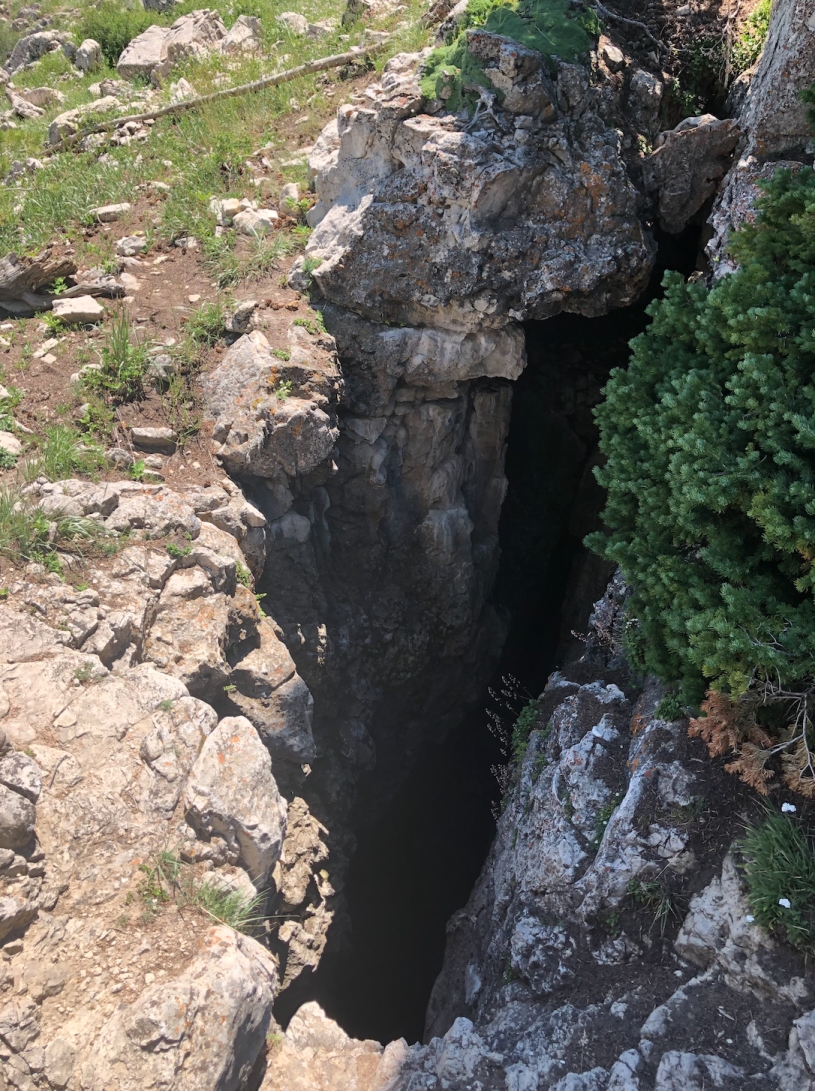
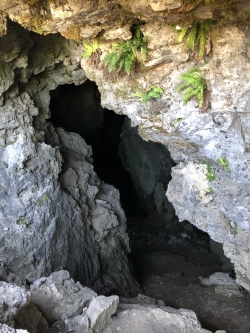
Karst topography’ refers to landscapes cleaved apart by the leaching of water through a soluble bedrock layer comprised of carbonate-rich rocks like the limestone and dolomite found throughout Utah’s mountains or the evaporate-type gypsum and rock salt layers found in Utah’s redrock country. Over time, this erosion by surface and groundwater creates pinnacles, rippling fissures, gaping sinkholes, or springs on the surface—deep caverns, plummeting vertical shafts, and winding tunnels through which entire rivers can flow below.
We floated one such river once, in complete darkness, guided only by a subtle current and the voice of our local guide. He said he was of Mayan descent, so we listened closely when he relayed stories of Chaac, the Mayan god of rain responsible for the generous flow of water through the caverns we explored. Indeed, it is within these same caverns that he dwells, we were told. Further north, in Mexico and the desert southwest, it’s Tlaloc, the goggle-eyed Aztecan deity that controls the rain. He, too, is supposed to reside within the body of the earth.
Main Drain is Utah’s deepest and the nation’s 11th-deepest cave. It’s also wildly difficult and dangerous to navigate, yet absolutely critical to explore for the sake of furthering scientific understanding. I talked to Larry Spangler of the US Geological Survey in Salt Lake City about the significance of karst landscapes like Main Drain. “The caves that are developed in these terrains,” Spangler says, “are…valuable sources of information in regard to changes in climate and landscape evolution over time.” The chemistries of these caves are unique to their environment, and analysis of mineral deposits within the caves can provide insights into how average surface temperatures have changed over time and how wet or dry the landscape above was in any given period. Karst caves can reveal climate data for specific locales that may help us predict how a warming planet might affect our local ecosystems.
The water that flows through Main Drain and other cave systems like it in the form of snowmelt and subterranean streams carves its way vertically and horizontally through layers of bedrock hundreds of millions of years old—providing researchers a literal inside look at the formation of mountains. And as a map of these subterranean watersheds begins to come together, we gain a better understanding of the hydrology of an area and its effects on water quality.
When I spoke to Spangler, he wanted to make it very clear just how sensitive these karst landscapes are to surface activities, for the health of ecosystems and the integrity of watersheds, of course, but also for the health of human communities. The US Geological Survey estimates that as much as a quarter of the world’s population depends on karst landscapes for their water supply. The city of Logan, where my family and I live, sources its water from one of the larger karst springs in the area. The people are drinking straight from the mountain.
Rivers run beneath these hills, and through us as well.
Author’s note: Caves and other karst features are inherently dangerous. You should never enter a cave or other karst feature without the appropriate training, gear, and an experienced person(s) to accompany you.
Karst Topography Paper Model (Learning Activity, Grade Level: 9-12), National Park Service, US Department of the Interior, https://www.nps.gov/subjects/caves/karst-topography-model.htm Karst Topography Paper Model Background
Soto, Limaris R.(modified by), After: Alpha, Tau Rho, Galloway, John P, and Tinsley III, John C., Karst (U.S. Geological Survey Open-file Report 97-536-A), Topography Paper Model, U.S. Department of Interior, U.S. Geological Survey, National Park Service, https://www.nps.gov/subjects/caves/upload/Karst-Topography-Model-_Written-Section_508c.pdf (formerly: https://www.nps.gov/subjects/caves/upload/Final-Karst-Topography-Model-_Written-Section_5-14-2014.pdf)
Weary, David J. and Doctor, Daniel H., Karst in the United States: A Digital Map Compilation and Database, Open-File Report 2014–1156, U.S. Geological Survey(USGS), https://pubs.usgs.gov/of/2014/1156/pdf/of2014-1156.pdf
Snow at Bryce Canyon National Park Courtesy NOAA, Mark Stacey, PhotographerI love snow! It began when I was old enough to know the difference, and has continued since. We kids always celebrated the first snow of the year at our home in northern Wisconsin. We waded through it, ate it, made snow angels, looked for the most beautiful snowflake, dug snow caves, and waited for a warm up so we could make snowballs, snow people, and snow forts. Once it got deep enough, we broke out the 6-person toboggan and trudged up the biggest hill we could find. And we couldn’t imagine a Christmas without snow!
When we moved to Cache Valley Utah 34 years ago, I was delighted to learn of its superb snow, reminiscent of N. Wisconsin. Further, I learned of its life and death importance for wildlife. Too much, or too little could spell doom for many of our critters. In a heavy snow year, our deer fawn crop may take a major hit- up to 80% mortality, while small mammals can thrive. Snow is an excellent insulator when deep enough- 8 inches or so will maintain a subnivean (beneath the snow) temperature of 32 degrees when the ambient temperatures plunge well below zero above. Further, they are better protected from predators. Too little snow tells a reverse story- great for predators, but disastrous for their prey.
Snow isn’t just snow. According to those who live in the high latitudes- Eskimos, Siberians, and Scandinavians, they have between 180 and 300 words for different types of snow. As a skier, I have a few myself- powder, crusty, gropple, corn snow, and slush. I’m sure you can guess which of these I prefer.
Utah is world renowned for its extraordinary, low moisture powder- less than 8% water. You’re basically skiing on air. I’m aware of only one other location that beats us- Japan’s Hokkaido mountains with only 4% water content.
Another element of snowfall for the Wasatch front results from the very large lake to our west. Thanks to the Great Salt Lake, our snowfall gets a considerable boost from latent heat and added moisture from this great lake. Additionally, airborne salt particles enhance the formation of snow producing clouds.
I must share an extremely strange and rare phenomenon referred to as “thundersnow”. While skiing the North Ogden bench many years ago, an approaching ominous cloud delivered lightning and thunder, shaking the ground enough to bring up swarms of worms to the snow surface. It took a double take to realize what I was witnessing!
Another strange snow phenomenon is an avalanche. This once soft, pliable medium instantly transformed to cement as the avalanche settles. The friction of sliding snow removes the snowflake crystalline structure, changing it from fluff to a high-density medium. The friction generated heat melts it enough to form the deadly tomb that has encased many.
As the Great Salt Lake shrinks from stream diversions and a warming climate, combined with a dwindling winter season, I cannot help but wonder what will become of our indispensable mountain snowpack, essential for Utah’s water supply and our winter recreation.
Jack Greene for the Bridgerland Audubon Sociey, and I’m wild about Utah’s Snow!
Credits:
Images: Courtesy NOAA, Mark Stacey, Photographer (2011)
Audio: Contains Audio Courtesy and Copyright Friend Weller
Text: Jack Greene, USU Sustainability and Bridgerland Audubon Society
Male Western Tanager Courtesy PixabayHow To Create a Bird Friendly Yard
Growing up in Smithfield Canyon in northern Utah, I heard birds singing every day. We had the incredible luxury of having variety of native plants and trees in our yard and the yards of our neighbors. The natural landscape of the canyon makes every yard bird friendly!
When my husband Marc and I moved to downtown Logan, we realized we need to be more intentional about creating bird friendly yards. We purchased two feeders to attract birds to the yard. We started with a globe feeder filled with black oil sunflower seeds, a sock feeder filled with nyjer thistle, and a suet cage.
I set up the feeders where I had the best line of sight from where I spent the most time at home. I was really disappointed that the birds weren’t coming to my feeders! After a bit of research, I learned that I need to place the feeders where the birds are most comfortable, near trees, bushes, and flowers where they can take cover and enjoy food from native plants.
Taking note of this, I relocated the feeders near bushes and trees and rearranged the furniture in my home to allow me a better view. Because relocating the feeders took them farther from my home, I put a small pair of binoculars in the console of our couch so I could grab them quickly if a bird landed at the feeder.
Black Oil Sunflower Seeds (Chickadees, Finches, Grosbeaks)
Black oil sunflower seeds feed the widest number of birds year-round, including chickadees, finches, pine siskins, and grosbeaks. If you are new to attracting birds to your yard, start with black oil sunflower seeds.
Learning to recognize different species by sight and sound is made easier by paying attention to your feeders. If you are lucky birds will stay at the feeder for 30 seconds, giving you time to study the markings or grab your binoculars for a closer look. The globe feeder with black oil sunflower seeds helped me learn the difference between a pine siskin and a female finch.
Looking at photos posted in the Facebook Group, Birding in Utah, I noticed a pattern of beautiful Evening and Black-Headed Grosbeaks at platform feeders. I had not realized that different birds utilize different styles of feeders! I ordered a platform feeder, filled it with black oil sunflower seeds, and soon had Grosbeaks at my feeders at home.
Nyjer Thistle
A nyjer thistle sock or feeder will bring goldfinches to your yard. I love trying to determine the difference between American goldfinches and lesser goldfinches. This task becomes even more challenging when you begin to see differences in males, females, and juveniles. This type of identification is meditative for me and has been an especially important form of self-care for me through the COVID-10 pandemic. T
Grape Jelly
This spring, I added a grape jelly feeder to my feeding station. I was working from home and engaging in a Zoom call. I happened to look out of my window at the jelly feeder and nearly screamed with delight when I saw a yellow warbler enjoying the jelly. I took note of the general time it visited and took a photo of it at the feeder on the weekend.
Resources
I use eBird, a website and app, to track bird sightings in my yard. Ebird helps me know the dates I can expect to see migrating birds in my yard. I love to look at the data to see which birds I am recording most often and the months that I see the most density.
Like many of you, I have been spending more time at home due to the coronavirus pandemic. In mid-May, I looked out the window to see a Western Tanager, my favorite bird, perched on the top of a hook holding my feeders. Spending more time at home has become an opportunity to take small steps to make my yard more bird friendly. The birds give me something to look forward to every day and they are a great reminder for staying present and hopeful for the future.
This is Mykel Beorchia from the Bridgerland Audubon Society and I am wild about Utah.
About eBird, https://ebird.org/about
Note: eBird is a project of the Cornell Lab of Ornithology and is supported entirely by grants, sponsors, and donations.
Creating Landscapes for Wildlife… A Guide for Backyards in Utah, Written by Sue Nordstrom and Illustrated by Kathlyn Collins Department of Landscape Architecture and Environmental Planning, Utah State University with Margy Halpin, Utah Division of Wildlife Resources; Second Printing 2001,
Updated for the Utah Division of Wildlife Resources, by Frank Howe, DWR Avian coordinator; Ben Franklin, DWR–Utah Natural Heritage Program botanist; Randy Brudnicki, DWR publications editor; and landscape planning illustrations by Stephanie Duer.,
Published by:
State of Utah Natural Resources, Division of Wildlife Resources,
Utah State University Cooperative Extension Service and
Utah State University Department of Landscape Architecture and Environmental Planning;
1991 updated 2001 https://wildlife.utah.gov/pdf/landscapingforwildlife.pdf