Bird Bathing

Click for more a larger view of a Northern Flicker and two American Robins at a bird bath.  Courtesy and Copyright 2012 Linda Kervin, Photographer

Two American Robins and a
Northern Flicker Drinking
Copyright © 2012 Linda Kervin

Click for more a larger view of three American Robins at a bird bath.  Courtesy and Copyright 2012 Linda Kervin, Photographer

Three American Robins Drinking
Copyright © 2012 Linda Kervin

No songbird can be led to water, and you certainly cannot make them drink. Give them a birdbath, though, and many birds will drink and bathe with gusto, especially here in the arid West. As a yard ornament the idea is not so old; the word “birdbath” was first coined in the Gilded Age. At our birdbath, robins daily crowd the rim, as many as six at a time, alternately bobbing and thoughtfully swallowing. Few birds can suck in water with their beak immersed. Instead, they lift their head with a beak full of water which they drink down in a few gulps. The gray Townsend’s solitaire, another regular visitor, perhaps needs to wash down its winter diet of dry, tangy juniper berries.

Birds like to bathe, even in winter. Just why they bathe is not so obvious. Cleaning their insulative layer of down may keep it fluffy to trap maximum heat. After bathing, birds often nibble their flight feathers. This preening removes dirt, feather detritus and parasites, while realigning each feather’s barbs so that they lock together for flight. Feathers repel water not by oils, but through their fine structure. Some game birds, such as quail, take dust baths, squatting in a shallow dirt scrape to ruffle loose dust through their feathers. When quail were experimentally denied dust baths, their plumage became greasy and disheveled. Bathed, preened birds are dapper.

So what features make a good birdbath? It should be shallow, just an inch or two deep and placed two feet or more above the ground to thwart terrestrial predators. A nearby preening perch is helpful. The bath should be convenient to refill, both because bathing birds splash a lot, and also because changing the water frequently deters disease transmission. Our birdbath mounts to our deck railing and has a low wattage heating element that prevents freezing. If you are already feeding birds, consider adding a birdbath. The exuberance of a bathing bird is a joy to behold.

This is Linda Kervin for Bridgerland Audubon Society.

Credits:

Graphics: Courtesy and Copyright 2012 Linda Kervin, Bridgerland Audubon Society

Text: Jim Cane, Bridgerland Audubon Society

Additional Reading:

Bird Notes from Sapsucker Woods, Cornell Lab of Ornithology, 2004, https://www.birds.cornell.edu/pfw/Members/BirdNote09–ProvideWater.pdf

Providing Water for Birds, Great Backyard Bird Count, Cornell Lab of Ornithology, https://www.birds.cornell.edu/bbimages/gbbc-email/ProvidingWater.pdf
Sleeping the Winter Away

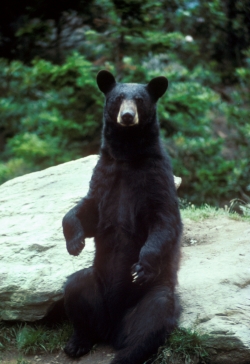
Click to view larger image of male Black Bear, Photo Courtesy US FWS, Mike Bender, Photographer
This Black Bear will retain heat
much better during hibernation
because it has a larger body
compared to the area of its outer
surface and it has thicker fur
compared to smaller animals
Photo Courtesy US FWS
Mike Bender, Photographer

Click to view the Mountain Chickadee, courtesy and copyright Stephen Peterson
Mountain Chickadee
Even though some small birds, like chickadees, may enter torpor,
they use almost all of their
energy stores each night.
Courtesy & Copyright
Photographer: Stephen Peterson

Hi, this is Mark Larese-Casanova from the Utah Master Naturalist Program at Utah State University Extension.

While I’ve mentioned how certain animals are well adapted to being active in winter, some choose to save their energy and sleep the winter away. Maintaining a constant body temperature in winter, when air temperature is relatively low, can require consuming great amounts of energy stores, such as fat. This can be especially difficult during a time of year when food is scarce.

Smaller animals especially struggle with heat loss because, relative to their body size, they have much more surface area from which they can lose heat. Compare a mouse to a bear- the bear will retain heat much better because it has a larger body compared to the area of its outer surface. Not to mention, a bear’s fur is much thicker than that of a mouse!

For certain animals, it makes sense to lower body temperature while being inactive so that they can conserve as much energy stores as possible. This can happen in several different ways. Sleeping for part of a daily cycle can conserve a little energy since body temperatures drop slightly during sleep. If air temperatures are particularly low and food is scarce, some animals will enter torpor, allowing their body temperatures to drop closer to air temperatures in order to save even more energy. An animal can be in torpor for just a night, or perhaps a few days. If it is able to store enough energy reserves and can survive a decrease in body temperature for longer periods, some mammals may enter deep torpor and hibernate for several weeks or months in the winter. During this time, the rate of energy consumption is just a small fraction of what it might normally be when the animal is active.

Body size and energy stores influence just how inactive an animal can be in winter. Some of our smallest mammals, such as shrews and mice, lose heat so readily and can store so little fat that they cannot afford to hibernate. They must always find food in order to survive. Even though some small birds, like the black-capped chickadee, may enter torpor, they use almost all of their energy stores each night. If they fail to replenish their fat reserves each day, they might not survive.

The true hibernators are the mid-sized mammals. While ground squirrels, jumping mice, and bats may hibernate for much of the winter, they occasionally wake up for a day or two of activity. Even larger mammals, including raccoons, skunks, and bears, don’t actually need to hibernate. Their body temperature drops just a little, and they are able to survive on their stored fat simply by sleeping.

So, while I sometimes envy the true hibernators on some of those cold winter days in Utah, I’m still thankful that I can adapt to winter and enjoy our great outdoors year-round.

For Wild About Utah, I’m Mark Larese-Casanova.

Credits:

Images: Courtesy US FWS and Stephen Peterson, Bridgerland Audubon Society

Text:     Mark Larese-Casanova, Utah Master Naturalist Program at Utah State University Extension.
Additional Reading:

Heinrich, B. (2009). Winter world: The ingenuity of animal survival. Harper Perennial.

Eckert, R., D. Randall, and G. Augustine. Animal physiology: Mechanisms and adaptations. W. H. Freeman and Company.


Snowy Owl Invasion

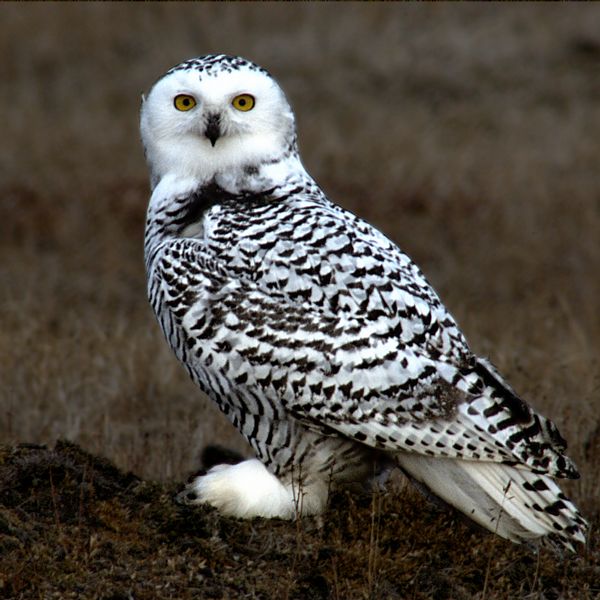
Click for a larger view of the tethered Snowy Owl, Bubo scandiacus, Image courtesy US FWS.  Ronald Laubenstein, Photographer
Tethered Snowy Owl in Alaska
Bubo scandiacus

Courtesy US FWS
Ronald Laubenstein, Photographer

Click for a larger view of Snowy Owl in Alaska, Bubo scandiacus, Photo taken in Alaska by Floyd Davidson, Photographer, Courtesy Wikimedia and licensed through GNU Free Documentation License 1.2Snowy Owl in Alaska
Bubo scandiacus

Courtesy Wikimedia
Floyd Davidson, Photographer
Licensed under the
Creative Commons: GNU Free Documentation License

Click for a larger view of Snowy Owl with chick, Bubo scandiacus, Photo taken by Tony Hisgett, Photographer, Courtesy Wikimedia and licensed through the Creative Commons: Attribution 2.0 Generic LicenseSnowy Owl with Chick
Bubo scandiacus

Courtesy Wikimedia
Tony Hisgett, Photographer
Licensed under the
Creative Commons: Attribution 2.0 Generic License

Click for a larger view of Snowy Owl in Alaska, Bubo scandiacus, Photo taken by Bert de Tilly, Photographer, Courtesy Wikimedia and licensed through the Creative Commons: Attribution-Share Alike 3.0 Unported LicenseSnowy Owl in Flight
Bubo scandiacus

Courtesy Wikimedia
Bert de Tilly, Photographer
Licensed under the
Creative Commons: Attribution-Share Alike 3.0 Unported License
Hi, I’m Holly Strand.

Maybe you’ve seen some headlines or blog titles this winter: Snowy owls invading the US or Scientists bewildered by mass migration of snowy owls from the Arctic.

What’s going on? The thought of bewildered scientists makes me uneasy. Should we be concerned or should we be delighted at the prospect of maybe seeing one of these ethereal birds?

A dramatic increase of a single species outside its usual habitat is called an irruption—that’s irruption with an “i” not an “e.” Snowy owl irruptions are usually attributed to periodic spikes in the population of their favorite snack—the lemming. In an a year with plentiful food resources, an owl can lay up to 10 or 11 eggs! Having lots of baby snowy owls in the nest forces the parents to hunt more. Eventually, the lemming supply crashes and by winter you have a large, hungry population of owls, some of which must disperse far and wide to search for food.

A rise and fall of lemming numbers likely did occur in 2011, causing a lot more snowy owls to move south. But is this year really as amazing as it seems? Consider: The number of people birding in 2001 grew 232 percent above the number involved in birding in 1983. And the total has grown still more over the last decade. More bird counters = more sightings. In fact, a single bird might be sighted and counted many times by these rapidly multiplying bird counters.

Furthermore, the counters–and even people who don’t count—are recording and storing all their personal bird sightings online. The most popular storage tank is a checklist program called eBird. Personal and group records in eBird are amassed together into a giant global database. Ebird uses this database to create figures, summaries and maps which are available to anyone. It’s eBird’s map of snowy owls that is being cited in blogs and newspaper articles. The map clearly shows a remarkable number of snowies decending upon the lower 48 especially in the Great Plains region. Everyone can agree that it’s a great year but still, you can’t help but question if the much higher counts are partly due to the spiraling rates of human counting and reporting.

Here in Utah there have been two recorded sightings this winter—one in the Bear Lake Valley and one on the causeway to Antelope Island. Not what I’d call an invasion, but these two sightings do represent the first ever records of snowy owls on Ebird. However, if you snoop around enough you’ll find there have been sporadic sightings in Utah dating back to 1908.

For pictures, sources and links go to WWW.Wildaboututah.org

For Wild About Utah, I’m Holly Strand.

Credits:

Images: Courtesy US FWS, Ronald Laubenstein, Photographer; and
Courtesy Wikimedia, Photographers: Floyd Davidson, Tony Hisgett, Bert de Tilly.
Text/Voice: Holly Strand

Sources & Additional Reading:

eBird [Accessed February 16, 2012]. Distribution and frequency map machine. https://ebird.org/ebird/map/snoowl1?&eyr=2012 and The Winter of the Snowy Owl (February 2, 2012) https://ebird.org/content/ebird/news/the-winter-of-the-snowy-owl

Kerlinger, P. and M. Ross Lein. 1988. Population Ecology of Snowy Owls during Winter on the Great Plains of North America in The Condor, Vol. 90, No. 4 pp. 866-874. URL: https://www.jstor.org/stable/1368844 [Accessed February 15, 2012]

Parmelee, David F. 1992. Snowy Owl (Bubo scandiacus), The Birds of North America Online (A. Poole, Ed.). Ithaca: Cornell Lab of Ornithology; Retrieved from the Birds of North America Online: formerly: https://bna.birds.cornell.edu/bna/species/010 [Accessed February 16, 2012]

Snowy Owl, Birds of the World, The Cornell Lab of Ornithology, Cornell University, https://birdsoftheworld.org/bow/species/snoowl1/cur/introduction

Utah Birds Rare Bird sightings in Utah https://www.utahbirds.org/RecCom/RareBirds3.htm#SnowyOwl[Accessed February 16, 2012]

Link to Youtube video “Snowy Owl Invasion” produced by the Cornell Lab of Ornithology: https://www.youtube.com/LabofOrnithology [Accessed February 16, 2012]

Alternate URL: https://www.youtube.com/watch?v=Ufkcx-UqljM&list=PLA20B4F3F9F421EC9

Webmaster picks:

Laura Erickson, The Owls of Harry Potter, https://lauraerickson.com/bird/Species/Owls/HarryPotter/HarryPotter.html

Snowy Owls swoop down from the arctic, Kristen Dahlgren, MSNBC, https://video.msnbc.msn.com/nightly-news/46228248#46228719

Photographer waited ‘long time’ for snowy owl to come back, MSNBC, https://video.msnbc.msn.com/nightly-news/46228248#46228248

Reaction to Snowy Owl “Wow”, MSNBC, https://video.msnbc.msn.com/nightly-news/46228248#46226508


Wilderness, Much Closer Than You Think

Wilderness, Much Closer Than You Think: Courtesy Wilderness.net and Copyright 2009 Cordell Andersen, Photographer
High Unitas Wilderness, Utah
Courtesy Wilderness.net
Copyright © 2009 Cordell Andersen, Photographer

Wilderness, Much Closer Than You Think: Courtesy Wilderness.net and Copyright 2011 Paul Gooch, PhotographerRed Butte Wilderness, Utah
Courtesy
Wilderness.net
Copyright © 2011 Paul Gooch, Photographer

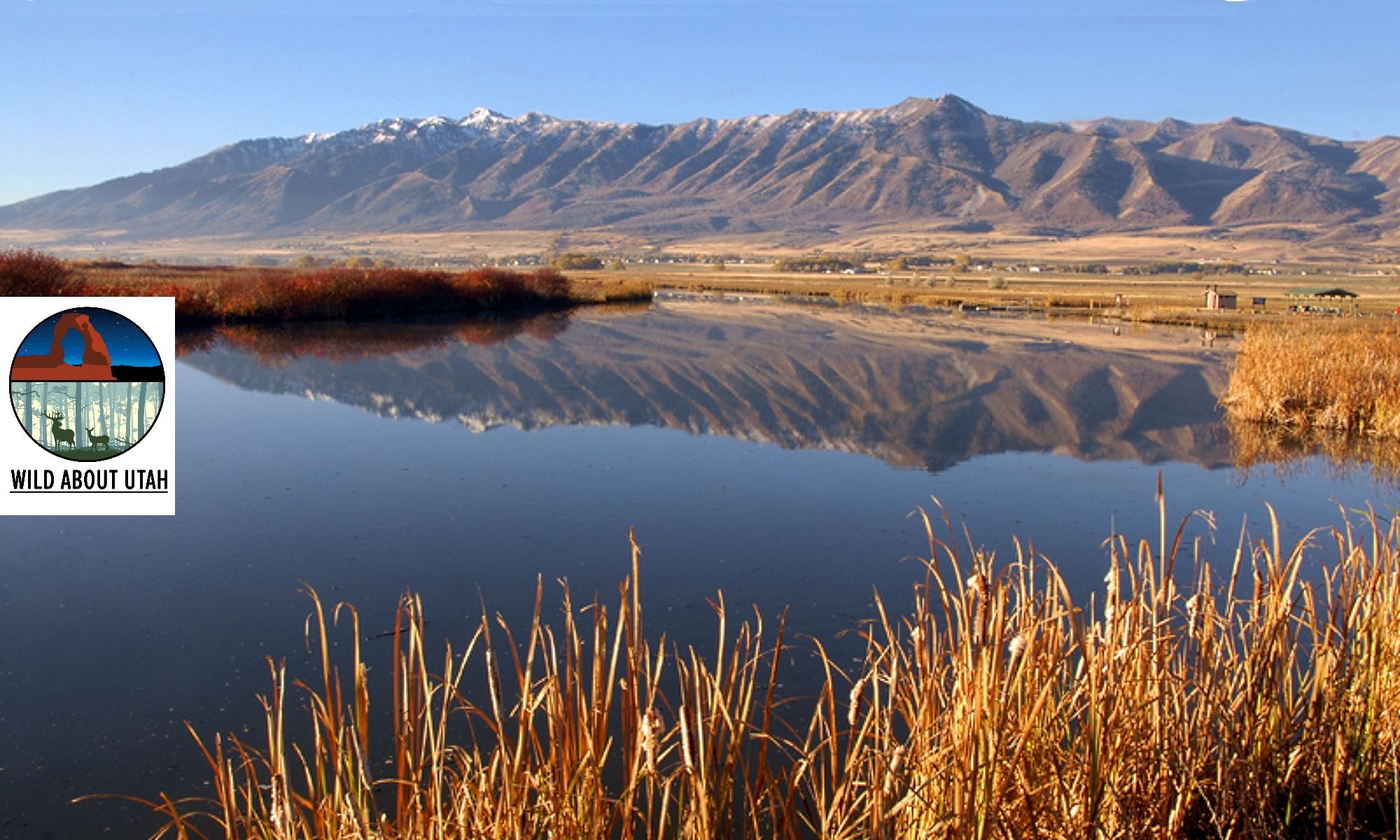
Courtesy Wilderness.net and Copyright 2011 Dusty Vaughn, PhotographerWellsville Mountain Wilderness, Utah
Courtesy Wilderness.net
Copyright © 2011 Dusty Vaughn, Photographer

Courtesy Wilderness.net and Copyright 2011 Mike Salamacha, BLM, PhotographerParia Canyon
Vermilion Cliffs Wilderness
Courtesy Wilderness.net
Copyright © 2011 Mike Salamacha, Paria Ranger, BLM, Photographer


The word conjures up romantic images of wide open landscapes teeming with birds, beasts, and plants. I imagine places untouched by human influence – truly wild and free. Places that are exotic and far away.

But wilderness exists much closer than you may think.

The United States Congress adopted the Wilderness Act with a nearly unanimous vote in 1964. Ours was the first country in the world to define and designate wilderness areas – lands valued enough to be set aside for the purpose of protection.

Currently, the Wilderness Act protects 757 individual wilderness areas across the United States – totaling more than 109 million acres. Thirty-three wilderness areas are found in Utah, and they protect a variety of unique landscapes from the red rock desert found in Red Butte Wilderness to the alpine forests of the High Uintas Wilderness. While the landscapes may look incredibly different from one wilderness area to the next, these lands share a number of qualities which can be described by adjectives such as peaceful, quiet, untouched, and pristine.

These areas protect some of the most unique and incredible landscapes that Utah has to offer, but that doesn’t mean they’re off limits. Our wilderness areas are just that – ours. They are public lands, accessible to anyone who wants to visit – so long as you tread lightly.

Areas that fall under its protection are described in the Wilderness Act as “lands designated for preservation and protection in their natural condition…” which “…shall be devoted to the public purposes of recreation, scenic, scientific, educational, conservation and historic use.” These amazing lands were set aside in 1964 with an eye to the future and because of it, should still be around for your grandchildren’s grandchildren to enjoy.

There is an ongoing effort to educate Americans about the immense value of preserving wilderness areas. For without education, they may one day be selfishly reclaimed and lost. One of these educational opportunities is coming to Logan on April 13th and 14th. The Arthur Carhart National Wilderness Training Center will be hosting a teacher training workshop in conjunction with the Stokes Nature Center and the Utah Society for Environmental Education. The workshop is aimed at teachers in grades 5-8, though anyone is welcome to attend. For more information, please contact the Stokes Nature Center at www.logannature.org

Not a teacher? The best way to learn about wilderness areas is to go visit one! Information, and photos of Utah Wilderness Areas, can be found at www.wildaboututah.org

For the Stokes Nature Center and Wild About Utah, this is Andrea Liberatore.

Credits:

Photos: Courtesy Wilderness.net, Steve Archibald, (Individual Copyrights noted)
Text:    Andrea Liberatore, Stokes Nature Center, logannature.org

Additional Reading:
The Arthur Carhart National Wilderness Training Center:
wilderness.net

Wilderness Investigations teacher training workshop:
logannature.org/wi_workshop

Public Law 88-577 a.k.a. Wilderness Act, Sept 3, 1964, U.S. Government Publishing Office: https://www.govinfo.gov/content/pkg/STATUTE-78/pdf/STATUTE-78-Pg890.pdf