Beavers: The Original Army Corps of Engineers

Beavers: The Original Army Corps of Engineers: Click for larger picture, Beaver with branch in water, Courtesy US FWS
Beaver with branch in water
Courtesy US FWS,
Steve Hillebrand, Photographer


Hi, I’m Holly Strand from Stokes Nature Center in beautiful Logan Canyon.

Beavers and beaver dams are a common feature of the Utah landscape. You’ll see the dams on smaller streams and side channels, constructed of branches, downed trees and mud. The still, deep water of the resulting pond creates ideal conditions for a beaver lodge. Beavers can escape and hide from predators by slipping into the pond and disappearing into the lodge. Beavers also use their ponds to cache their favorite
food—aspen and willow.

Because of their tree cutting and dam making skills, humans tend to have two divergent opinions of beavers: 60-pound nuisance or environmental engineer.

Click for larger picture, Beaver Lodge, Courtesy US FWS
Beaver lodge
Courtesy US FWS
Hans Stuart, Photographer

Beavers are considered a nuisance when they gnaw down trees that humans want to keep. Dams can flood roads or stop up irrigation canals. When beaver activity conflicts with human interests, they—the beavers–are likely to be trapped and killed.

However, beaver activity has many positive environmental consequences that we are just beginning to appreciate. Wetlands created by beaver dams help soak up sediments, improving downstream water quality. Because of beaver dams, the winter snowpack isn’t lost in a short spring pulse, This results in a more constant stream flow through the summer –and that’s important as Utah’s climate is predicted to become drier. Finally, beaver dams enhance habitat for many other fish and wildlife species and plants.

Click for larger picture, Beaver in pond, Courtesy US FWS
Beaver in pond
Courtesy US FWS
Steve Hillebrand, Photographer

According to Dr. Joe Wheaton, a geomorphologist at Utah State University, there’s a lot of untapped potential for employing beaver engineers in stream and floodplain restoration. Say you want to restore a stream by reconnecting it with its floodplain. You need to excavate channels, redirect stream flow, revegetate and nurture the
area for a long period of time. To accomplish this, you often need a
number of highly trained professionals and some large Tonka toys.

Alternatively –under the right conditions– you might transplant a
colony of beavers and let them apply their vigorous work ethic to your
landscape and get quite satisfying results.

Recognizing that nuisance beavers can be rehabilitated into hard
working wetland engineers and stream habitat restorationists, the Utah
Division of Wildlife Resources has rolled out the state’s first beaver
management plan in 2010. This plan encourages live trapping of entire
families of beavers in nuisance areas and moves them to specific sites where their
environmental services can be appreciated and put to use.

Click for larger picture, Beaver in snow, Courtesy US FWS
Beaver in snow
Courtesy US FWS

Thanks to the USU College of Natural Resources for supporting this Wild about Utah topic.

For Wild About Utah and Stokes Nature Center, I’m Holly Strand.

Credits:
Images:
Text: Stokes Nature Center: Holly Strand

Sources & Additional Reading


ARKive Images of Life on Earth, Information Sheet on Castor Canadensis (including some outstanding videos) https://www.arkive.org/ – (BBC Natural History Unit)

  • American Beaver – Overview
  • American Beaver in the Lodge with Young
  • American beaver felling trees and storing food for the winter
  • American beaver scaring moose away from its lodge
  • American beaver returning to its lodge with food

  • Collen, P. and R.J. Gibson. 2001. The general ecology of beavers (Castor spp.), as related to their influence on stream ecosystems and riparian habitats, and the subsequent effects on fish – a review. Reviews in Fish Biology and Fisheries 10: 439–461, 2001. https://web.archive.org/web/20230202160926/https://www.researchgate.net/publication/227028536_The_general_ecology_of_beavers_Castor_spp_as_related_to_their_influence_on_stream_ecosystems_and_riparian_habitats_and_the_subsequent_effects_on_fish_-_A_review [ Accessed May 1, 2010]

    Prettyman, B. 2009. Utah wildlife: Leave it to the beavers. Article in Salt Lake Tribune, October 16, 2009. https://www.sltrib.com/ci_13570110 [ Accessed April 29, 2010]

    Smithsonian Castor Canadensis Information Page https://www.mnh.si.edu/mna/image_info.cfm?species_id=32 [ Accessed April 29, 2010]

    Big Bend Habitat Restoration Project: A Natural Work of Heart, Open Spaces-A Talk on the Wild Side, US FWS, https://www.fws.gov/news/blog/index.cfm/2016/3/25/Big-Bend-Habitat-Restoration-Project-A-Natural-Work-of-Heart [Accessed March 31, 2016]

    Beaver Dams Strengthened by Humans Help Fish Rebound
    60-Second Science – July 25, 2016 – By Jason G. Goldman02:29 https://www.scientificamerican.com/podcast/episode/beaver-dams-strengthened-by-humans-help-fish-rebound/ Also available through the podcast https://itunes.apple.com/us/podcast/60-second-science/id189330872?mt=2

    Goldfarb, Ben, Eager: The Surprising, Secret Life of Beavers and Why They Matter, Chelsea Green Publishing, March 8, 2019, https://www.amazon.com/Eager-Surprising-Secret-Beavers-Matter/dp/1603589082/ref=asc_df_1603589082/

    Spider Silk

    Orb Spider Web
    Contains 3 Types of Silk

    Courtesy & Copyright 2011
    Terry Greene, Photographer

    Spider silk has long been of interest to scientists and engineers for its incredible strength. Silk can be, by weight, a stronger fiber than steel or Kevlar. But new research has discovered that the strength of the individual fibers does not explain the durability of a web, which can remain functional after sustaining extreme stress. The web’s overall design adds to silk’s durability to create a truly functional product.

    Spiders utilize silk for many different reasons – transportation, lining burrows, protecting and securing egg cases, and of course for catching prey. Amazingly, an individual spider has the ability to manufacture several different types of silk, which are used for different purposes. In a typical orb-style web there are at least three kinds of silk at work. One is strong and dry, making up the ‘spokes’ of the web. These are the strands upon which the spider itself moves around, so as not to get stuck in its own trap. The strands which create the characteristic spiral pattern are actually made of two types of silk – one is a fine, stretchy fiber, and the other a sticky, glue-like substance. Together, these two silks make up the part of the web responsible for snaring prey.

    Another important property of silk is that when stretched the fiber stiffens. As more pressure is applied, the properties of the silk change, allowing it to become stretchy and flexible. If still more pressure is added, the silk stiffens again, until finally it breaks. Originally, this stiff-stretchy-stiff response to stress was viewed as a weakness, but when analyzed as part of an interconnected web, that’s not the case. A team of scientists from MIT noted that webs could be subjected to a lot of force with only minimal damage. Whether the force was localized – for example while ensnaring a large insect – or more widespread over the entire surface – such as pressure from strong winds – the damage incurred by the web was minimal. Only the individual strands that endure the most pressure break, while others stiffen, flex, and remain intact.

    Localized damage allows the spider to more often than not simply repair a web instead of abandoning it and starting over. Creating silk and weaving a web is a costly process for a spider – it takes up a lot of the arachnid’s energy. The ability to simply patch the broken parts is a more efficient strategy which requires less energy expenditure and fewer materials than weaving a new web.

    Figuring out how to mimic this response to stress on a material could be infinitely useful in the human world. Imagine a skyscraper in an earthquake that fails in one small place where the forces are strongest – not in its entirety as is currently the case. That same earthquake-damaged building might also need only minimal repairs, saving time, money, and materials. Oh the lessons we could learn from one of nature’s smallest creatures…

    Thank you to the Rocky Mountain Power Foundation for supporting the research and development of this Wild About Utah topic. For the Stokes Nature Center and Wild About Utah, this is Andrea Liberatore.

    For the Stokes Nature Center and Wild About Utah, this is Andrea Liberatore.

    Credits:
    Images: Courtesy & Copyright 2011 Terry Greene
    Text:     Andrea Liberatore, Stokes Nature Center in Logan Canyon.

    Additional Reading:

    Chandler, David L. (2012) How Spider Webs Achieve Their Strength. MIT News Office. Available online at: https://web.mit.edu/newsoffice/2012/spider-web-strength-0202.html

    National Science Foundation press release (2012) A Spider Web’s Strength Lies in More Than its Silk. Available online at: https://www.nsf.gov/news/news_summ.jsp?cntn_id=123041

    Law, Steven (2012) Curious Things About Spider Webs. Available online at: https://www.ksl.com/?nid=968&sid=20488145

    Utah Paper Wasps

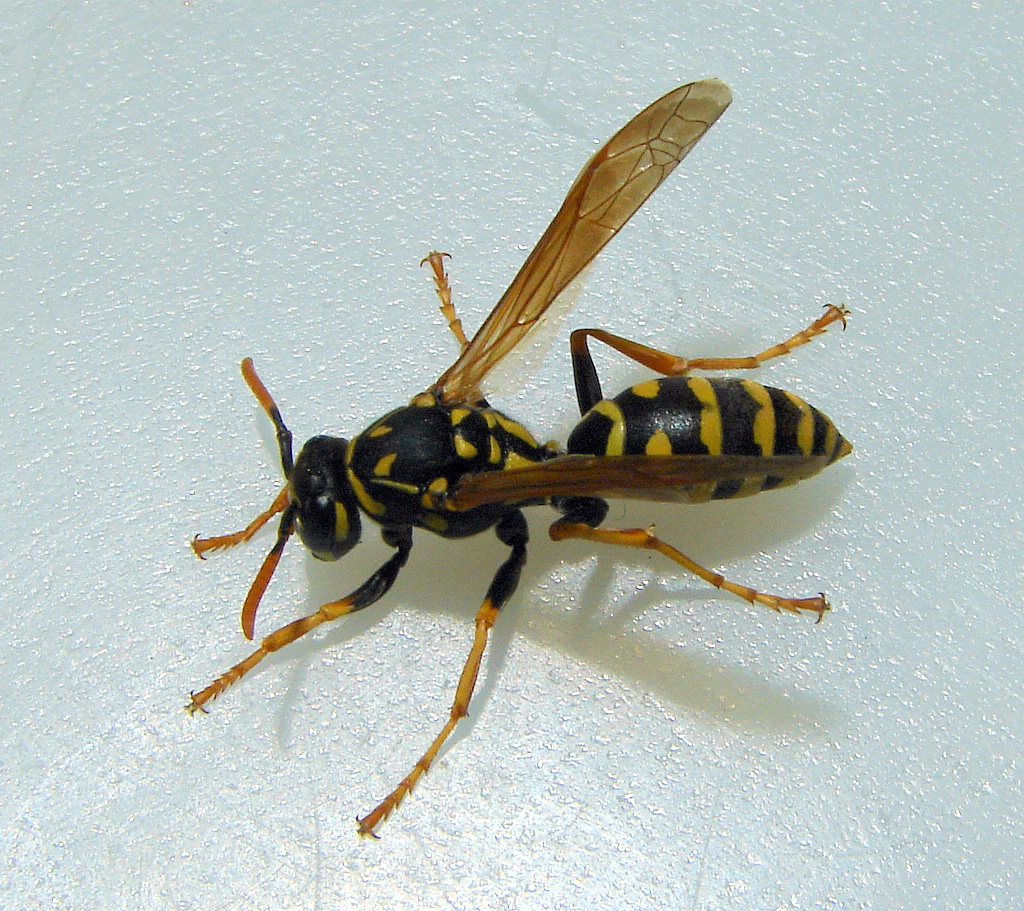
    Adult Poliste Paper Wasp, Courtesy and Copyright 2009 Jim Cane - All Rights Reserved
    Adult Poliste Paper Wasp
    Copyright © 2009 Jim Cane

    We credit the Chinese with inventing paper 2000 years ago, but some social wasps have been making their paper nests for eons. Species of paper wasps are found throughout Utah.

    The burly bald-faced hornet workers are patterned in black and white. They place their grey, basketball sized paper nests in tree branches.

    Bold yellow and black striped Yellowjackets are the persistent unwelcome guests at summer picnics. They too wrap their round nests in an envelope of paper, but typically place it in a shallow underground chamber. Within the paper envelope, both hornets and yellowjackets have a muti-tiered stack of paper honeycombs, like an inverted pagoda.

    Open-faced nest of Polistes  paper wasp with grub-like larvae, Courtesy and Copyright 2009 Jim Cane - All Rights Reserved
    Open-faced nest of Polistes
    paper wasp with grub-like larvae
    Copyright © 2009 Jim Cane

    Our most familiar paper wasps belong to the genus Polistes. These are the reddish-brown spindly looking wasps. They make their simple paper nests under your home’s roof eaves and deck railings. A Polistes nest consists of a single inverted paper honeycomb suspended from a stiff, short stalk. There is no paper envelope, so you can readily see the hexagonal paper cells. Around your yard, look for the workers scraping fibers from weathered wood surfaces. Workers mix the chewed fibers with saliva and water, carry the ball of wood pulp home, and add it to the thin sheets of their paper nest. The nest is their nursery, where you can see the queen’s tiny sausage shaped eggs and the fat white grubs. The grubs are fed by their sisters, the workers, who scour the surrounding habitat for insect prey or damaged fruit.

    The enclosed nest of the bald-faced hornet Copyright © 2009 Jim Cane - All Rights Reserved
    The enclosed nest of the
    bald-faced hornet
    Copyright © 2009 Jim Cane

    Utah has been invaded by the European species Polistes dominula. These interlopers are displacing our native Polistes. Where these European Polistes wasps are a stinging nuisance, you can easily dispatch them at their nests with a sprayed solution of dishwashing detergent and water. Thus stripped of its clever defenders, take the opportunity to admire their homes of paper.

    This is Linda Kervin for Bridgerland Audubon Society.

    Credits:

    Photo: Courtesy and © Copyright 2009 Jim Cane

    Text: Jim Cane, Bridgerland Audubon Society

    Additional Reading:

    https://extension.usu.edu/files/publications/factsheet/yellowjackets-hornets-wasps09.pdf

    https://ohioline.osu.edu/hyg-fact/2000/2077.html

    https://insects.tamu.edu/fieldguide/cimg348.html

    Wildfires in Utah

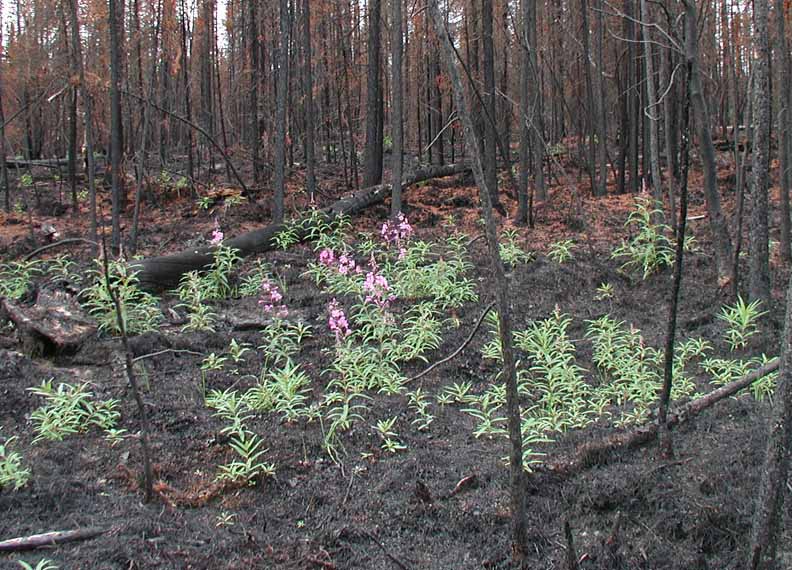
    Wildfires in Utah: Click to view larger image of Fireweed growing in burned area, Photo Courtesy US FWS, U.S. Fish and Wildlife Service
    Fireweed Grows in Burned Area
    Photo Courtesy
    U.S. Fish and Wildlife Service

    Hi, this is Mark Larese-Casanova from the Utah Master Naturalist Program at Utah State University Extension.

    Prior to settlement by the pioneers at the end of the 19th century, wildfires were relatively common throughout the mountains of Utah. Wildfires were a result of natural disturbance, such as lightning strikes, but many were purposely set by Native Americans. Wildfires restarted the cycle of forest succession and also created a mosaic of plant communities across the landscape.

    Although Utah’s changing climate has had a major influence, human factors have considerably altered the natural fire regime over the past 150 years. Fire frequency slowly declined prior to settlement by the pioneers due to a period of global cooling; however, fire activity increased considerably to its highest point during the settlement period between 1856 and 1909. This increase was linked to the dramatic growth in human population and activity, which lead to increased surface fuel from extensive timber harvesting, and inevitably to more ignition sources for more frequent fires.

    Between 1910 and 1990, there was a dramatic decline in wildfires throughout Utah, despite the gradual increase in global temperatures. This was due to intensive livestock grazing, habitat fragmentation as a result of development, agricultural expansion, and effective fire suppression. As a result, shade-intolerant trees that relied on fire for regeneration, such as aspen and lodgepole pine, were often replaced by long-lived, shade-tolerant trees, such as spruce and fir. In general, this resulted in a gradual decline in diversity of plant communities.

    As a result, more homogenous forests that are densely populated with trees and accumulated fuels are more susceptible to intense fires that burn hotter and are more difficult to control. In 2007, Utah had a record-setting fire season that burned over 629,000 acres, including the 363,000-acre Milford Flat Fire. We’re halfway through the fire season this year, and approximately 400,000 acres have burned in Utah, costing over $47,000,000 to control. Additionally, wildfires that have burned about three-quarters of the acreage this year were classified as large in size. It seems that increased temperatures, decreased snowpack, and a century of land use and management has resulted in a dangerous wildfire situation in Utah and much of the West. It will take some creative management strategies, such as sustainable timber harvesting or prescribed fires, to tackle this ongoing issue if we want to limit the risk and cost of larger and more frequent wildfires.

    For Wild About Utah, I’m Mark Larese-Casanova.

    Credits:

    Images: Courtesy U.S. Fish and Wildlife Service, images.fws.gov

    Text:     Mark Larese-Casanova, Utah Master Naturalist Program at Utah State University Extension.
    Additional Reading:

    Madany, M. H., and N. E. West. (1983). Livestock grazing-fire regime interactions within montane forests of Zion National Park, Utah. Ecology 64:661-667., https://www.jstor.org/discover/10.2307/1937186?uid=3739928&uid=2&uid=4&uid=3739256&sid=21100946519023

    Neugebauer, C. (Jul 15, 2012). Burning through money: the cost of Utah wildfires. Salt Lake Tribune., https://www.sltrib.com/sltrib/news/54485976-78/fire-fires-cost-costs.html.csp

    Utah Fire Info webpage: https://www.utahfireinfo.gov/

    Williams, J., D. Albright, A.A. Hoffmann, A. Eritsov, P.F. Moore, J.C.M. de Morais, M. Leonard, J.S. Miguel-Ayanz, G. Xanthopoulos, P. van Lierop. (2011). Findings and implications from a coarse-scale global assessment of recent mega-fires. 5th International Wildland Fire Conference. Sun City, South Africa., https://www.fao.org/docrep/014/am663e/am663e00.pdf

    Live Worldwide Network for Lightning and Thunderstorms in Real Time, Blitzortung, https://en.blitzortung.org/live_lightning_maps.php?map=30