Monarch Butterflies

Click to view a closer view of Andrea Liberatore's photograph of a Monarch butterfly (Danaus plexippus).  Courtesy and Copyright 2009 Andrea Liberatore, Photographer
Monarch Butterfly
Danaus plexippus
Courtesy & Copyright 2009
Andrea Liberatore, Photographer


Click to view a closer view of a Monarch butterfly caterpillar, (Danaus plexippus), Courtesy US FWS, images.fws.govMonarch Butterfly Caterpillar
Danaus plexippus
Courtesy US FWS, images.fws.gov

Click to view a closer view of a Monarch butterfly chrysalis (Danaus plexippus).  Courtesy NASA JPL, climate.nasa.gov, Plant a butterfly garden!, Climate Kids: Earth NowMonarch Butterfly Chrysalis
(Enlarged)
Danaus plexippus
Courtesy NASA JPL, climate.nasa.gov
Plant a butterfly garden!
Climate Kids: Earth Now


Click to view a closer view of Andrea Liberatore's photograph of Gene Nieminen's photograph of Monarch butterflies resting during migration.  Courtesy US FWS, Gene Nieminen, PhotographerA Rest Stop During the
Monarch Butterfly Migration
Courtesy US FWS, images.fws.gov
Gene Nieminen, Photographer

One sure sign that the end of the summer is near are the holes that appear in milkweed leaves this time of year. Take a peek underneath and you might find a great treasure – a chubby caterpillar boldly dressed in yellow, black, and white stripes.

We are currently playing host to two of these voracious larvae at the Stokes Nature Center, satiating their appetites with fresh milkweed leaves in the hopes of witnessing their transformation into a Monarch butterfly.

The incredible story of a Utah monarch begins in southern California in spring. After being dormant throughout winter, an adult female will rouse itself, mate, and begin flying. Monarchs are gliders, meaning they don’t flap their wings much when traveling. Instead they rely on thermal air currents to keep them aloft and moving – traveling up to 80 miles per day. The female flies until she finds habitat suitable for reproduction. There she will lay up to 400 eggs, exclusively on milkweed plants, which contain a toxin that makes caterpillars and adults inedible, or at least unpalatable, to predators.

Eggs of the second generation hatch in April or May. Larvae eat, undergo metamorphosis and keep traveling until they find an ideal place to mate and lay eggs. The adults then die within a few weeks. The third generation hatches in June and July, traveling still farther north and east. This group’s offspring, the fourth generation of the year, are the caterpillars and butterflies we are currently seeing. And this fourth generation does things a little differently.

Once in their adult stage, eating is priority number one. As temperatures turn cool, migration is triggered and the butterflies head for southern California, back to the same place from which their great-grandparents set out in spring. These butterflies live significantly longer than their parents and grandparents, for successful individuals will survive the winter, and start the entire four-generation process over again next year.

Much of a monarch’s migration remains a mystery, and not just how they know when and where to go, but also what routes they use, what habitats they need along the way, and how humans are affecting their movements.

A number of citizen science projects have been established to try and answer these questions. The Monarch Program monitors migration in the western U.S. each fall. Adults are fitted with a small, sticky tag on their right forewing with a color code specific to the tagging site. As these butterflies are spotted again either during migration or at their final destination, data is collected that can help us better understand their journey.

Recent declines in monarch populations make this research all the more important. You can help by cultivating milkweed in your garden to provide habitat to resident monarchs. Anyone with information on the location of caterpillars or chrysalises can contact local Monarch Program volunteer Ron Hellstern for tagging. For more information on tagging and how you can help monarch butterflies, visit our website at www.wildaboututah.org.

For the Stokes Nature Center and Wild About Utah, this is Andrea Liberatore.

Credits:

Images: Courtesy &
Copyright 2009 Andrea Liberatore
Courtesy NASA JPL, climate.nasa.gov
Courtesy US Fish and Wildlife Service,
images.fws.gov
Text:     Andrea Liberatore,
Stokes Nature Center in Logan Canyon.
For Information On Tagging:

The Monarch Program: https://www.monarchprogram.org

To tag butterflies found in Cache Valley, please contact Monarch Program volunteer Ron Hellstern at 435-245-9186. Please note that captive caterpillars or chrysalises are easiest to tag, as capturing adults can harm their wings.

Growing milkweed:

Monarch Watch, Propagation (Growing Milkweeds). https://www.monarchwatch.org/milkweed/prop.htm


Additional Reading:

Pyle, Robert Michael. 1981. National Audubon Society: Field Guide to Butterflies, North America. Alfred A. Knopf: New York.

Monarch Watch: Monarch Life Cycle. https://monarchwatch.org/biology/cycle1.htm

National Geographic: Monarch Butterfly (Danaus plexippus). https://animals.nationalgeographic.com/animals/bugs/monarch-butterfly/

NRCS Partners with Farmers, Ranchers to Aid Monarch Butterflies, Posted by Jason Weller, Chief, Natural Resources Conservation Service, on November 12, 2015, USDA Blog, https://blogs.usda.gov/2015/11/12/nrcs-partners-with-farmers-ranchers-to-aid-monarch-butterflies/

NRCS Working Lands for Monarch Butterflies, https://arcg.is/0TjueO

Sunflowers, the late summer feast

Sunflowers, the late summer feast: Click for a larger view of the sunflower garden. Image courtesy and copyright Jim Cane
Stand of ornamental sunflowers
in Cache Valley
Image courtesy and Copyright Jim Cane

Click for a larger view. Image courtesy and copyright Jim CaneHoney bee foraging at sunflower
Image courtesy and Copyright Jim Cane


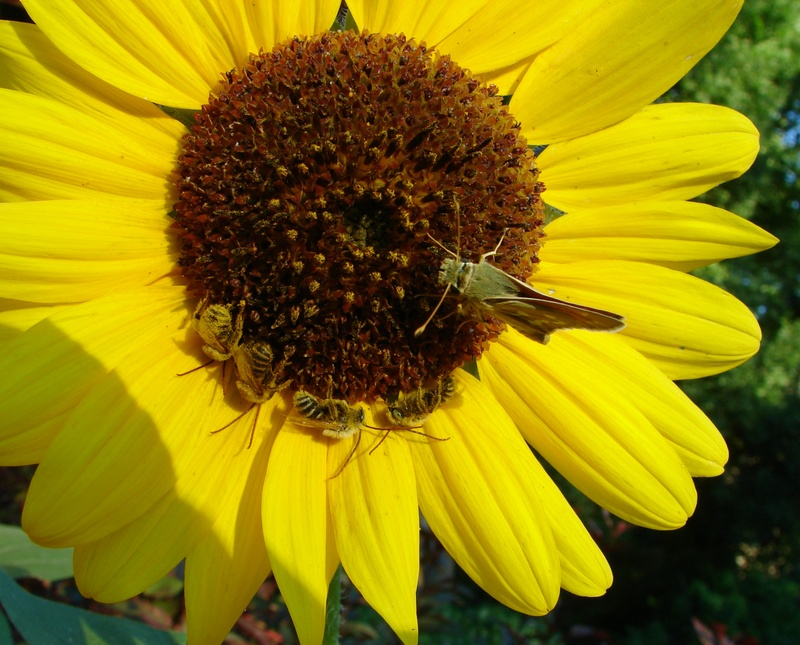
Click for a larger view. Image courtesy and copyright Jim CaneMale Melissodes bees and a skipper
butterfly sleeping on a sunflower at dusk
Image Courtesy and Copyright Jim Cane

Now, in late summer, the sunny golden blooms of sunflowers adorn gardens, roadsides and wild places across much of the United States. Utah is home to five sunflower species, four of them annuals. You are most likely to see Helianthus annuus, the aptly named “common sunflower”. Early domestication of common sunflower by Plains Indians led to the major oilseed crop that the world enjoys today.

Humans are not the only species seated at the sunflower dining table, however. The grub of one specialist weevil bores in sunflower stalks; as do larvae of 2 long-horned beetles. Another weevil hollows out the seeds. A third decapitates the flowerhead before ovipositing. One moth’s caterpillar gnaws the roots; several cutworm species topple seedling sunflowers, and several more kinds of butterfly caterpillars skeletonize sunflower leaves. In your garden, though, sunflowers generally escape pestilence. Chickadees and both American and Lesser Goldfinches cling to the ripe seed heads to pluck out the nutritious seeds. Listen for the plaintive call of the Lesser Goldfinch which is very distinctive.

[Lesser Goldfinch, Audio recording courtesy Kevin Colver, https://wildstore.wildsanctuary.com/collections/special-collections: Songbirds of the Southwest Canyon Country]

All those sunflower seeds are the direct result of pollination by bees. In the American West, more than 200 species of native bees visit sunflowers for nectar or pollen, a remarkably large fauna for any flower. None is more charming than the male of the bee genus Melissodes. They are discernible by their extra long antennae. Melissodes males dart among sunflowers all day long, seeking willing mates. Come sunset, the males bed down on the flower heads to snooze. They become drowsy enough to pet with your fingertip, and being males, have no sting. So if you have sunflowers at hand, chances are you have Melissodes bees around too. Look over your sunflowers this evening, and you may be lucky enough to find these dozing bachelor bees with their extra long antennae.

This is Linda Kervin for Bridgerland Audubon Society.

Credits:

Audio: Courtesy Kevin J. Colver, 7loons.com and On Amazon.com
Photos: Courtesy and Copyright Jim Cane
Text: Jim Cane, Bridgerland Audubon Society

Additional Reading:

LeBuhn, Gretchen, Greenleaf, Sarah, Cohen, David, The Great Sunflower Project, Department of Biology, San Francisco State University, https://www.greatsunflower.org/

Charlet, Larry D., Brewer, Gary J., Sunflower Insect Pest Management in North America, Radcliff’s IPM World Textbook, University of Minnesota, https://ipmworld.umn.edu/chapters/charlet2.htm

Gall Insects

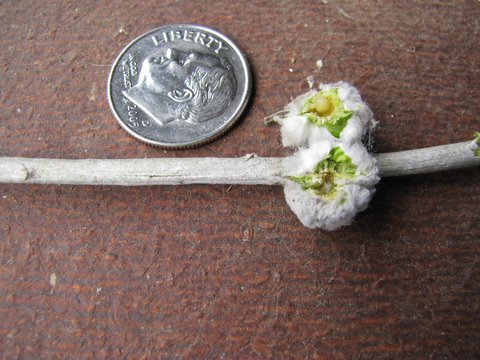
Gall Insects: Click to view Rabbit Brush Galls made by a tephritid fly (Aciurina trixa.) Image courtesy and copyright Jim Cane
Rabbit Brush Galls
made by a tephritid fly Aciurina trixa
Image courtesy and Copyright Jim Cane
Fly identification courtesy Gary Dodson

Does Utah have more Gauls than Caesar conquered? Certainly not Gaulish peoples of the ancient Roman Empire, but yes, galls of the vegetal kind we have aplenty. Galls are small protuberant growths on plants that are induced hormonally by insects, nematodes, and microbes. For its resident juvenile insect, the gall is a sort of edible fortress.

Some plant galls made by insects persist into winter, when they are more apparent to the naturalist’s eye. Looking at just rabbitbrush, you can find a menagerie of galls shaped like peas, pineapples and spindles that were formed from leaves, buds and stems. No growing tissue is immune to galling. The morphology of a gall is often diagnostic for the species of juvenile insect within. Gall-making insects are all tiny and include gall midges and tephritid flies, cynipid gall wasps, various nondescript moths, and any number of aphids and their kin.

One aphid causes the unsightly brown galls on branch tips of blue spruce, a bane to homeowners. Another aphid forms the pea-shaped galls that swell leaf petioles of aspens and cottonwoods. On sagebrush can be found a leaf gall whose soft surface surpasses that of a puppy’s ear. Oaks and willows host a remarkable diversity of galls. One oak gall was formerly used for tanning leather and making inks because it is rich in tannic acids. The Hessian fly is of grave agricultural importance today because its stem galls weaken wheat stems, causing them to lodge over.

Click to view Tephritid fly (Aciurina bigeloviae) galls on Rabbitbrush. Image courtesy and copyright Jim Cane
Tephritid fly Aciurina bigeloviae
galls on Rabbitbrush
Image courtesy and Copyright Jim Cane
Fly identification courtesy Gary Dodson

But these are exceptions; most galls are of little or no ecological or economic importance. For that reason, most galling insects remain understudied by all but a handful of passionate specialists. Finding plant galls is easy, and once you begin to notice them, you will find it hard to stop. There is no guide to Utah’s plant galls, but we list several starting references for you on our web site.

This is Linda Kervin for Bridgerland Audubon Society.

Credits:

Photos: Courtesy and Copyright Jim Cane
Text: Jim Cane, Bridgerland Audubon Society
Additional Reading:
Sagebrush Gall made by the fly Rhopalomyia pomum, https://bugguide.net/node/view/200946
Robert P. Wawrzynski, Jeffrey D. Hahn, and Mark E. Ascerno, Insect and Mite Galls, WW-01009 2005,
University of Minnesota Extension, https://www.extension.umn.edu/distribution/horticulture/dg1009.html

Click to view Willow Cone Gall Midge. Image courtesy and copyright Jim Cane
Willow Cone Gall Midge
Image Courtesy and Copyright Jim Cane

Field Guide to Plant Galls of California and Other Western States by Ron Russo
ISBN: 978-0-520-24886-1 https://www.amazon.com/California-Western-States-Natural-History/dp/0520248864
Gall, Wikipedia, Wikimedia Foundation, Inc., https://en.wikipedia.org/wiki/Gall (Accessed Dec 2010)
Gagné R (1989) The plant-feeding gall midges of North America. Cornell University Press, Ithaca
https://www.amazon.com/Plant-Feeding-Midges-North-America-Comstock/dp/0801419182

Phragmites-Utah’s Grassy Invader

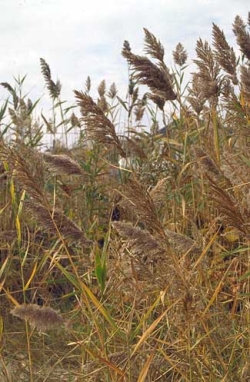
Invasive Phragmites
Phragmites australis
Photo Courtesy
Plant Conservation Alliance
Alien Plant Working Group
As found on
nps.gov/plants/alien/fact/phau1.htm
Photographers credited on Factsheet

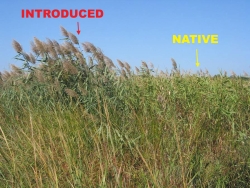
Invasive Phragmites vs. Native

Photo Courtesy
Plant Conservation Alliance
Alien Plant Working Group
As found on
nps.gov/plants/alien/fact/phau1.htm
See guide to distinguish
Invasive from Native plants
Photographers credited on Factsheet

Hi, this is Mark Larese-Casanova from the Utah Master Naturalist Program at Utah State University Extension.

When exploring wetlands, streambanks, and the shores of Great Salt Lake this time of year, it’s common to see tall grasses, over ten feet high, blowing in the breeze. While it is very abundant, the common reed known as Phragmites australis is anything but normal.

Phragmites was introduced from Europe over a century ago, and is now found in all 50 states and on every continent except Antarctica. It can grow to more than 15 feet in height, with long blade-like leaves. It flowers from July to October, producing dense, feathery clusters of small flowers that are purple while flowering and turn light brown after producing seeds. Each stem can produce up to 2,000 wind-dispersed seeds that are particularly effective at colonizing new areas. Because of this, Phragmites can take over a disturbed area quickly and prevent native plants, such as bulrush and cattail, from becoming established.

Like other invasive plants, Phragmites is successful at outcompeting native plants. Once a plant is established from seed, Phragmites spreads quickly through rhizomes, or underground stems, that can produce many additional stalks. While Phragmites may start growing among other wetland plants, it quickly outcompetes them for nutrients and sunlight. However, the native “Phragmites australis subspecies americanus” does not grow nearly as dense or tall, and tends to not be invasive.

Because introduced Phragmites can quickly grow into solid stands, it can greatly reduce plant diversity in wetlands, ultimately reducing the quality of wildlife habitat. Wetlands along the shore of Great Salt Lake are particularly important habitat for many migratory birds species, some of which occur here in the largest populations in North America or the world. The rapid takeover by Phragmites in these wetlands could eventually have dramatic impacts to the entire Great Salt Lake ecosystem.

In order to combat this threat, wetland managers have tried several methods for controlling or removing Phragmites, including spraying with herbicide, burning, livestock grazing, and mowing. Dr. Karin Kettenring, a Utah State University researcher, and her graduate students are currently studying the effects of several of these Phragmites control methods along the shores of Great Salt Lake. By experimenting with the timing of mowing and herbicide treatment, as well as covering mowed Phragmites with heavy black plastic, Dr. Kettenring and her team hope to find the most effective combination of treatments. With the continual conversion of native wetland habitats to a monoculture of Phragmites, Dr. Kettenring’s research is of particular importance to maintaining the health of the Great Salt Lake ecosystem- one of our state’s greatest natural wonders.

For Wild About Utah, I’m Mark Larese-Casanova.

Credits:
Images: Courtesy & Copyright
            Jil M. Swearingen, National Park Service, Center for Urban Ecology, Washington, DC
            Dr. Kristin Saltonstall, Adjunct Research Scientist, Horn Point Laboratory,
                  University of Maryland Center for Environmental Science, Solomon, MD
            Robert Meadows, Environmental Scientist, North DE Wetland Rehabilitation Program,
                  DE Mosquito Control Section, Newark, DE
            As found on https://www.nps.gov/plants/alien/fact/phau1.htm
Text:     Mark Larese-Casanova, Utah Master Naturalist Program at Utah State University Extension.


Additional Reading:

Evans K, Martinson W (2008) Utah’s featured birds and viewing sites: a conservation platform for Important Bird Areas and Bird Habitat Conservation Areas. Salt Lake City, Utah

Kulmatiski A, Beard KH, Meyerson LA, Gibson JR, Mock KE (2010) Nonnative Phragmites australis invasion into Utah wetlands. Western North American Naturalist 70:541-552

Long, A.L., C.M.U. Neale, and K.M. Kettenring. 2012. Management of Phragmites in the Great Salt Lake watershed. Final report to the Utah Department of Natural Resources, Division of Forestry, Fire & State Lands. 15 pp.