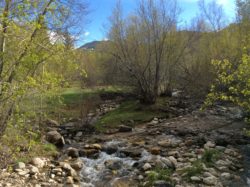
Clear Creek in the Spring Courtesy & Copyright Holly Strand, PhotographerSummer’s heat has turned on. It was evident in a dramatic fashion as I ran a ridge in N. Utah where the early am temps were near 70 degrees, flowers had faded, and the absence of bird song. As I descended to the canyon bottom the temperature dropped a solid 20 degrees and bird voices returned where yellow warblers were competing with lazuli buntings for top songster. I had entered the riparian, or river side biotic community- from the burnt brown of cheat grass above to the lush “green zone” below supporting abundant life in our desert state. I won’t be running ridge tops any time soon!
Throughout the Intermountain West and Great Basin, these givers of life are critical areas for water, wildlife, agriculture, and recreation. About 80 % of all animal life is dependent on stream side habit sometime during its life cycle. As a birder and botanist, this is where I spend much of my time documenting and enjoying the abundance.
On a recent, brief bird survey along the Logan River golf course trail, I recorded 33 species with another ten or so known to nest in this river corridor. I’m planning to prepare a bird checklist for golfers to add more “birdies” to their score card.
Many of these special places have been seriously degraded through invasion of exotic species, agricultural practices, various forms of development, and channelization. But help is on the way.
The Logan River Task Force is one excellent example. Launched in 2016, the task force is well on its way to restoring a much healthier, biologically rich river system. Replacing crack willow, a Eurasian non-native tree, with native cottonwood and willow accompanied by a rich understory of shrubs, will significantly enhance the biodiversity along the floodplain. Another major change is underway as they replace the straight, channelized portion of the river to its meandering original channel. This will create more pools for fish, wetlands for flood control and filtering, while improving aesthetics and recreation opportunity.
In an earlier WAU reading, I mentioned the good work being done by western boxelder ranchers reintroducing beaver whose dams will assist with maintaining stream flow and water quality along with improved fish and wildlife habitat. I’m aware of the same occurring on a Mink Creek ranch in SE Idaho.
The world appears to be awakening to the many values of these critical wildlife and water quality riparian zones, as I awoke to the same on my early morning run.
This is Jack Greene and I’m Wild about Utah!!
Credits:
Images: Holly Strand
Audio: Courtesy and Copyright Kevin Colver
Text: Jack Greene
Common Raven (Corvus corax) Bryce Canyon National Park Courtesy US National Park Service And found on Wikipedia I was three days downriver and hadn’t seen a soul since shoving my canoe away from the boat ramp outside of town. The only sounds accompanying my solitude were the white noise of rapid water and the echoes of thoughts pin-balling around my mind—that is, until the third morning when, stooped over the small, blue roar of my cook stove, I was startled by an unfamiliar sound. It was a dry heave and the snap of a twig to my imagination at first, before I turned on my haunches to face the raven. But when I saw its eyes reflecting my own, set within a Victorian ruffled collar of frosted ebony feathers, the sounds became a gesture, an announcement of the bird’s presence.
At first, it was only the eyes I could track—deep, watery, and of a midnight hue, darker even than the feathery blanket they peered through. I didn’t respond quickly enough, I suppose. The raven blinked first, hopped toward the cold charcoal of last night’s fire and scooped a piece into his beak—not intending to eat it I’m sure; there was no tilting of the head as to swallow it. And after the first unpalatable bit was cast aside, another was scooped and cast in the same fashion. Then another. Four or five times before I realized what the raven wanted—my oatmeal, of course. As I turned back to my stove, there came the sound again, an ‘Urp!’ and a click of the beak.
The languages of birds in general are vastly complex and nuanced. And the language of ravens is supreme among them. In the unassuming journal Psychology Today, Avian Einsteins blogger and bird author John Marzluff dissects the reasons why. “A complex social lifestyle, long lifespan, and songbird brain provide the motive and machinery a raven needs to remain the most eloquent of avian orators,” Marzluff explains. The clucks, trills, haaas, and quorks common among all ravens are, in and of themselves, amazingly contextual and referential, used in varying sequences and settings to convey different meanings. And according to Marzluff, “New, useful, and intriguing noises can be memorized…and imitated as near perfect renditions,” to be “incorporated into a growing and individual repertoire.” This capacity for continued song learning not only makes raven language one of the most complex in the Animal Kingdom, but it also allows them to engage us humans.
My raven had given up scattering charcoal chips across the sand and had taken to watching me spoon oatmeal into my mouth as I stared back at him. Sat atop my cooler, hunched against the cold, January wind blowing up the canyon, I must not have been a menacing sight to the raven. Every few seconds, it hopped several inches forward toward me and clicked its beak, just as it had done when we first met. Then came the ‘Urp!’ again.
I would relay this experience several weeks later to a colleague and teacher of avian ecology. “It’s a begging behavior,” he would tell me. I was starting to figure this out for myself that morning—however late. I could tell the raven was getting frustrated with me, my relative intelligence coming into question within those midnight black eyes.
Our eyes kept finding each other. Only then did the ‘Urps’ and clicks stop. I was clearly not the first of its human encounters, but this was the first acquaintance I’d ever formally made with a raven. It was both thrilling and unsettling. I thought of Poe, shuddered, and looked away, back to my breakfast which was finally getting cold. I didn’t look at the raven anymore.
He left in disgust, I think, with a parting scoff. I turned at the gesture’s remarkable humanity, a familiar emotion translated between species. And I swear, as he banked into the river bend, he turned his head to glare back at me with those watery midnight eyes.
I’m Josh Boling, and I’m Wild About Utah.
Credits:
Photos: Courtesy US FWS, US NPS
Sound: Courtesy ESA and Popular Culture via YouTube
Text: Josh Boling, 2017, Bridgerland Audubon Society
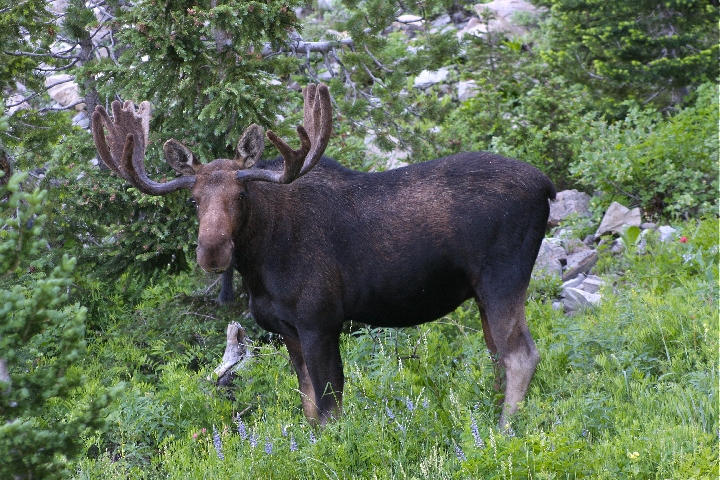
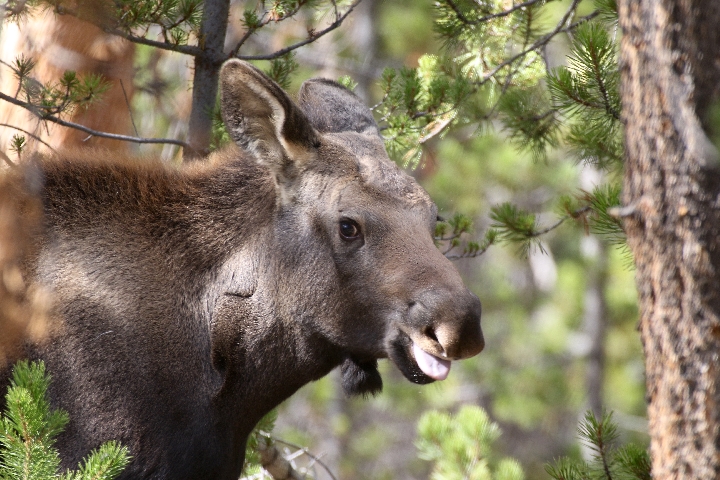
Shiras Moose Cow in Northern Utah Courtesy & Copyright Sam RobertsonIn the early 1900s, moose began expanding south into Utah from Wyoming.
This moose sub-species was named in honor of [Congressman] George Shiras III who explored Yellowstone in the early 1900’s and found large numbers of moose.
The Shiras (Shy-ras) moose is the smallest sub-species and occupies the southern-most moose habitat. Specific to the southern Rocky Mountains, the population extends from the bottom of British Columbia, Canada to Colorado.
For the past 100 years, Utah’s Shiras moose population has fluctuated, peaking at 3,500 in 2005. The number has now stabilized at about 2,700.
Dan MacNulty, associate professor in the Department of Wildland Resources in the Quinney College of Natural Resource at USU, and his research team, joined with the Utah Division of Wildlife Resources (DWR) to identify what threatens Utah’s moose population, and then work together to ensure the herds remain stable.
The condition of a moose herd is highly dependent on the health of its adult females, hence, this has been the focus of their research.
Shiras Moose Cow & Calf Courtesy & Copyright Sam RobertsonIn May or June, the females begin having their calves. The calves remain with their mothers for a full year. If the mother is expecting, she’ll chase the yearling off before the new calf arrives.
Once the yearling has left, the mother begins searching for secluded thicket to have her calf. Usually the thicket is so dense, a hiker walking by would never know the mother and calf are nearby.
The female moose will stay in the thicket with her calf until its strong enough to walk by her side. Unlike deer, who hide their young while they graze, moose keep their calves in sight.
Shiras Moose with Moose Ticks
Courtesy & Copyright Sam RobertsonOne threat, neither the mothers nor calves can hide from – is the winter tick, also known as the moose tick since moose are its preferred host. Deer and elk are able to keep most ticks rubbed off. The winter tick is not prone to pester humans.
Sam Robertson, USU graduate student in MacNulty’s lab explains, “They are a one-host tick and will remain on the same animal during all three stages of the tick’s life.”
In the late summer, the winter tick larvae climb up blades of grass, or other vegetation, and wait for a moose to walk by. When it does, the ticks will jump on, take hold, and stay latched on to the moose for its blood meals and growth until early spring when the tick falls off. By this time, the female moose is at her weakest – likely due to lack of food and tick load.
Kent Hersey, Big Game Projects Coordinator for DWR, explains, “In April, [after the long winter of using their fat stores] the female moose are usually in their worst possible condition. Hopefully they’ll find enough green vegetation to regain energy to help the calf’s growth in its last trimester, and produce sufficient milk reserves.”
To monitor females and calves in 2017, GPS collars were fitted on 80 adult females and 26 6-8 month old calves.
The data from the Wasatch herd indicated that, “The average tick load for adult females who lost their calves within the first couple of days after birth was almost double the average tick load.”
Monitoring of mother moose and calves will continue through 2018 to see how tick abundance changes from year to year.
Once the multi-year tick data are gathered and analyzed, the researchers and managers hope to begin searching for management methods to decrease the tick loads on moose – which in turn, will enhance the stability of Utah’s Shiras Moose population.
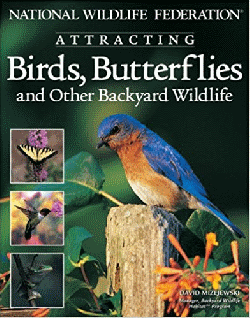
Attracting Birds, Butterflies and Other Backyard Wildlife National Wildlife Federation 2004 Cover Courtesy and Copyright Creative Homeowner a.k.a Fox Chapel PublishingAs human populations increase, and construction developments overtake agricultural land and wildlife habitat, some people may feel as if there is little hope for local connections to nature. Don’t raise the white flag of surrender. There is much you can do in your own yards to help attract wild songbirds and butterflies.
The simple answer is to keep things in line with restoring their natural habitat by providing food, water, shelter and places to raise their young.
The best way to restore, or maintain, a successful and healthy ecosystem is to utilize “native” plants. Natives are basically the plants that would grow in the area naturally. Although some exotic transplants from other locations can be stunning to look at, and may even grow successfully in a new environment, wildlife may not be able to adapt to its use as food or shelter. In fact, those foreign plants may actually spread and push out native plants and prevent songbirds and pollinators from entering your yard. Some of them also carry diseases for which our native plants have no immunity.
Scientific studies have proven that having a diversity of plant species in an area improves the health of all those plants…..if they are natives to that locale. And healthy plants provide healthy benefits for wildlife and people. Westerners should reconsider the idea of having a monoculture lawn of Kentucky Bluegrass that is so common in the Eastern parts of the U.S.
What are some factors that determine which native plants will succeed in your area?
Learn about the elements and nutrients in your soil by using simple soil-test kits which can be purchased at Garden Centers.
Can you obtain plants that will succeed in natural soils, or will you have to supplement it with chemical fertilizers? Are you willing to deal with the potential effects of additional chemical use?
Some plants require mostly sunny areas, some shady, and some a combination of both.
What is the climate like in your locale? Don’t confuse this with weather. Climate is the average condition of a place for twenty years or more.
What is the normal precipitation pattern? Will you have to supplement that with irrigation? Can you afford that if your area is suffering from drought conditions?
Make certain that you check the cold-hardiness zone of plants you purchase. Some commercial retail stores will sell whatever they are shipped, often knowing that those plants will never survive in your area.
For a list of Utah native trees, shrubs, and flowers, research:
* Utah Native Plant Society at unps.org
*Utah State University Extension Center for Water-Efficient Landscaping at cwel.usu.edu
Creating Landscapes for Wildlife… A Guide for Backyards in Utah, Written by Sue Nordstrom and Illustrated by Kathlyn Collins Department of Landscape Architecture and Environmental Planning, Utah State University with Margy Halpin, Utah Division of Wildlife Resources; Second Printing 2001,
Updated for the Utah Division of Wildlife Resources, by Frank Howe, DWR Avian coordinator; Ben Franklin, DWR–Utah Natural Heritage Program botanist; Randy Brudnicki, DWR publications editor; and landscape planning illustrations by Stephanie Duer.,
Published by:
State of Utah Natural Resources, Division of Wildlife Resources,
Utah State University Cooperative Extension Service and
Utah State University Department of Landscape Architecture and Environmental Planning;
1991 updated 8/2025 https://wildlife.utah.gov/pdf/landscapingforwildlife.pdf