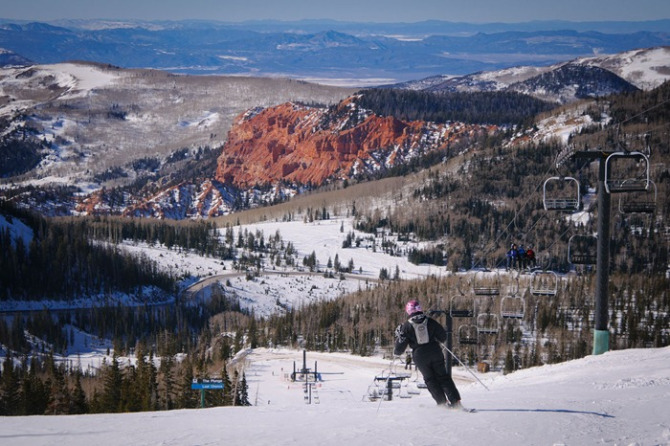

Photo from 1989 Utah History Fair
Courtesy & Copyright Shannon Rhodes
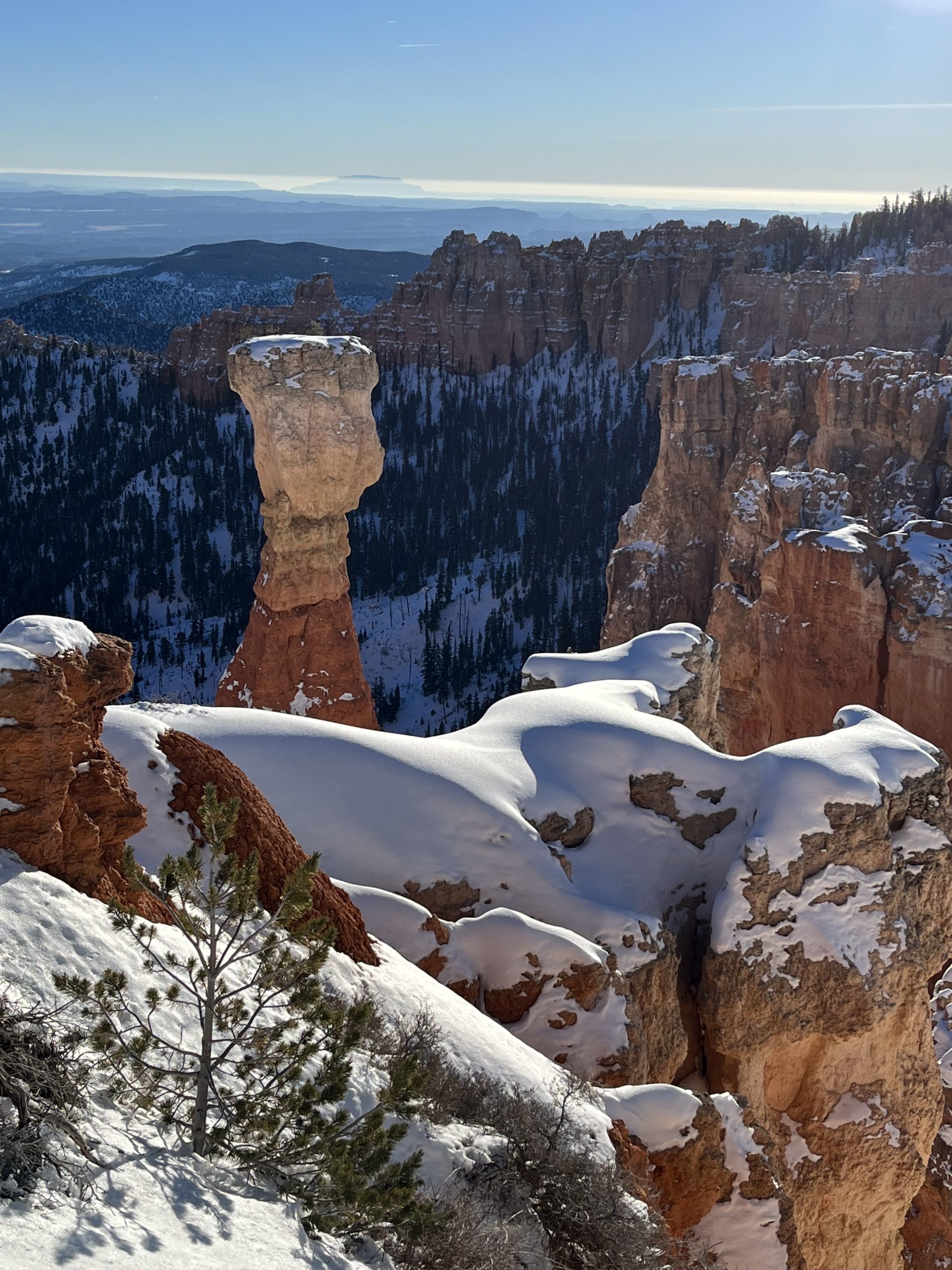 Snow-frosted Hoodoos of Bryce Canyon
Courtesy & Copyright Shannon Rhodes, PhotographerSnow. Tiny specks of dust and other particles in the air that attract water vapor to become ice crystals. That is what fascinated a man named Wilson ‘Snowflake’ Bentley enough to capture thousands of one-of-a-kind snowflake photographs and what drew my friend Alf to Utah. In the winter and early spring of 1989, I sat as a Bonneville Junior High ninth grader with Alf Engen in his office at Alta. As a presenter at the Utah History Fair that year, I was gathering stories and artifacts for my project titled Utah’s Winter King: A Key Individual in the History of Utah’s Ski Industry.
Engen shared stories about building ski jumps over the fences between his home and school and his journey from Norway to America, not to ski but to buy back the Engen estate divided up at his father’s death of the Spanish Flu in 1919. He said, “I was going to make enough money to go back, but I didn’t know how I was going to do that. I didn’t even know there was much snow here, I never read about that.” After sharing stories about arriving in Ellis Island, playing soccer in Milwaukee, scaffold hill jumping on Ecker Hill, and cross-country skiing as a forest service employee over Catherine Pass to imagine Alta as a ski hub, he ended with how he felt about jumping Utah’s snow: “They would say “Send Gummer–that is ‘old man’ in Norwegian–over first,” and I would have to do anything new. I knew I could do it, even if I had never tried it before. Once you are up there, you can fly.”
I had forgotten about that experience chatting about snow with a Utah snow giant until a few weeks ago, gazing out at the snow-frosted hoodoos of Bryce Canyon. I gripe about snow plowing piles and delayed-start school days, and I’d rather cut snowflakes from paper than be out in it most frigid days. Yet, this Christmas a friend gave me a blue and white book titled “The Little Book of Snow.”
For someone who grew up in “the greatest snow on earth,” I thought I knew snow well enough, but in addition to discovering linguistic similarities for the word snow and that some have estimated the number of snowflakes that fall to earth each year to be a number with at least 24 zeroes, I confirmed my suspicions about snow that is not white. I’ve often encountered pink snow patches at the high altitudes of Utah, and with a nudge from the watermelon snow paragraph, I found an intriguing citizen science opportunity online called The Living Snow Project led by Dr. Robin Kodner at Western Washington University. By contributing data about spring snow algal blooms through sample vials or at least observation photographs, scientists can study microscopic snow communities and their impact on snow melt.
Snow. When I asked him what about Utah made him stay, Alf Engen said, “Why, it was definitely the snow.” Snow is the stuff of which stories, science, and wonderful dreams are made.
I’m Shannon Rhodes, and I’m wild about Utah.
Credits:
Images: Courtesy & Copyright Shannon Rhodes, Photographer
Audio: Courtesy & © Friend Weller, https://upr.org/
Text: Shannon Rhodes, Edith Bowen Laboratory School, Utah State University https://edithbowen.usu.edu/
Additional Reading Links: Shannon Rhodes
Additional Reading:
Blanchard, Duncan. 1970. The Snowflake Man. https://snowflakebentley.com/snowflake-man-bio
Coulthard, Sally. 2018. The Little Book of Snow. https://www.chroniclebooks.com/products/the-little-book-of-snow
Engen, Alan K. 2001. Alf Engen: A Son’s Reminiscences. https://issuu.com/utah10/docs/uhq_volume69_2001_number4/s/10191712
Greene, Jack. 2020. I Love Snow. Wild About Utah, https://wildaboututah.org/i-love-snow/
Larese-Casanova, Mark. 2014. Utah’s Rich Skiing History. Wild About Utah, https://wildaboututah.org/utahs-rich-skiing-history/
Libbrecht, Kenneth G. 1999. Guide to Snowflakes. https://www.its.caltech.edu/~atomic/snowcrystals/class/class-old.htm
Liberatore, Andrea. 2011. Snowflakes. Wild About Utah, https://wildaboututah.org/snowflakes/
Living Snow Project. https://wp.wwu.edu/livingsnowproject/
Local Lexi. 2021. The History of “The Greatest Snow on Earth” https://www.skiutah.com/blog/authors/lexi/the-history-of-the-greatest-snow-on.
Martin, Jacqueline Briggs. 1998. Snowflake Bentley. Boston: Houghton Mifflin. https://www.amazon.com/Snowflake-Bentley-Jacqueline-Briggs-Martin/dp/0547248296
Strand, Holly. 2009. A Utah Skier’s Snow Lexicon. Wild About Utah, https://wildaboututah.org/a-utah-skiers-snow-lexicon/
Rascoe, Ayesha. 2022. Why Snow Is Turning Pink at High Altitudes. https://www.npr.org/2022/12/18/1143929924/why-snow-is-turning-pink-at-high-altitudes
Weller, Kristine. 2023. In a State Obsessed with Snowpack, Finding Pink Snow in Utah Is a Problem. https://www.kuer.org/health-science-environment/2023-01-03/in-a-state-obsessed-with-snowpack-finding-pink-snow-in-utah-is-a-problem