Kokanee Salmon in Utah

Edith Bowen third graders watch Kokanee Salmon in Cinnamon Creek Courtesy and Copyright Josh Boling
Edith Bowen third graders watch Kokanee Salmon in Cinnamon Creek
Courtesy and Copyright Josh Boling
It’s a cool crisp morning as my Edith Bowen third graders disembark their mini buses at Cinnamon Creek Campground and sprint for the water’s edge. We’re here to witness an animalian rite of passage as old as evolutionary time: the Salmon Run.

Kokanee Salmon in Cinnamon Creek Courtesy and Copyright Josh Boling
Kokanee Salmon in Cinnamon Creek
Courtesy and Copyright Josh Boling
Utahns flock to reservoirs and their adjacent streams all over the state in early autumn to watch as salmon- adorned in their fiery red spawning attire- depart their placid range waters en route to their natal homeland. It’s an extraordinary feat of endurance. The salmon, once they start, will not rest or eat for the duration of their journey upstream. We have Kokanee Salmon here in Utah, brought from the far reaches of the Pacific Northwest. ‘Kokanee’ is an Okanagan word used to refer to landlocked populations of Sockeye Salmon. Unlike their ocean-dwelling cousins, Kokanees will spend their entire lives in fresh water, trading the unattainable ocean swells for a more placid existence in inland lakes. I’ll let Blake explain how it happened. “A long time ago, some Sockeye schools got separated from one another- possibly when mountains formed, large bodies of water shrank, or some fish decided to try something new. This caused some Sockeye to be cut off from the ocean. However, all Sockeye Salmon, including Kokanees, will return to the same freshwater streams where they were born.” In the case of our fish, they are travelling from Porcupine Reservoir, in East Canyon at the southern end of Cache Valley, upstream to nesting sites along the East Fork of the Little Bear River.

And when they return, it is an impressive sight to behold! Salmon is a word derived from the Latin salmo, itself a possible derivative of salire, meaning “to leap.” And leap they do! Over beaver dams and waterfalls, rock outcroppings and logjams in order to make their way upstream. Salmon are well-known for their acrobatics even when they aren’t attempting to scale a turbulent obstacle course, and scientists are really at a loss as to why. “Some people think the salmon jump out of the water to clean parasites from their gills and scales. Others say they jump because their bodies are changing, or because they’re agitated. I think it’s because they want to get to a shallower area so they can lay their eggs.” It’s quite clear to Aspen why the fish are breaching the water today. They have places to be and evolutionary duties to fulfill.

The salmon run is a coming-of-age ritual of sorts wherein mature adult Kokanee Salmon, usually around the age of three to five years old, vie for the privilege of reproduction. For salmon, reproduction is a taxing stage of life. Their bodies morph and change colors- the males much more so than the females; social hierarchies can break down entirely as a result of competition to breed; and females may lay eggs in as many as three to five different nests, known as redds, before tirelessly defending their progeny until the very end.

During our excursion along the Little Bear River, students were able to see both the beginning and the end of the Kokanee life cycle. Adjacent to the spawning redds where the next generation lay incubating, there were several mature adults seen wavering in their task, their scales turned gray from age and exhaustion. One departed salmon washed up on the river bank, causing quite a stir amongst the young researchers gathered there.

The salmon run is a fascinating and poetic scene to witness. In their last grand gesture to the perpetuation of life, the spawning Kokanee admirably fulfill their evolutionary duty, and pass from this world to whatever is next for such an elegant fish.

Writing and reading for Wild About Utah, I’m Josh Boling.

Credits:
Photo: Courtesy & Copyright Josh Boling
Text: Josh Boling

Sources & Additional Reading

Strand, Holly, Kokanee Salmon, Wild About Utah, October 7, 2008 https://wildaboututah.org/kokanee-salmon/

Strand, Holly, Kokanee Life Cycle, Wild About Utah, September 19, 2013, https://wildaboututah.org/kokanee-life-cycle/

Fifield, Laurie, Kokanee Salmon at Cinnamon Creek, YouTube, Sep 13, 2013, https://www.youtube.com/watch?v=Hcs6LK-O5Pg

See red spawning kokanee salmon, Sept. 16, 2017 is Kokanee Salmon Viewing Day at Strawberry & Sheep Creek, Strawberry Reservoir, Wildlife News, Utah Division of Wildlife Resources, https://wildlife.utah.gov/wildlife-news/2095-see-kokanee-salmon-at-strawberry-reservoir-2.html

Little Bear River/Porcupine Reservoir Salmon Run, Josh1990, The Trek Planner, Sept 17.2017, https://thetrekplanner.com/little-bear-riverporcupine-reservoir-salmon-run/

Ross, Crystal, Where to see Utah’s spawning kokanee salmon, Wildlife Blog, Utah Division of Wildlife Resources, August 29, 2019, https://wildlife.utah.gov/news/wildlife-blog/755-where-to-see-utah-s-spawning-kokanee-salmon.html
Greater Sage Grouse Recovery

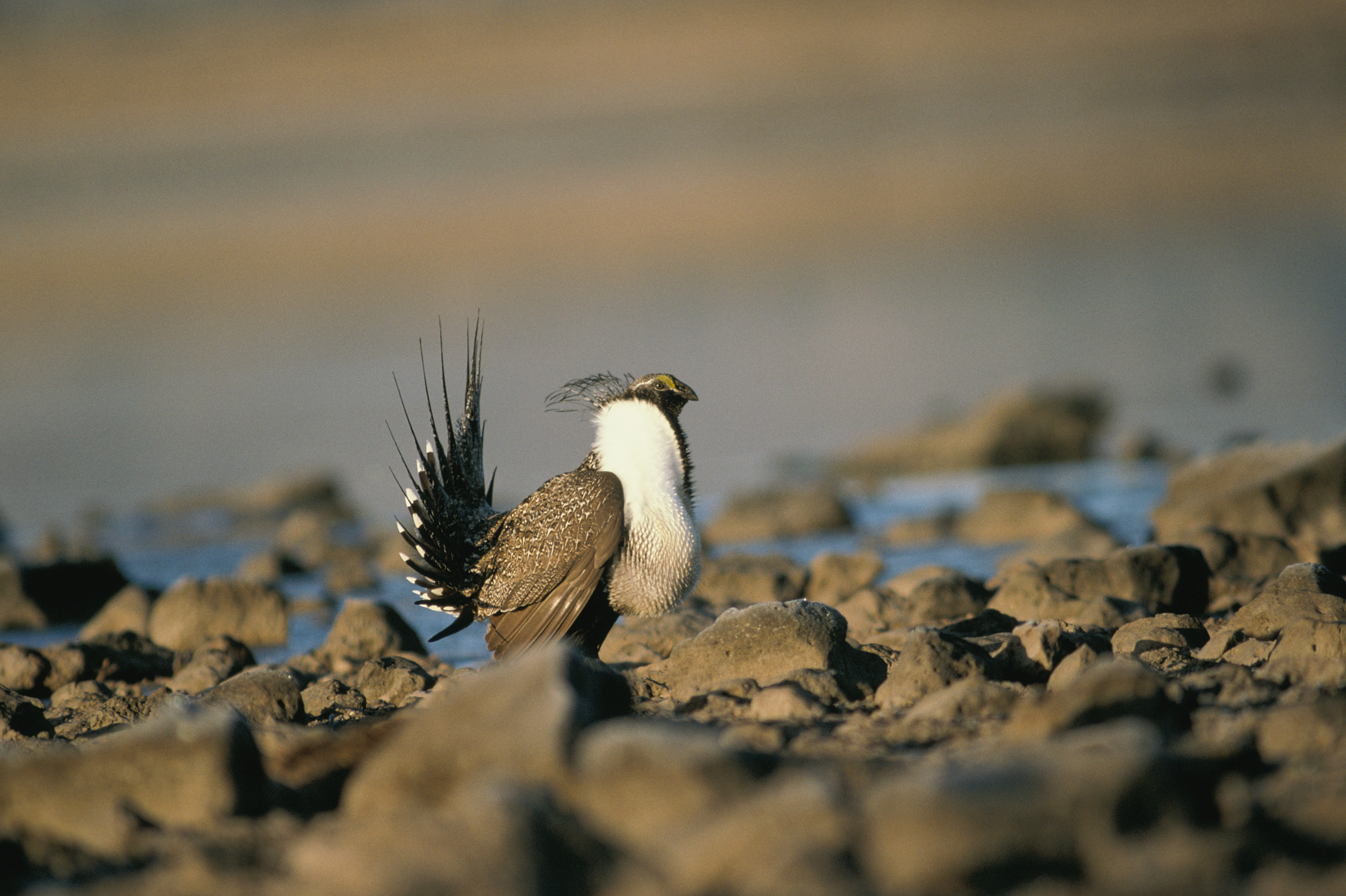
Greater Sage Grouse Recovery: Sage grouse standing in profile on rocky lake shore Courtesy US FWS Dave Menke, Photographer
Sage grouse standing in profile on rocky lake shore
Courtesy US FWS
Dave Menke, Photographer
So what happens when you get a bunch of ranchers together with a bunch of scientists and agencies? I found the answer as I attended a meeting in a remote part of western Boxelder County a few evenings ago. I was pleasantly surprised to discover much good for both wildlife and people.

This was a formal meeting under the auspice of the West Boxelder Conservation Resource Management (CRM) Group targeting greater sage grouse recovery. It was a very informative meeting covering everything from juniper forest removal, prescribed burns, and reseeding to enhance range for cattle, birds, and wildlife.

I learned that due to wildfire suppression which is essential to maintaining healthy range conditions, juniper forests have replaced thousands of acres of grasses, forbs, and sage steppe communities. I was also informed that pinyon pine will be preserved honoring Native American traditions which is central to their culture and diet. In addition to this work, the group addresses general rangeland condition and invasive species.

The CRM is planning wetland and riparian improvements that will provide resting, feeding, and nesting sites for migrating birds. Fencing has been put around key springs and off-site water sources have been developed. The reintroduction of beaver to the stream will help the extremely limited water supply by slowing the spring water runoff, stabilizing the stream banks, and raising the water table.

There was a lively exchange regarding a paper published in a respected science journal by USU authors addressing grazing impacts on grouse populations. The Greater Sage Grouse has become a species of special concern due to plummeting populations, and is considered an umbrella species being its recovery should be paralleled by other sensitive faunal species.

A statement in the papers abstract “Our meta-analysis revealed an overall negative effect of livestock grazing on grouse populations.” raised some red flags with the ranching community. Reading further, this study was conducted on a different grouse species in the U.K. There appeared to be a peaceful resolution to this concern and agreement that future abstract wording would get more scrutiny before published.

I also learned the verdict is still out on grazing impacts on the greater sage grouse. Intense research is underway in the CRM attempting to find answers. My prediction is with all of the range restoration activity combined with well managed grazing will eventually result in higher grouse populations.

This good work has not gone unrecognized. In 2016, the West Boxelder CRM was presented with the Sage Grouse Habitat Stewardship-Collaborative Award from the BLM as an ideal example of a community-based land stewardship organization that is committed, engaged, and active across land ownership boundaries. A tip of the hat to all interests on this remarkable effort!

This is Jack Greene writing and reading for Wild About Utah

Credits:

Pictures: Courtesy US Fish & Wildlife Service, Dave Menke, Photographer
Text: Jack Greene, Bridgerland Audubon Society

Additional Reading:

Community Based Conservation Plan, https://utahcbcp.org/localworkinggroups/WestBoxElder-WBECRM/westboxelder

Trout vs. Chub

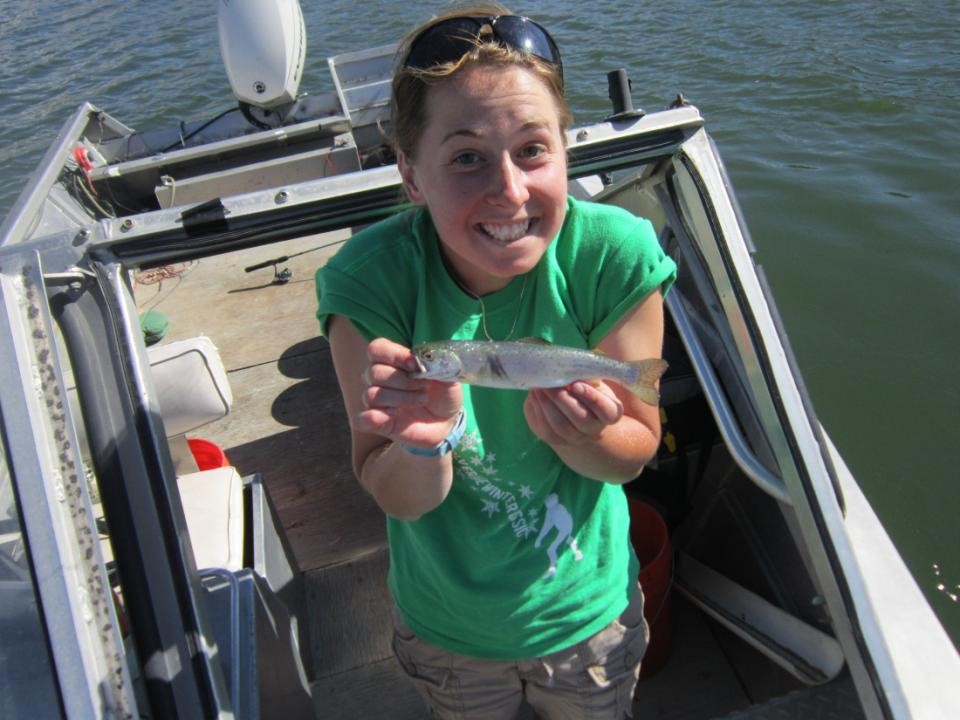
Trout vs. Chub: Graduate student Lisa Winters holds a mature tiger trout. Trout grow quickly when they are on a Utah chub diet.
Graduate student Lisa Winters holds a mature tiger trout. Trout grow quickly when they are on a Utah chub diet.
Scofield Reservoir (a 2,815-acre, man-made lake), has, “Historically [been] the most important trout fishery in Utah’s southeastern region…” says Dr. Phaedra Budy, Unit Leader for the U.S. Geological Survey Cooperative Fish & Wildlife Research Unit at USU.

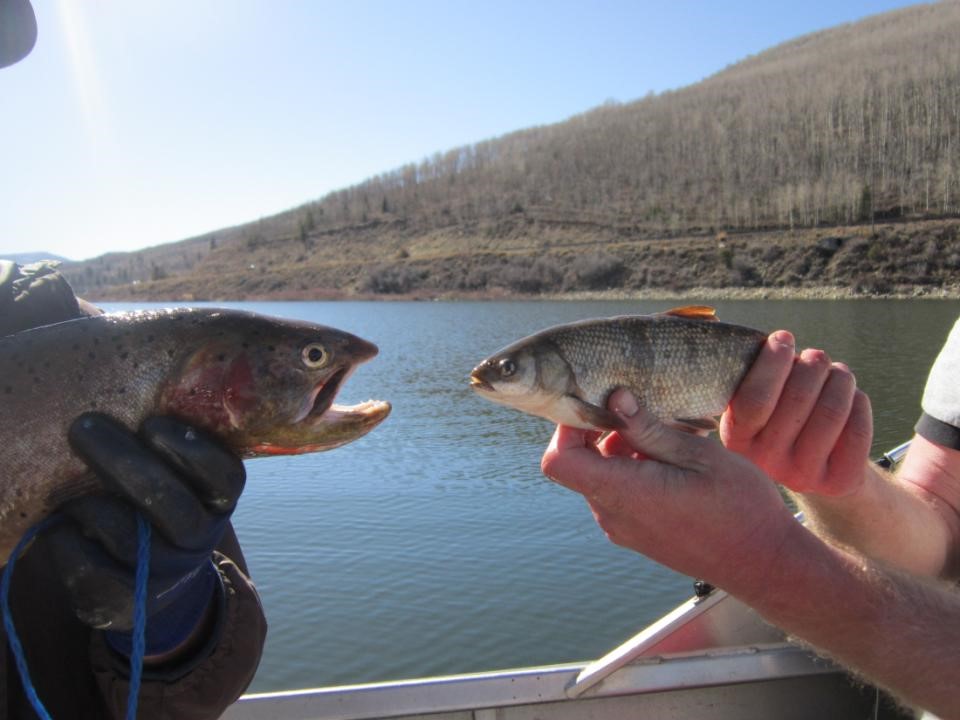
The trout (tiger, cutthroat and rainbow) now share the reservoir with high densities of Utah chub. The reservoir is thick with chub – a carp-like fish that matures quickly and is extremely prolific. At times chub have outnumbered trout in Scofield Reservoir nine to one.

Trout vs. Chub: The competitors: trout vs Utah chub in Scofield Reservoir
The competitors: trout vs Utah chub in Scofield Reservoir
The Utah Chub is native to the state, as indicated by its name, but it wasn’t observed in the lake until 2005.

The main concern for fisheries managers is whether or not the growing population of chub will compete with sport fish for food and/or space, as has been observed elsewhere, or whether chub can be effectively controlled by trout populations.

Trout vs. Chub: Undergraduate student Konrad Hafen holds a mature Tiger trout which preys on the Utah chub.
Undergraduate student Konrad Hafen holds a mature Tiger trout which preys on the Utah chub.
In an effort to answer these questions, Utah Division of Wildlife Resources (UDWR) commissioned a multi-year research project with Dr. Phaedra Budy’s Fish Ecology Lab in the Department of Watershed Sciences, Quinney College of Natural Resources to determine the predator and forage relationships between the trout and chub.

Fishing on Scofield Reservoir
Based on this USU research, one observed benefit of chub is the impact it has on the growth of trout that eat it. After stocked tiger and cutthroat trout reach a certain size (usually a year after being stocked) they switch to a diet of fish and begin eating the chub.

According to Gary Thiede, fishery biologist in the Department of Watershed Sciences, once the trout begin eating chub they grow rapidly. Tiger trout in particular grow to very large sizes eating a diet of 100% chub.

Sunset on Scofield Reservoir
The chub may, therefore, be beneficial to the reservoir’s ecosystem if the numbers are controlled.

DWR has used three trout species to control the population of chub and also enforced a catch and release rule for larger cutthroat trout so the biggest predators would remain in the reservoir. But since chub can live up to 30 years, some of the adults have reached a size where they are too big for trout to eat.

Graduate student Lisa Winters holds a tiger trout likely stocked earlier that spring. It takes at least a year before the stocked fish grow big enough to begin preying on the chub.
In 2016, it became obvious the public would no longer tolerate waiting for the trouts’ appetite to decrease the chub population.

After an extensive public input process, of gathering over 2500 public angler surveys, a committee was formed comprising of Scofield residents, sportsmen organizations, and wildlife agencies to develop a management plan, which would provide DWR recommendations to control the Utah chub population and create a sustainable, high-quality fishery at Scofield.

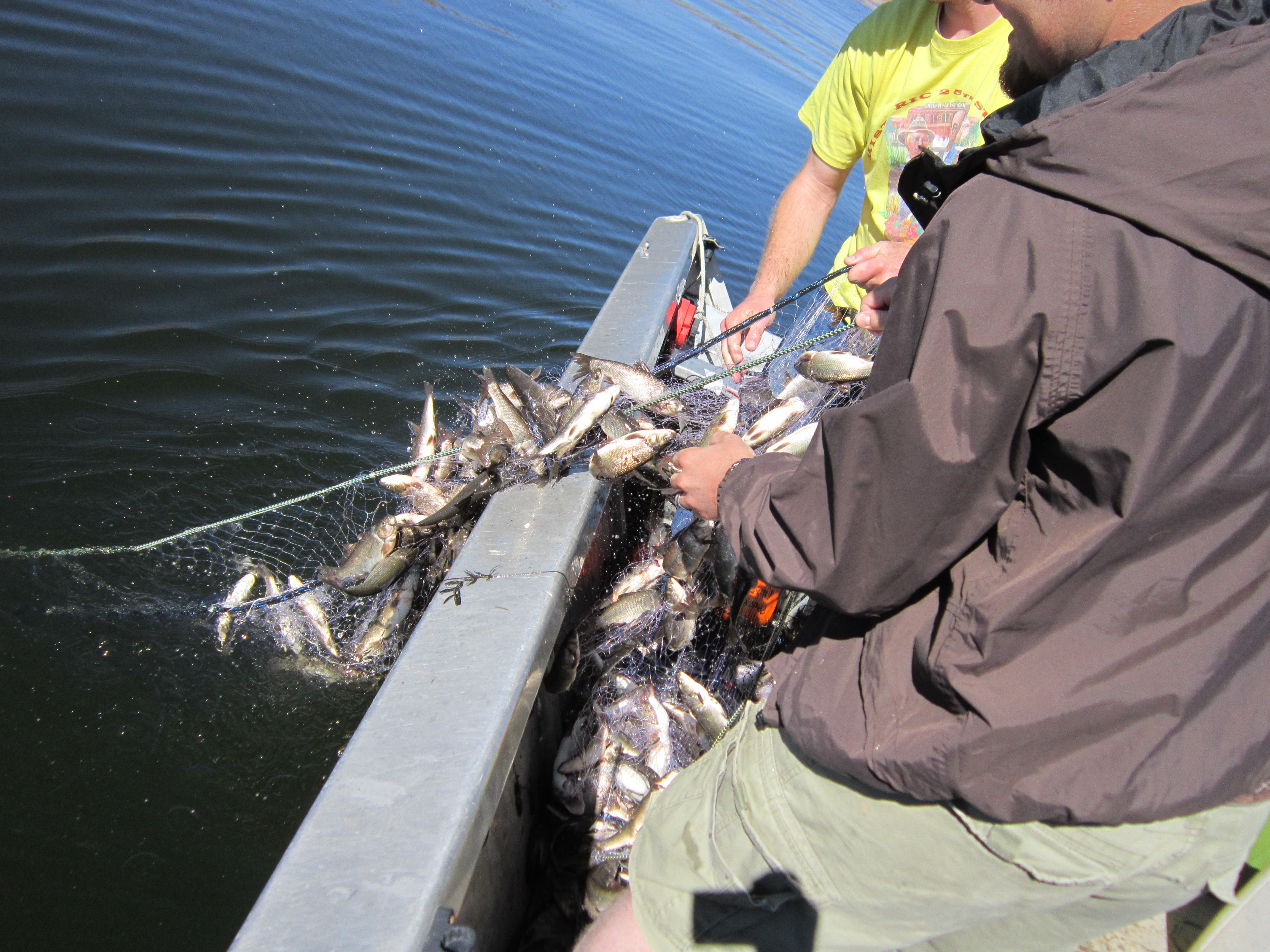
Research technicians pull in a net full of Utah chub.
The plan was reviewed and approved by the Central and Southeast Regional Advisory Councils.

The first step in the plan will be DWR introducing three new fish to Scofield: wiper (a hybrid of white and striped bass), tiger muskie and triploid walleye.

According to Chris Wood, the southeastern regional supervisor, “All three grow quickly and have an appetite for the Utah chub.”

Justin Hart, the DWR’s aquatics manager in southeastern Utah said, we don’t want to completely eliminate [the chub], but we do need to get their biomass down. We plan to use the chub to grow some big fish.

Once the chub population has dropped, DWR will resume stocking the rainbow trout – a favorite among the state anglers.

If the plan is successful, the chub population will remain at a sustainable level and be a benefit, instead of a burden to the Scofield Reservoir trout populations.

This is Shauna Leavitt for Wild About Utah.

Credits:
Photos: Courtesy and Copyright
Text: Shauna Leavitt

Sources & Additional Reading

Leavitt, Shauna, Trout vs. chub, Determining the effect Utah chubs have on Scofield trout populations, July 15, 2014, https://wildlife.utah.gov/news/wildlife-blog/732-trout-vs-chub.html

Bird Brains

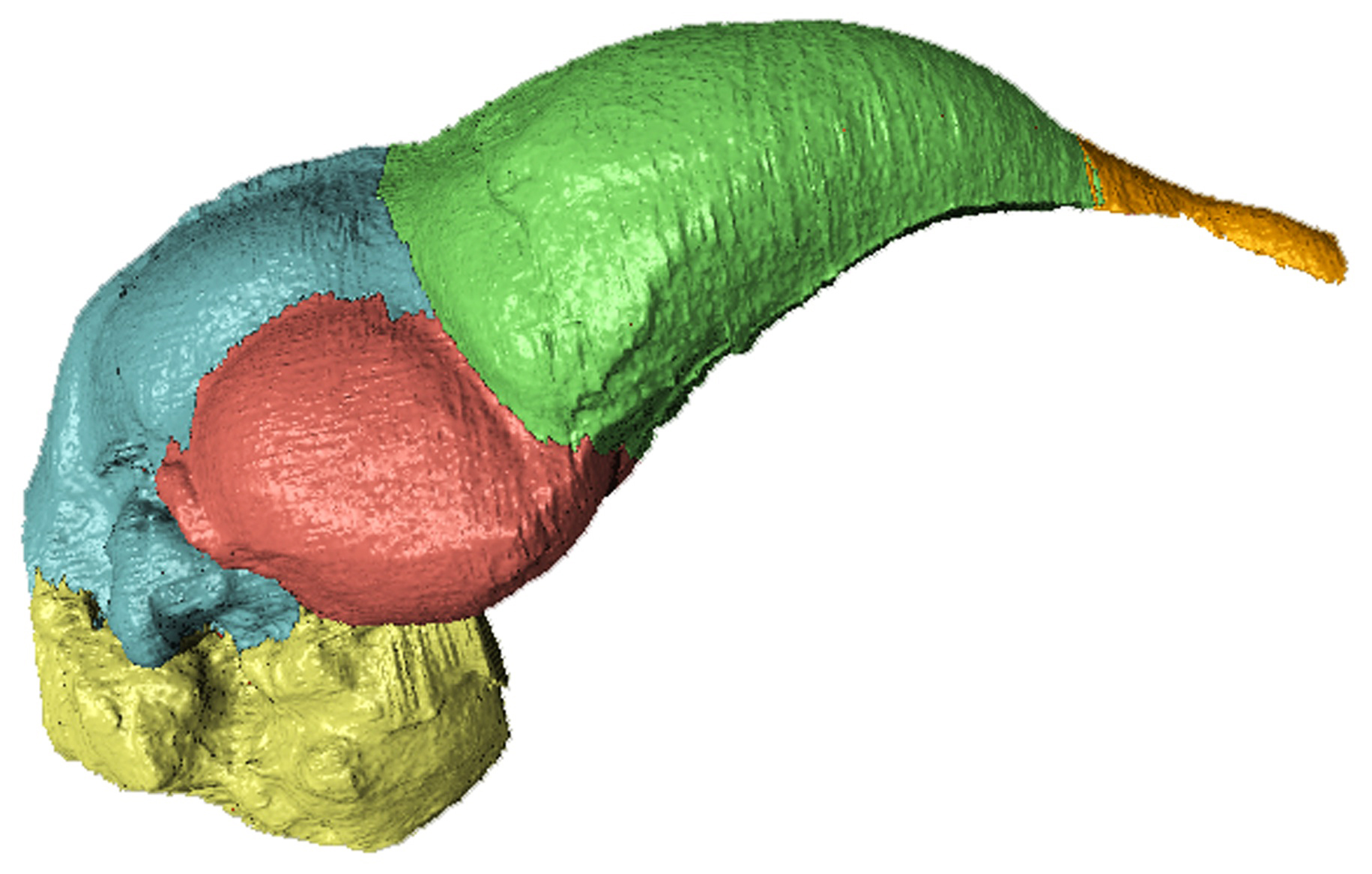
CT image of a Bird Brain Golden Woodpecker, Melanerpes aurifrons https://www.nsf.gov/news/mmg/mmg_disp.jsp?med_id=79726
CT image of a Bird Brain
Golden Woodpecker
Melanerpes aurifrons
https://www.nsf.gov/news/mmg/mmg_disp.jsp?med_id=79726
When I was a young lad being called “bird brain” was an indication that one was lacking in mental capacity.
Over the years I’ve come to question this connotation, and might even consider it a compliment. I suggest that quantity of this gray matter might be outweighed by quality.

Consider the hummingbird brain. Slightly larger than a bibi, it is very capable of feats beyond our imagining. Think unerring migration over hundreds of miles, efficient pollination while suspended in air, extraordinary flight capability, adjusting to extreme environmental challenges of cold, heat, predation, nourishment; exquisite nest design and construction, and so on.

Clark's Nutcracker Courtesy US Fish & Wildlife Service Dave Menke, Photographer
Clark’s Nutcracker
Courtesy US Fish & Wildlife Service
Dave Menke, Photographer
Regarding memory, nothing has been found to match the recall ability of the Clark’s nutcracker, which can bury thousands of pine nuts in rugged mountain terrain, finding them with uncanny ability following months of absence. Of course they hoard far more than needed, allowing many to germinate into seedlings- an amazing keystone species responsible for planting millions of trees from Mexico to Canada – this “squirrel bird” of the Rockies.

I’ve watched crows dropping nuts on roadways so they can be crushed open by passing vehicles, then flying down to eat the contents between oncoming traffic. And gulls dropping rocks on our pets to shoo them away from food dishes so they can have their turn at the table.

An ice fisherman was puzzled by a thief who was stealing his fish by pulling the line out of the ice hole and removing the fish. The culprit was finally observed- a raven- who used its beak and feet to gradually pull up the line with fish attached- an easy catch!

How about those mimics- parrots, corvids, starlings, gray catbirds, and the masterful mocking bird who can expand their repertoire of mimics to nearly 100 imitations without a pause.

And let us consider the remarkable Peregrine falcon. How is it possible that this lovely bird can strike a fast moving, highly maneuverable target as it drops from the heavens at a speed approaching 200 mph? Eyes, muscles, and nerves woven in such a manner that allow it to perform this feat is beyond comprehension.

I’ll conclude with perhaps my favorite bird attribute- their vocalizations. The more scientists learn, the richer their communications appear, possessing qualities once ascribed solely to the human language. Recent research has revealed that birds use syntax, which is altering the sequence of notes for variable meanings. Call order matters to them, much like word order does to us. The sound of birds calling isn’t just pretty. It’s full of meaning. I dare you to call me bird brain!

This is Jack Greene writing and reading for Wild About Utah

Credits:

Pictures: Courtesy US National Science Foundation & Courtesy US Fish & Wildlife Service, Dave Menke, Photographer
Audio: Courtesy and Copyright Kevin Colver
Text: Jack Greene, Bridgerland Audubon Society

Additional Reading:

Bird IQ Tests: 8 Ways Researchers Test Bird Intelligence, National Audubon, Alexandra Ossola, 9 Dec 2015, https://www.audubon.org/news/bird-iq-tests-8-ways-researchers-test-bird-intelligence

Bird Intelligence: Using Tools, Speech, Memory, Interactive Toys, and Emotional Displays
Veterinary & Aquatic Services Department, Drs. Foster & Smith, PetEducation.com, Petco Wellness LLC, https://www.peteducation.com/article.cfm?c=15+1795&aid=3342

Here’s Why ‘Birdbrain’ Should Be a Compliment, Simon Worrall, National Geographic, 15 May 2016, https://news.nationalgeographic.com/2016/05/160515-genius-birds-animal-intelligence-ackerman-ngbooktalk/