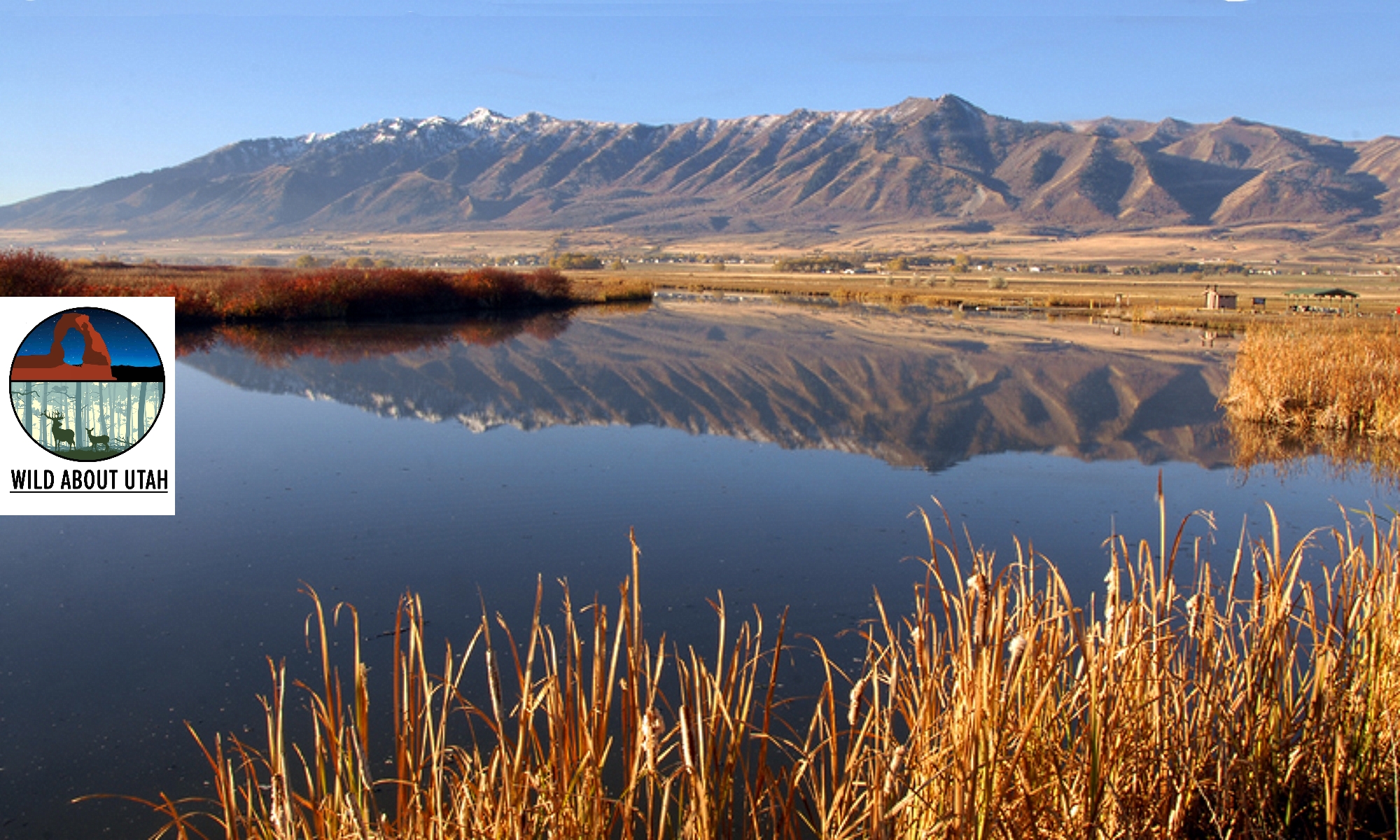
You can see the story unfold if you visit the Nibley Firefly Park after dark. But please tread carefully. For fireflies, this is their Grand Finale. It has taken two years for them to grow from larvae to flying adults. Now they are choosing a mate. By July they will have laid their eggs in the nearby marshy ground and their life cycle will come to an end.
Any artificial light brought to the scene (such as flashlights and car headlights) seriously disrupts the courtship flashing. If you visit the Nibley Firefly Park this summer, please keep your light to the barest minimum, and – enjoy the party.
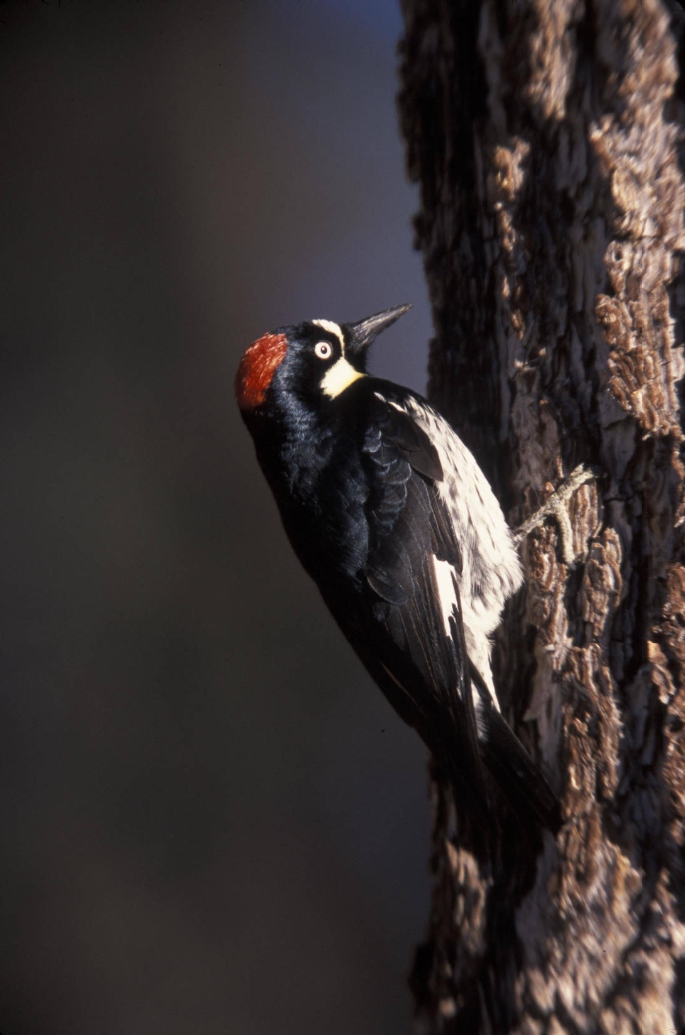
Acorn Woodpecker Melanerpes formicivorus Courtesy US FWS, Gary Kramer, Photographer
My first encounter with an acorn woodpecker occurred many years ago in California, a species unknown to me. I was surprised to find a small flock of these comedic looking birds- most unusual for woodpeckers, which are generally solitary other than with mates or young. And those startling yellow eyes!
On a recent West Rim trek in Zion N.P., to my delight, I got a second encounter near Potato Hollow. Their loud, sharp calls first alerted me. I paused to find the source, and was startled to see who it was, unaware they existed in our state.
Acorn woodpeckers live in large groups, hoard acorns, and breed cooperatively. These woodpeckers live in oak and mixed oak-evergreen forests on slopes and mountains in the Southwest and West Coast. They are found infrequently in the south end of our state. They’re tolerant of humans, and occur in towns where there are acorns and suitable places to store them.
If more than one female in a colony breeds, they lay eggs in the same nest cavity. When egg-laying is not synchronized, females often destroy each other’s eggs. In-synch egg-layers, however, produce a clutch totaling three to seven eggs. Although this behavior seems counterproductive, it may be beneficial, resulting in all chicks being roughly the same age and size. Several different individuals of each sex may breed within one family, with up to seven breeding males and three breeding females in one group.
All members of the colony share in incubation duties, and all pitch in to feed the chicks when they hatch. Young adults remain with their parents for several years to help raise successive broods, but eventually disperse to other territories. Nesting groups can contain up to ten offspring helpers. These breeding coalitions are typically closely related. The males are often brothers, and the females are usually sisters. Inbreeding is rare, however, meaning that co-breeders of the opposite sex are almost never related.
All members of an Acorn Woodpecker group spend large amounts of time storing acorns. typically stored in holes drilled into a single tree, called a granary tree. One granary tree may have up to 50,000 holes, each of which is generally filled with an acorn by autumn.
When any protective group of woodpeckers experiences a death or disruption to the hierarchy, nearby birds rush to the area and fight for access to the trove; these fights also attract woodpecker audiences who leave their own territories to witness the battles.
In 1923, American ornithologist William Leon Dawson called the dapper Acorn Woodpecker “our native aristocrat.” “He is unruffled by the operations of the human plebs in whatever disguise…Wigwams, haciendas, or university halls, what matter such frivolities, if only one may go calmly on with the main business of life, which is indubitably the hoarding of acorns.”
Jack Greene for Bridgerland Audubon Society and I’m totally wild about Utah and its acorns!
Murtaugh, Paul, Granary Tree Image, Oregon State University, sites.science.oregonstate.edu/~murtaugp/photos/jan2017/p12.html [Link broken and removed January 2024]
Cat Courtesy Pixabay Genocre, photographerOur Homes, Our Pets, and Our Natural Environment: Supporting Coexistence through Responsible Pet Ownership.
Nature perseveres in even the most built environment. The cycle of life continues, in our parks, our backyards, and the green spaces in between. Hawks hunt for rodents, rodents forage for seeds, and both seek out mates, no matter how temporary.
We rarely pause to consider how the ‘wildlife’ we bring with us impacts the natural world around us. Our dogs, from stoic german shepherds to the fluffiest toy poodle, are descended from wolves. Our cats, distant relatives of the middle eastern wildcat, are arguably semi-domesticated, after only 12,000 years of human intervention. Perhaps in another 12,000 years the common house cat will be as perky and eager to please as the average golden retriever, but I doubt it.
No matter how loving, our pets are descendants of great predators and they have the ability to negatively impact the fragile ecological balance that persists around us. Some simple commitments allow us to continue to coexist. First, spay and neuter your pets. Unplanned litters contribute to animal shelter crowding and stray populations. Intact pets are also more likely to roam, and to disturb and harm wildlife.
Second, maintain control of your pets at all times. It may be adorable to watch your fox terrier romp unhindered through an urban park, but she is potentially searching for rodent burrows and bird nests to demolish with glee. Your cat is a fierce predator, with the unfair advantage of a delicious and reliable supply of cat food. The ready flow of calories you provide gives fluffy the energy to hunt with enthusiasm. Keep your dogs on a leash or under voice control and your cats indoors. If your feline demands fresh air, consider building her an enclosed catio. Generations of demanding cats have ensured that the internet contains instructions for easy and affordable catio construction.
And last, take a moment to observe and appreciate the vibrancy of life around you. All around your home, animals are hunting, eating, breeding, and dying. Nature has found a way, and we all have responsibility to respect and protect our local natural ecosystems and the essential biodiversity that relies on the interconnectedness of all it’s parts.
I’m Stacey Frisk with the Cache Humane Society and I’m Wild About Utah!
How cat advocates can allocate time and other resources for the biggest impact, Bays, Danielle Jo, Animal Sheltering magazine, Humane Society of the US, Winter 2018-2019, https://humanepro.org/magazine/articles/pointing-way-pyramid Inspired by diagrams for healthy diets, the community cat pyramid encourages a holistic approach to cat management and a strategic use of resources. Graphic by Patrick Ormsby/The Humane Society of the United States
Hummingbirds Eat Insects and Drink Nectar From Flowers Black-chinned Hummingbird Archilochus alexandri Courtesy US FWS, Alan Schmierer, PhotographerDid you know that hummingbirds eat aphids and mosquitoes?Native Plants Are Key
When we think about landscaping for the birds we might think of the National Wildlife Federation guidelines to include food, water, shelter and places to raise young, but chances are the foods we think of first are berries, nuts, and seeds, when in fact the single most important food to ensure the survival of songbirds are the insects hosted by native plants. The Bridgerland Audubon Society website includes a wealth of resources on many aspects of Bird_Friendly Living, not least of which native plants for Utah gardens.
Douglas Tallamy’s website “Bringing Nature Home” states that most songbirds need insect protein for their young, and the top plant species that host the caterpillars birds need are oak, cherry and willow. Just one of many plants to share with birds is the Chokecherry, preferably with green leaves, as the red-leafed cultivars are not attractive to insects. Chokecherry fruits are great for people and birds, and the leaves will host insects for baby birds. Remember, those little hummingbirds aren’t just sipping nectar and pollinating flowers, they’re eating aphids and mosquitoes, serving an important pest management role in your garden!
I will now read the Mayor’s Proclamation to Grow Native for Birds, a timeless summary of the reasons to err toward native plants:
Proclamation To Grow Native For Birds:
Whereas, growing native plant communities in our residential, municipal and commercial landscapes promotes and enhances our sense of place; and Whereas, increased awareness and use of native plants is fundamental to water conservation, water quality, habitat preservation and successful gardening; and
Whereas, gardens and landscapes composed of Utah’s native plants require little or no fertilizers, soil amendments, or pesticides; and
Whereas, using firewise plants native in our landscape is often the safest option; and
Whereas, landscaping choices have meaningful effects on the native insects that bird populations need to survive; and
Whereas, a diversity of birds is indicative of a healthy ecosystem, including biological control of pests, carrion regulation, seed dispersal, and nutrient cycling; and Whereas, birdwatching can be a fun, relaxing, multigenerational, educational family wellness activity;
Now, Therefore, we do hereby declare this Proclamation to Grow Native for Birds and encourage everyone to actively foster and support the use of Utah native plants in their gardens and landscapes.
I’m Hilary Shughart with the Bridgerland Audubon Society, and I’m Wild About Utah
Creating Landscapes for Wildlife… A Guide for Backyards in Utah, Written by Sue Nordstrom and Illustrated by Kathlyn Collins Department of Landscape Architecture and Environmental Planning, Utah State University with Margy Halpin, Utah Division of Wildlife Resources; Second Printing 2001,
Updated for the Utah Division of Wildlife Resources, by Frank Howe, DWR Avian coordinator; Ben Franklin, DWR–Utah Natural Heritage Program botanist; Randy Brudnicki, DWR publications editor; and landscape planning illustrations by Stephanie Duer.,
Published by:
State of Utah Natural Resources, Division of Wildlife Resources,
Utah State University Cooperative Extension Service and
Utah State University Department of Landscape Architecture and Environmental Planning;
1991 updated 8/2025 https://wildlife.utah.gov/pdf/landscapingforwildlife.pdf