Golden Spike Locomotive Refurb.

Driving the golden spike ceremony at Promontory Summit, Utah on May 10, 1869, Courtesy of the US National Park Service
Driving the golden spike ceremony at Promontory Summit, Utah on May 10, 1869
Courtesy of the US National Park Service
 
Reinactment of the golden spike ceremony at Promontory Summit, Utah on May 10, 2014, Utah. Photo Courtesy US NPSReinactment of the golden spike ceremony at Promontory Summit, Utah on May 10, 2014
Courtesy of the US National Park Service
 
Box Elder County, Utah. Photo Courtesy US NPSSteve Sawyer
National Park Service Locomotive Engineer
Photo Courtesy and Copyright Pat Cone
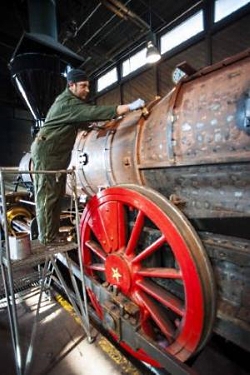
 
Fireman Michael Ostereich. Photo Courtesy and Copyright Pat ConeFireman Michael Ostereich
Photo Courtesy and Copyright Pat Cone
 
 
This sage-covered valley is not on the way to anywhere, unless you’re a railroad and history fan. For it was here, on that May 10th, 146 years ago, that a grand undertaking came to its celebratory conclusion: the meeting of the rails and two grand locomotives.

With the driving of the Golden Spike the Central Pacific, that had clawed its way across the High Sierra and vastness of the Nevada Desert, and the Union Pacific, which rolled across the plains and Rocky Mountains completed a steel artery of commerce and transportation.

Union Pacific Number 119 and the Central Pacific Number 60 (better known at Jupiter) faced each other amidst a crowd of dignitaries, engineers, and railroad workers as the final rails were laid, and spikes were driven. President Abraham Lincoln’s dream of a transcontinental railroad was complete.

Today, the Golden Spike National Historic Site at Promontory, Utah commemorates this event, staging daily reenactments of this meeting with two, grand replica engines. And this May 10th, they’ll look and run better than ever after having undergone a thorough refurbishing.
The original engines were scrapped for their metal in the early 1900s. These two massive replicas were built in 1979 at a cost of nearly $750,000 a piece, in Costa Mesa, California, by Chad O’Connor. He had a passion for steam.

Every 15 years these locomotives are disassembled, boilers cleaned and tested, and over 166 fire tubes replaced. The boiler is pressure tested, the gauges and brass bells and whistles are brightly shined, and the funneled smokestack is repainted, ready for their big day. There’s over 500 feet of tubing in each engine, they weigh 62 tons apiece, and make steam from treated water the old fashioned way: 119 burns coal, and the Jupiter is wood-fired.

Steve Sawyer has been a National Park Service locomotive engineer for 8 years and loves driving these down the track, wearing period costume. He’s one of two engineers, and a fireman who fires them up and takes them out. “These engines run 8 hours a day for 5 months from May 1st through October 15th,” he says, so they need a thorough rebuilding.

Fireman Michael Ostereich takes his time as he puts a rust-proof sealant around the new welds on the boiler, in preparation for a layer of insulation, and the final jacket. But the three railroadmen aren’t alone. There are over 60 volunteers that help in this grand task, reminding us of what it meant to be able to travel from coast to coast in style and comfort.

Jupiter is red and blue, while Number 119 is mostly red with black. Jupiter has a bright blue cowcatcher and a large funnel, while Number 119’s cowcatcher is red with a straight smokestack. The drive wheels are as tall as most men and the pistons are shined to a mirror finish, and there are hand-painted scenes adorning them from Disney animator Ward Kimball.

They are huge, noisy, and magnificent works of art. And, they’ll both be ready for their debut during the anniversary of the meeting of the rails on May 10th. There will be kids of all ages there, so catch them in action if you can.

For Wild About Utah, this is Patrick Cone with National Parks Traveler

Credits:

Image: Courtesy US National Parks Service, www.nps.gov
Image: Courtesy and Copyright Patrick Cone, www.nationalparkstraveler.com
Theme: Courtesy & Copyright Don Anderson as performed by Leaping Lulu https://www.leapinglulu.com/
Text:  Patrick Cone, www.nationalparkstraveler.com
Voice: Patrick Cone, www.nationalparkstraveler.com

Additional Reading:

Golden Spike National Historic Site, Brigham City, Utah, Golden Spike National Monument, US NPS, https://www.nps.gov/nr/Travel/cultural_diversity/Golden_Spike_National_Historic_Site.html

Golden Spike National Monument, US NPS, https://www.nps.gov/gosp/index.htm

Golden Spike Locomotives Being Refurbished, Patrick Cone, National Parks Traveler, https://www.nationalparkstraveler.com/2015/03/golden-spike-locomotives-being-refurbished26421

Blowing Off Steam…, National Parks Traveler, https://www.nationalparkstraveler.com/potw/blowing-steam22551
Capitol Reef

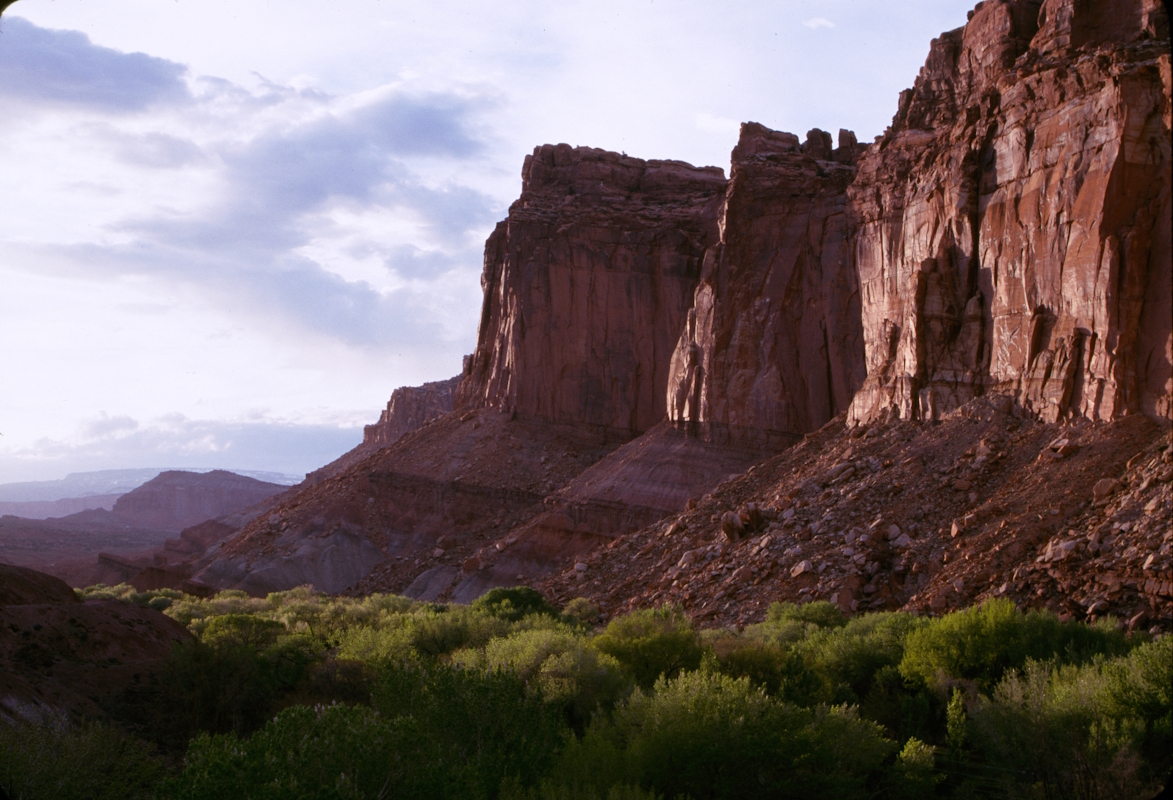
Fruita and the Wingate Cliffs
Capitol Reef National Park
Photo Courtesy US NPS

Orchard
Capitol Reef National Park
Photo Courtesy US NPS

Early settlers to the landscape we know as Capitol Reef National Park in south-central Utah planted cherry, apricot, peach, pear, apple, and walnut trees as a cash crop for survival along the Fremont River bottoms. Visitors today are often surprised by the fruit trees in light of the surrounding desert climate, and campers can pick apples and peaches from their campsites in the orchards. But the green fields and fruit trees also attract deer, marmots, and other small critters, which are easy to spot and are comfortable with humans in their environment.

Though the deer roam free in the tall grass between apple trees, there are other species that are a bit more dangerous lurking nearby. Mountain lions and black bears skillfully stalk around this historic district of Fruita without being seen. Mountain lions have been spotted within a half-mile of the popular campground, yet little is known about the species within the confines of Capitol Reef. With so many questions unanswered about the predator and prey relationship in the unique landscape, the park has received a Disney Nature Impact Grant to enlighten us.

Lori Rome, the park’s chief of interpretation, says, “We are setting up 10-20 infrared motion detected camera traps in surrounding areas. This is a non-invasive way to learn basic information about the species.”

The cameras will provide useful evidence and reveal the patterns of the quiet predators in the park. The public will be engaged through a citizen science project using social media and public interpretive programming, for example helping to survey deer populations.

If you’ve seen Disney Nature’s movie Bears, you, too, helped contribute to the Disney Nature Impact Grants program. Fourteen national parks are receiving funding via proceeds from the movie. Disney Nature has pledged a contribution to the National park Foundation, the official charity of America’s national parks, through the Disney Worldwide Conservation Fund, for each person who saw the film during its first week in theaters.

This type of support helps preserve and protect Capitol Reef and the rest of the National Park System. The Disney Nature Impact Grant enables parks to conduct much-needed conservation projects, such as studying mountain lions at Capitol Reef.

Each park selected to receive a grant through this program had to demonstrate a clear need for the money, and how it would make a profound difference in habitat restoration, wildlife protection or conservation research. With this assistance, we should be able understand predator’s actions in Capitol Reef National Park.

For Wild About Utah and National Parks Traveler, I’m Patrick Cone.

Credits:
Image: Courtesy and Copyright Kurt Repanshek, www.nationalparkstraveler.com
Theme: Courtesy & Copyright Don Anderson as performed by Leaping Lulu https://www.leapinglulu.com/
Text:     Patrick Cone, NationalParksTraveler.com.
Voice:     Patrick Cone, NationalParksTraveler.com.

Additional Reading:

Capitol Reef And 13 Other National Parks Receive Impact Grants From Disney Nature’s Movie “Bears”, Submitted by Carli Jones, June 26, 2014, Formerly at: NationalParksTraveler.comhttps://www.nationalparkstraveler.com/2014/06/capitol-reef-and-13-other-national-parks-receive-impact-grants-disney-natures-movie-bears25263 Now linked to an archived record courtesy Archive.org

Capital Reef National Park, Formerly at: https://web.archive.org/web/20141218101634/https://www.nationalparkstraveler.com/park/capitol-reef-national-park Now linked to an archived record courtesy Archive.org

Capital Reef National Park, https://www.nps.gov/care/index.htm

Mammals in Capital Reef National Park, https://www.nps.gov/care/learn/nature/mammalchecklist.htm
Amphibians in Capital Reef National Park, https://www.nps.gov/care/learn/nature/amphibians.htm
Fish in Capital Reef National Park, https://www.nps.gov/care/learn/nature/fish.htm
Birds in Capital Reef National Park, https://www.nps.gov/care/learn/nature/birds.htm
Reptiles in Capital Reef National Park, https://www.nps.gov/care/learn/nature/reptiles.htm