Out Fishing

Out Fishing: Hatchery Brood Fish Courtesy & © Mary Heers, Photographer
Hatchery Brood Fish
Courtesy & © Mary Heers, Photographer
The minute I heard there was a well stacked community fishing pond just five miles down the road from where I live, I dusted off my old fishing pole, slipped out of the house, and threw my line into the Wellsville Reservoir. I had the place to myself. There was snow on the ground but the water wasn’t frozen. Within the first hour I felt the tug on the line and reeled in a 12 inch trout. I was hooked! I returned just about every evening to catch my limit of 2. I called all my friends who liked to eat fish, and started to consider adding fresh fish delivery to my resume.

About this time I heard that although trucks from the state hatcheries stocked the community ponds, the hatchery in Kamas delivered fish to high mountain lakes in the Unitas via airplane. A few phone calls later, and I was lucky enough to get invited to watch the loading of the fish.

It was 5 in the morning when I followed the Kamas hatchery truck out onto to tarmac at the Heber airport. A specially designed Cessna 158 was waiting for us. There – just behind the pilot’s seat- was a water tank neatly divided into 7 compartments. 7 levers stuck out from the dashboard that would open and close a portal on the belly of the plane.

Hatchery staff loading about 8 lbs of fingerling trout onto a scale before loading into a plane tank via a funnel. Courtesy & © Mary Heers
Hatchery staff loading about 8 lbs of fingerling trout onto a scale before loading into a plane tank via a funnel.
Courtesy & © Mary Heers, Photographer
The crew got right to work. One pumped water into the plane’s water tank. Another netted about 8 lbs of fingerling trout onto a scale and dumped the lot into a funnel. Suddenly an especially feisty fingerling jumped out of the funnel and landed at my feet. I picked it up, cradling it in the palm of my hand, awed by the sleek beauty of this tiny trout that was exactly the size of my index finger. I wished it well as I tossed it back.

“Flush,” said the man in charge. And another man with a red bucket of water sent the fish through the funnel into the plane. Soon the pilot took off. When he got to his target lake, he would drop down and skim over the tops of the trees on the water’s edge. He would then open the portal in the belly of the plane and the tiny trout would flutter down like leaves into the water below.

If our feisty fingerling can avoid predators (mostly birds and bigger fish) it will grow to about 5 inches by September. When the water temperature drops to 30 degrees the fish become lethargic and stop growing. Next June, if the lake warms up to 50 degrees, the trout will grow 2/3 inch an month. At 60 degrees, the fish will grow an inch a month. But if the water temperature reaches 70, the amount of oxygen in the water will drop. Any higher and the fish will be severely stressed.

Growing up and backpacking with my family, I was always delighted to come across an alpine lake because it meant that I could take off my pack and stop hiking. But once I got hooked on fishing, I found myself agreeing with the poet Edgar Guest:

“A feller gets a chance to dream
Out fishing.
He learns the beauty of the stream
Out fishing….+

Now, as far as getting up to the high mountain lakes in the Unitas, one thing is for certain. The fish are already there.

This is Mary Heers and I am Wild About Utah.

Credits:
Photos: Courtesy & Copyright © Mary Heers
Photos: Courtesy
Featured Audio: Courtesy & Copyright © Kevin Colver, https://wildstore.wildsanctuary.com/collections/special-collections/kevin-colver
Text: Mary Heers, https://cca.usu.edu/files/awards/art-and-mary-heers-citation.pdf
Additional Reading: Lyle Bingham, https://bridgerlandaudubon.org/

Additional Reading

Wild About Utah, Mary Heers’ Wild About Utah Postings

Edgar Guest, 1881–1959, Biography, Poets.org, https://poets.org/poet/edgar-guest

Edgar Albert Guest, Out Fishin’, InternetPoem.com, 2018, https://internetpoem.com/edgar-albert-guest/out-fishin-poem/

Betancourt, Sarah, Flying fish: video shows Utah wildlife agency restocking lake by plane, The Guardian, July 13, 2021, https://www.theguardian.com/us-news/2021/jul/13/fish-plane-video-utah-lake

Facer, Austin, Who says fish can’t fly?: Aerial stocking places fish in lakes via airplane drop, ABC4 Utah, July 12, 2021, https://www.abc4.com/news/digital-exclusives/who-says-fish-cant-fly-aerial-stocking-places-fish-in-lakes-via-airplane-drop/

Knighton, Conor, In Utah it’s raining fish, CBS Sunday Morning, Oct 24, 2021, https://www.cbsnews.com/video/in-utah-its-raining-fish/

Nibley Firefly Park

Nibley Firefly Park: Luci the Firefly from  The Mystery of Luci’s Missing Lantern by Melissa Marsted and illustrated by Liesl Cannon Courtesy & © Liesl Cannon, Illustrator
Luci the Firefly from
The Mystery of Luci’s Missing Lantern by Melissa Marsted, illust. by Liesl Cannon
Courtesy & © Liesl Cannon, Illustrator
Just imagine waking from a very long sleep into a bright May morning in Cache Valley. This is the story of Luci, a western firefly, told charmingly by Melissa Marsted and illustrated by Liesl Cannon in their new children’s book, The Mystery of Luci’s Missing Lantern. After completing her transition from a larva to an adult firefly, Luci notices she has no light. She flies up Logan Canyon looking for her missing lantern, where the animals she meets encourage her to keep looking. But its a bluebird on top of Mt. Naomi, the highest point in the canyon, who turns Luci around and sends her back to where she was born, the Nibley Firefly Park.

Author Melissa Marsted and Illustrator Liesl Cannon at the Stokes Nature Center Book Signing Courtesy & © Mary Heers
Author Melissa Marsted and Illustrator Liesl Cannon at the Stokes Nature Center Book Signing
Courtesy & © Mary Heers
There Luci finds her light. She sits down near the top of a tall blade of grass, and suddenly males fly by, flashing their lights, trying to get her attention. Luci discovers she can flash back. It’s a party – a big courtship dance.

You can see the story unfold if you visit the Nibley Firefly Park after dark. But please tread carefully. For fireflies, this is their Grand Finale. It has taken two years for them to grow from larvae to flying adults. Now they are choosing a mate. By July they will have laid their eggs in the nearby marshy ground and their life cycle will come to an end.

Any artificial light brought to the scene (such as flashlights and car headlights) seriously disrupts the courtship flashing. If you visit the Nibley Firefly Park this summer, please keep your light to the barest minimum, and – enjoy the party.

This is Mary Heers and I’m Wild About Utah

Credits:
Images: Courtesy & Copyright © Mary Heers
Featured Audio: Courtesy & Copyright
Text: Mary Heers, https://cca.usu.edu/files/awards/art-and-mary-heers-citation.pdf
Additional Reading: Lyle Bingham, https://bridgerlandaudubon.org/

Additional Reading

Western Firefly Project: A Community Science Initiative, Natural History Museum of Utah, https://nhmu.utah.edu/citizen-science/fireflies

Wild About Utah, Mary Heers’ Postings

Bills, Christy, Utah Fireflies, Wild About Utah,Sept 7, 2020, https://wildaboututah.org/utah_fireflies/ AND
Bills, Christy, Fireflies, Wild About Utah, May 15, 2019, https://wildaboututah.org/fireflies/

Hellstern, Ron, June Fireflies, Wild About Utah, June 19, 2017, https://wildaboututah.org/june-fireflies/

Strand, Holly, Firefly light, Wild About Utah, June 20, 2013, https://wildaboututah.org/firefly-light/

Marstad, Melissa C, Author, & Cannon, Liesl, Illustrator, The Mystery of Luci’s Missing Lantern, Lucky Penny Publications, LLC, Mar 16, 2021, https://www.amazon.com/Mystery-Lucis-Missing-Lantern/dp/1945243805

Tundra Swans

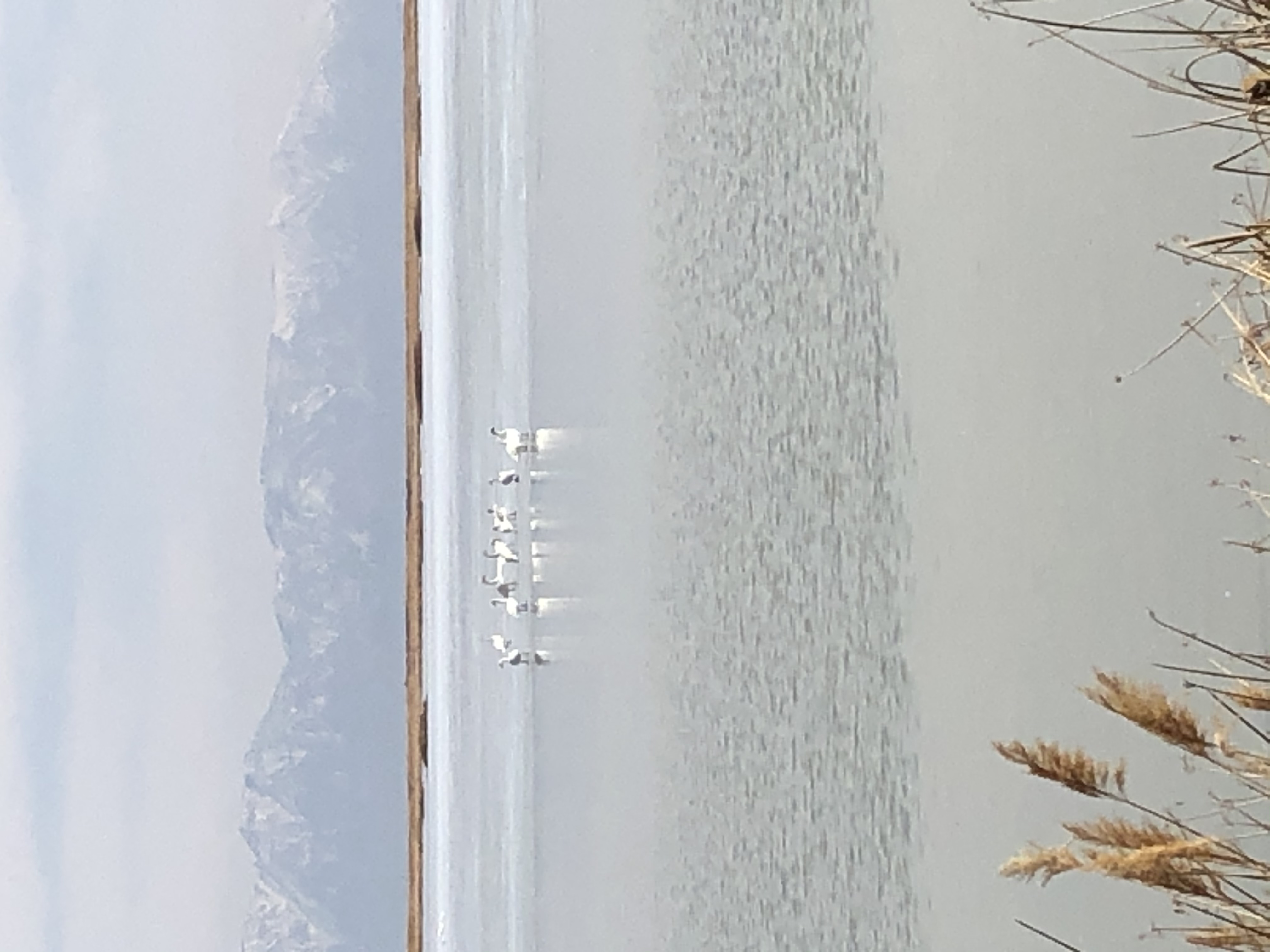
Tundra Swans Courtesy & © Mary Heers
Tundra Swans
Courtesy & © Mary Heers
A few months ago, I was driving a car on an interstate road trip when a picture of a coffee cup suddenly appeared on my dashboard with the question, “Need a rest?” I was a little startled to suddenly be getting questions from my car, but I must admit I felt a surge of relief when a large truck stop soon came into view.

I can imagine that the thousands of tundra swans following their traditional migration route must feel the same sense of relief when the Bear River Migratory Bird Refuge comes into view: Below them lie 74,000 acres of wetlands where the Bear River flows into the northern arm of the Great Salt Lake. Plenty of room, plenty of fresh water, and plenty of food.. It’s hidden from view, but the swans know its there. Growing in the muddy bottom of the shallow water is a marvelous buffet of the tundra swan’s favorite food: Pondweed.

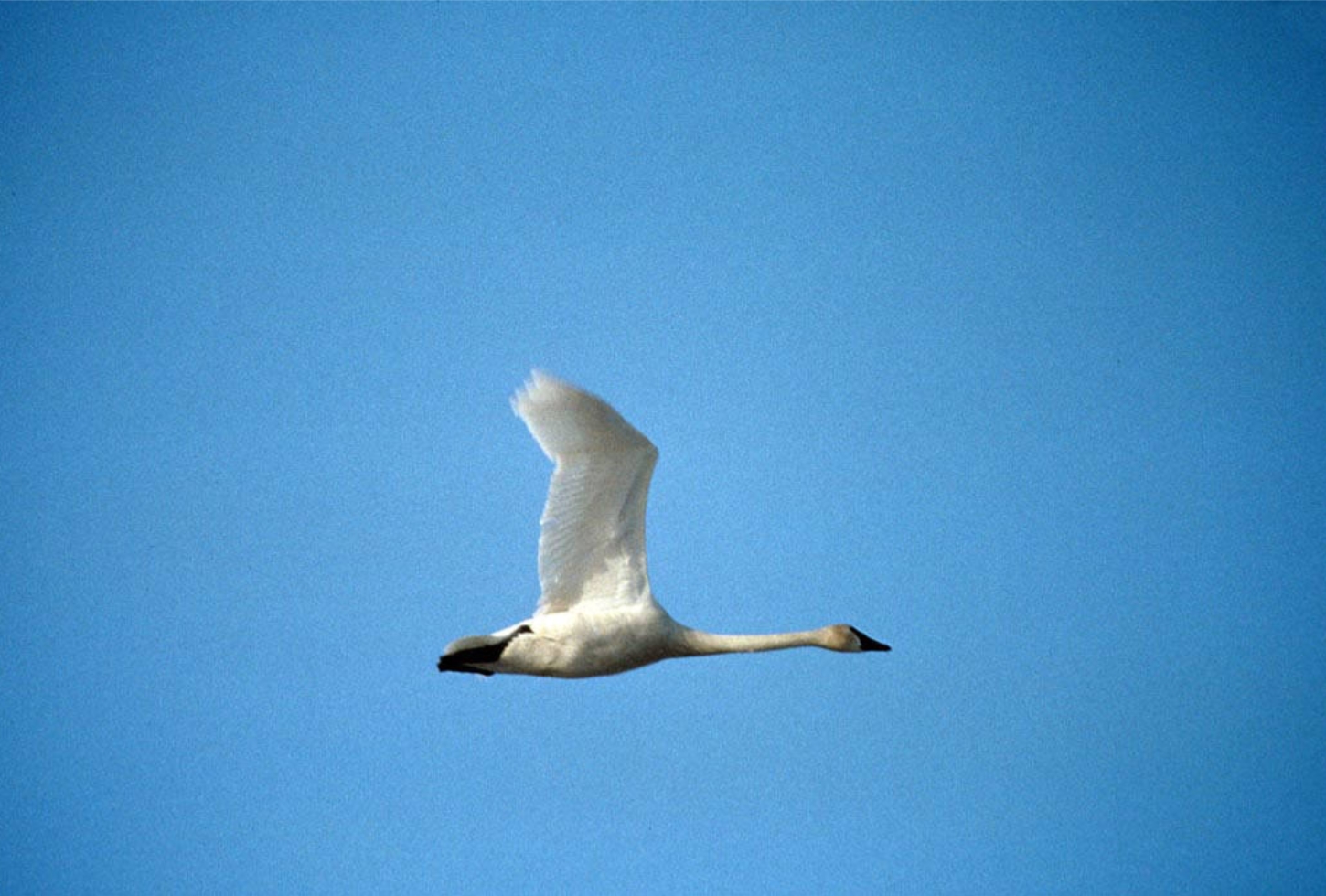
Tundra Swans in Flight Courtesy & © Mary Heers
Tundra Swans in Flight
Courtesy & © Mary Heers
In early March, when I heard the swans had started to arrive, I headed right over Ice was just beginning to melt and the first arrivals were sitting on the water and standing around on the ice. Of course I cringed to think about standing around on ice in bare feet, but these swans seemed perfectly content. They had already flown over 600 miles and had another 2,000 to go to get to their nesting grounds in the Alaska tundra. This was their time to rest and refuel. People who study the biology of swans tell us that eating pondweed is pretty effortless: the swan dips its flexible 3 ft neck into the water, locates a choice plant with the help of an extra underwater eyelid, and takes a bite. No need to surface; the swan swallows underwater. No need to chew; its gizzard will grind the cellulose into a digestible pulp.

Tundra Swans at Dusk Courtesy & © Mary Heers
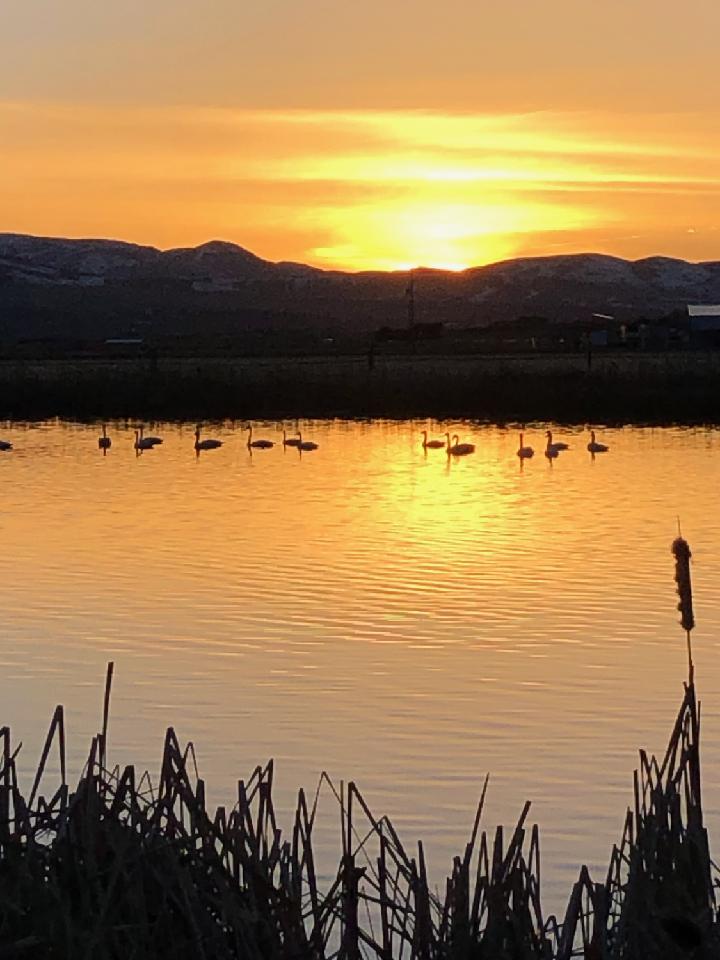
Tundra Swans at Dusk
Courtesy & © Mary Heers
Quite unexpectedly, I ran across some other swans the next day who had left the main migratory route and were taking the backroads of Fairview Idaho to forage across the farmer’s fields. I had gone to visit of friend. “Corn,” she said. “They come every year.” Inevitably some corn is left behind by the harvesting machines and these swans were more than happy to clean up the spills. But a 6 o’clock they would lift off and fly to a small stretch of open water by the Fairview cemetery where they could safely spend the night.

I hightailed it to the cemetery, sat down by the water’s edge, and made myself as small as possible. I waited. Soon the sky filled with incoming swans, some in pairs, some in small groups. They flew in over me so low I could hear the thump of their wings beating and the Whirrzz of the wind through their wing feathers. At the last minute they lowered their large black feet and skidded to a splashy stop The water was soon thick with swans, but these excellent aviators, weighing over 20 lbs and with a wingspan of 6-7 feet, skillfully landed in an open space.

Tundra Swan in Flight Cygnus columbianus Courtesy US FWS Donna A Dewhurst, Photographer
Tundra Swan in Flight
Cygnus columbianus
Courtesy US FWS
Donna A Dewhurst, Photographer
Like many people, I first heard about swans when I read The Ugly Duckling. Hans Christian Anderson spent a year writing this story in 1842. Later in life, when people asked him why he never wrote an autobiography, he said he already had – when he wrote The Ugly Duckling. His message was clear: bullying a youngster just because he looks different is cruel. But the suffering of the young swan as he spent his first winter miserably cold and alone did not preclude a happy ending. Remembering this story is especially poignant today as we are emerging from our own winter of social isolation, and stepping into spring with high hopes for happier, healthier days.

This is Mary Heers and I am Wild About Utah.

Credits:
Photos: Courtesy & Copyright © Mary Heers
Photos: Courtesy US FWS, Donna A Dewhurst and Tim Bowman, Photographers
Featured Audio: Courtesy & Copyright © Kevin Colver, https://wildstore.wildsanctuary.com/collections/special-collections/kevin-colver
Text: Mary Heers, https://cca.usu.edu/files/awards/art-and-mary-heers-citation.pdf
Additional Reading: Lyle Bingham, https://bridgerlandaudubon.org/

Additional Reading

Tundra Swans, All About Birds, The Cornell Lab of Ornithology, Cornell University, https://www.allaboutbirds.org/guide/Tundra_Swan/overview

Wild About Utah, Mary Heers’ Postings

Tundra Swan Pair Cygnus columbianus Courtesy US FWS Tim Bowman, Photographer
Tundra Swan Pair
Cygnus columbianus
Courtesy US FWS
Tim Bowman, Photographer
Strand, Holly, Til Death Do Us Part, Wild About Utah, February 13, 2014, https://wildaboututah.org/tag/monogamy/

Tundra Swan, Utah Bird Profile, UtahBirds.org, https://utahbirds.org/birdsofutah/ProfilesS-Z/TundraSwan.htm
Other Photos: https://utahbirds.org/birdsofutah/BirdsS-Z/TundraSwan.htm

Mirabilite Mounds and The Great Salt Lake

Mirabilite Mounds in the Great Salt Lake Courtesy & © Mary Heers, Photographer
Mirabilite Mounds
in the Great Salt Lake
Courtesy & © Mary Heers, Photographer
Back in October 2019, the ranger at the Great Salt Lake State Park began to notice a white mound forming on the sand flats behind the visitor center. The white mounds turned out to be hydrated sodium sulfate – known as mirabilite- which was being carried to the surface by the upwelling of a fresh water spring. Since the 1940’s geologists have known that in this area, 30 inches below the surface, there was a 3 – 6 foot thick shelf of mirabilite. They knew about the fresh water springs What was new was cold air. Since this stretch of sand was no longer underwater, the mirabilite carried to the surface stayed there as crystals, piling up on each other, puddling and spreading out. One mound rose to the height of 3 feet.

Mirabilite Springs in the shadow of the Kennecott Smelter stack Courtesy & © Mary Heers, Phorographer
Mirabilite Springs in the shadow of the Kennecott Smelter stack
Courtesy & © Mary Heers, Phorographer
When the mounds started to form again this winter, I jumped at the chance to to go and take a look. I must admit at first I was a little underwhelmed at the size, perhaps because the Kennecott Smelter Stack nearby dominates the view, rising to 1,215 feet – roughly the same height as the Empire State Building. But the park ranger got my attention when she told us that mirabilite mounds have only been seen in four places in the entire world – the Canadian Arctic, Antarctica, Central Spain, – and Utah. Just seeing them turns out to be a rare winter treat. When the air warms to 50 degrees, the mirabilite will crumble into a fine white powder and disappear.

Robert Smithson's Spiral Jetty (1970) Courtesy & © Mary Heers, Photographer
Robert Smithson’s Spiral Jetty (1970)
Courtesy & © Mary Heers, Photographer
My mind flashed back to a trip I’d made to the other end of the lake ten years ago. I’d just graduated from the docent training class at the Utah Museum of Fine Art, and a friend and I wanted to celebrate by having High Tea at the center of the Spiral Jetty, a 1,500 foot, long, 15 foot wide coil of black basalt rock – a stunning example of land art jutting out from the northern shore. We’d been warned that it might be underwater, but when we arrived we were delighted to find we could easily walk to the very center of the spiral as the lake water gently lapped at the edges of our shoes. We clinked our tea cups, and toasted the greatness of the lake.

Suddenly I wanted to see the jetty again, so I hopped in my car and drove to the remote site. I saw the Spiral Jetty was now high and dry. Drifting sand had already started to bury parts of it. The water’s edge was now over 300 yards away. I thought of the millions of migratory birds that would be arriving in the spring to rest and feast on the tiny treasures of the lake, the brine shrimp. I hoped a smaller lake would still be enough for all of them.

The recent words of the director of Friends of the Great Salt Lake, Lynn de Freitas, rang in my head: “The Great Salt Lake is a gift that keeps on giving. Just add water.”

This is Mary Heers and I’m Wild About Utah.

Credits:
Photos: Courtesy & Copyright Mary Heers, Photographer
Featured Audio: Courtesy and Copyright Kevin Colver https://wildstore.wildsanctuary.com/collections/special-collections/kevin-colver
Text & Voice: Mary Heers, Generous Contributor, Utah Public Radio
Additional Reading: Lyle Bingham, Webmaster Bridgerland Audubon Society

Additional Reading

Mirabilite Spring Mounds Near Great Salt Lake Marina, Utah Geological Survey (UGS), Utah Department of Natural Resources, https://geology.utah.gov/popular/general-geology/great-salt-lake/mirabilite-spring-mounds/

Mirabilite, Mindat.org, Hudson Institute of Mineralogy, https://www.mindat.org/min-2725.html

Tabin, Sara, Rare salt formations return to Great Salt Lake’s shores; take a tour while they last, The Salt Lake Tribune, Jan. 13, 2021, https://www.sltrib.com/news/2021/01/14/rare-salt-formations/

USGS 412613112400801 The Great Salt Lake at Spiral Jetty, Site Map for the Nation, U.S. Geological Survey(USGS), U.S. Department of the Interior, https://waterdata.usgs.gov/nwis/nwismap/?site_no=412613112400801&agency_cd=USGS

Case, William, GEOSIGHTS: PINK WATER, WHITE SALT CRYSTALS, BLACK BOULDERS, AND THE RETURN OF SPIRAL JETTY!, Survey Notes, v. 35 no. 1, Utah Geological Survey (UGS), Utah Department of Natural Resources, January 2003, https://geology.utah.gov/map-pub/survey-notes/geosights/spiral-jetty/

Board & Staff, Friends of the Great Salt Lake, https://www.fogsl.org/about/board-staff

Salt Lake Brine Shrimp, https://saltlakebrineshrimp.com/harvest/