Important Bird Areas

Important Bird Areas: Photo Courtesy Bridgerland Audubon Society
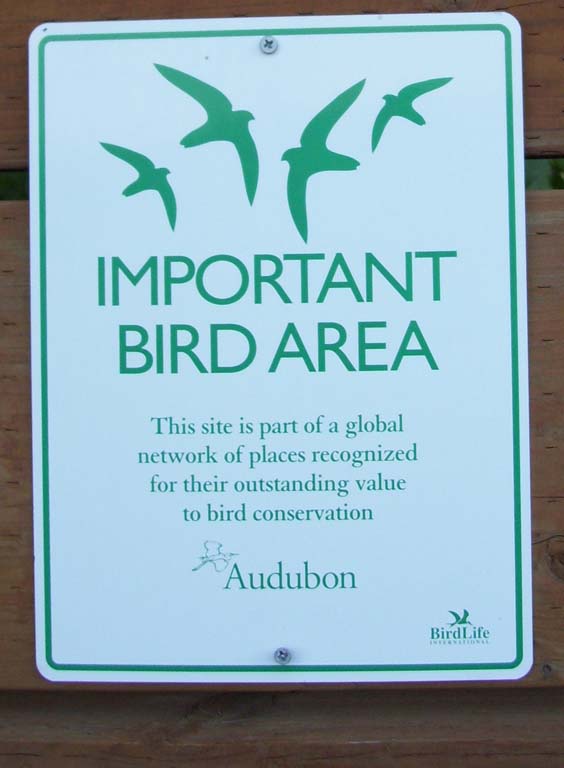
Important Bird Area Sign
at the Deep Canyon Trailhead
Leading to the Hawkwatch Intl
Wellsvilles Site
Courtesy Bridgerland Audubon Society

Not all places on earth were created equal. Some places attract lots of birds, and some don’t. And some places support birds that are at more at risk of extinction than others. Those two simple statements are the basis of a worldwide effort to map Important Bird Areas or IBAs as they are called in the birding world. This effort has been led by Birdlife International which is a conglomerate of partnership organizations dedicated to the welfare of birds. To date, over 7500 IBA sites have been identified and described in over 170 countries.

In the United States, the partner for identifying IBAs is the National Audubon Society. Wayne Martinson and Keith Evans of the Wasatch Audubon Society have just completed a book about the IBAs in Utah called Utah’s featured birds and Viewing sites. Reading it, I learned that Utah has 21 different sites and more are under consideration. Many of Utah’s IBA’s are clustered around the Great Salt Lake . The largest ones in area are Gilbert Bay and the Deseret Land and Livestock Ranch.

Landowner permission is required for an area to be recognized in Utah. Furthermore, an IBA designation does not imply any oversight or management implications. It is merely a form of recognition of the unique nature of each site.

IBAs are designated to be of global, national or state significance. There are carefully-defined criteria for making the designation. To be considered globally significant, one of the following must be true for a given site:

  1. It must regularly hold significant numbers of a globally threatened species or
  2. It must regularly hold a significant population of narrow endemics or species with very limited distribution or
  3. It must regularly support exceptionally large numbers of migrating or congregating species

Eight of Utah’s twenty-one IBA’s are considered of global significance. The globally significant sites include Gunnison Bay , Bear River Bay, Ogden Bay, Farmington Bay, Gilbert Bay of the Great Salt Lake, Deseret Land and Livestock Ranch, and the San Juan County/Gunnison Sage-Grouse IBA.

In the future, we’ll probably see more including Zion National Park based on the presence of Mexican Spotted Owl and California Condor, Parker Mountain based on Greater Sage Grouse , and Cutler Marsh-Amalga Barrens based on its large White-faced Ibis colony.

Each one of Utah’s important bird areas is an interesting subject in and of itself. You might just hear about a few of them in future episodes.

Credits:

Theme: Courtesy & Copyright Don Anderson as performed by Leaping Lulu
Photo: Courtesy Bridgerland Audubon Society
Text: Stokes Nature Center: Holly Strand

Sources & Additional Reading:

Cutler Marsh-Amalga Barrens IBA site description https://www.audubon.org/important-bird-areas/cutler-reservoir-and-marsh-ut08

Ryder, R. A. and D. E. Manry (2020). White-faced Ibis (Plegadis chihi), version 1.0. In Birds of the World (A. F. Poole and F. B. Gill, Editors). Cornell Lab of Ornithology, Ithaca, NY, USA. https://doi.org/10.2173/bow.whfibi.01 or https://birdsoftheworld.org/bow/species/whfibi/cur/introduction [Updated February 11, 2026]

Important Bird Areas, Audubon Society, www.audubon.org/bird/IBA/ Note: Website changed to https://www.audubon.org/important-bird-areas
See also
https://www.audubon.org/important-bird-areas/state/utah
https://www.audubon.org/important-bird-areas/cutler-reservoir-and-marsh-ut08 [Accessed September 19, 2021]

Protecting the most important habitats for birds, BirdLife International, https://www.birdlife.org/projects/ibas-mapping-most-important-places/ [Updated February 11, 2026]

Important Bird Areas, Audubon Society, https://www.audubon.org/important-bird-areas

Important Bird Areas(IBAs), BirdLife International, https://www.birdlife.org/focus-areas/sites/

[Page updated February 11, 2026]
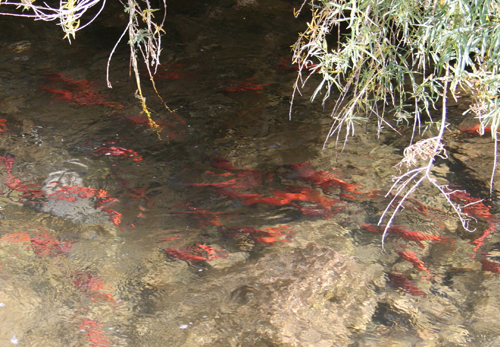
Kokanee Salmon

Kokanee Salmon above Porcupine Reservoir, Photo Courtesy and Copyright 2008 Mary-Ann Muffoletto
Kokanee Salmon above Porcupine Reservoir
Copyright 2008 Mary-Ann Muffoletto

A little over a week ago, I saw my first kokanee salmon run up Little Bear River just east of Porcupine Reservoir. This year, researchers counted over 10,000 fish within a mile of the reservoir. That’s a record number. My friends and I marveled at these wriggling flashes of color as they struggled upstream. It inspired me to spend the week reading about salmon. Here’s what I learned.

First of all it surprised me that salmon and trout are so close genetically. Along with whitefish and grayling, they form the family Salmonidae, but salmon and trout are the most similar. The main difference between them is that salmon generally migrate from their freshwater birthplace to the sea to get more and better food. And then they return to spawn in freshwater rivers and streams where there are fewer predators. And generally – although it’s not true for all – salmon spawn once and die while trout go through a number of spawning cycles.

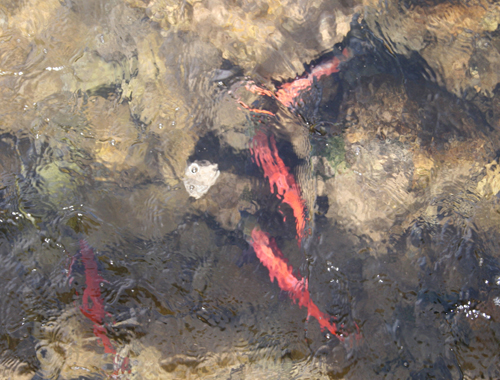
The Pacific Sockeye salmon resembles a silvery rainbow trout during most of its life. But when it spawns, the male especially undergoes a miraculous transformation. His head turns green, his body turns a bright red, and his back grows a bump. And his jaw begins to hook until he’s got a pronounced overbite. There’s a lot of jostling over females during breeding, and the humpback and hooked jaw helps him intimidate other male fish so he can fertilize more female eggs. And the red color is considered highly attractive to the opposite sex.

White-tailed Kokanee Salmon, Courtesy & Copyright 2008 Mary-Ann Muffoletto
White-talied Kokanee Salmon
Copyright 2008 Mary-Ann Muffoletto
The kokanee is an evolutionary branch of the sockeye. Both of them spawn in freshwater nurseries and then move to a nursery lake to grow for awhile. Then the sockeye salmon migrates to the ocean while the kokanee remain in the lake. After a few years they both return to the freshwater streams to spawn and die. The funny thing is, that if you take a sockeye and keep him in a lake, he doesn’t turn red when it’s time to spawn. That’s because red color derives from carotenoid pigments in the salmon’s diet and these pigments are much more prevalent in ocean food. So why does the kokanee turn the same red as the sockeye? It’s because the sexual preference for red was so strong that the kokanee actually evolved the ability to process carotenoid pigments with 3 times the efficiency of sockeyes.

Kokanee above Pineview Reservoir, Courtesy & Copyright 2008 Mary-Ann Muffoletto
Kokanee above Pineview Reservoir
Courtesy & Copyright 2008 Mary-Ann Muffoletto

Because it flexibly defines a lake as its ocean, the kokanee has become a popular fish for reintroduction into western lakes and reservoirs. In 1922, the kokanee was first introduced for sport fishing into Utah’s Bear Lake. Nowadays you can see them spawn in the Little Bear River out of Porcupine Reservoir, Sheep Creek near Flaming Gorge Reservoir, and tributary streams of Strawberry Reservoir.

If you hurry, you can still catch the last of the spawning kokanees, their bright red bodies an aquatic response to the flaming Utah maple on the surrounding hillsides.

Special thanks to Charles Hawkins (Watershed Sciences, College of Natural Resources, Utah State University) , Phaedra Budy (Utah Cooperative Fish and Wildlife Research Unit, College of Natural Resources, Utah State University) and Bret Roper (US Forest Service, Fish & Aquatic Ecology Unit, Logan, UT) for their comments on this piece.

Credits:

Photo: Courtesy of and Copyright 2008 Mary-Ann Muffoletto
Text: Stokes Nature Center: Holly Strand

Sources & Additional Reading
Aggies Help State with Fall Salmon Count 2008. Utah State Today. Sept 25, 2008. https://www.usu.edu/today/story/aggies-help-state-with-fall-salmon-count [Updated October 31, 2024, formerly https://www.usu.edu/ust/index.cfm?article=30698]

Coates, P. 2006. Salmon. London: Reaktion Books https://reaktionbooks.co.uk/work/salmon-2

Craig, J.K., and Foote, C.J. 2001. Countergradient variation and secondary sexual color: phenotypic convergence promotes genetic divergence in carotenoid use between sympatric anadromous and nonanadromous morphs of sockeye salmon (Oncorhynchus nerka), Evolution 55(2), 2001, pp. 380-391. https://pubmed.ncbi.nlm.nih.gov/11308094/

Utah Division of Wildlife Resources. Kokanee (Oncorhynchus nerka). Wildlife notebook Series No. 10.https://redrockadventure.com/fishing/species/kokanee-dwr-booklet.pdf (accessed Oct 31, 2021)
formerly held at https://wildlife.utah.gov/publications/pdf/newkokan.pdf (accessed Oct 3, 2008)
See also:

Stewart, Ron, UDWR, Kokanee Salmon in Strawberry Reservoir https://www.redrockadventure.com/fishing/Strawberry/strawberry_kokanee.htm

Where you can see bright red kokanee salmon in Utah this fall, Utah Division of Wildlife Resources, August 31, 2023, https://wildlife.utah.gov/news/utah-wildlife-news/1746-where-to-see-bright-red-kokanee-salmon-this-fall.html [Updated November 1, 2024]

Isaacson, Samantha, Kokanee Salmon Run the River, The Utah Statesman(USU Student Newspaper), October 21, 2024 https://usustatesman.com/kokanee-salmon-run-the-river/ [Accessed October 31, 2024]

Paleontological Paradise

Dinosaurs & Fossils
Photo Courtesy
Utah Geological Survey

Hi, I’m Holly Strand for Stokes Nature Center in beautiful Logan Canyon.

Mongolia, China, and United States have produced far more dinosaur fossils than any other countries in the world. And Utah is a prime dinosaur site within the United States. Scattered around Utah are several active quarries, including the world famous Carnegie Quarry in Dinosaur National Monument and the Cleveland-Lloyd Dinosaur Quarry outside of Price. Paleontologists are beginning to find that the Grand Staircase Escalante Area is another prolific boneyard. In their day, dinosaurs roamed almost all parts ofthe known world, so what makes Utah so exceptional for dinosaur discoveries?

First of all, it’s important to understand that the vast majority of dinosaurs lived and died without leaving any fossil traces. Thus, what we find today is an extremely small percentage of the total of all dinosaur matter. In order to be preserved a creature needs to be buried or frozen almost immediately upon death, Given that the world was pretty warm in the age of the dinosaurs, most of today’s fossils come from individuals that died in or near a sand dune, lake or sea and were then quickly covered by sand or mud. Dinosaurs lived in the late-Triassic, Jurassic and Cretaceous periods of the Mesozoic era –that is 225-65 million years ago. At that time, what-would-be-become Utah featured both a shallow inland sea and dunes.. So dinosaurs who lived and died here had a much better chance of being fossilized.

Once fossils are well preserved, certain conditions will increase the probability that they will be found. First of all, you want exposed Mesozoic rock, since dinosaurs lived and died in the Mesozoic era. The Morrison and Cedar Mountain Formation are both from the Mesozoic and are extremely rich in dinosaur fossils.. In fact, Utah has one of the most detailed Mesozoic rock records in the world. Certain types of sedimentary rock –including sandstones, mudstones and limestones –are most promising for fossils and Utah has plenty of these.

Another condition for good fossil hunting is a dry environment. Desert and semi-deserts are optimal for discovery, since decomposition is slowed. With little or no vegetation on the ground, wind and water erosion increases and more ancient fossils are uncovered. In this regard also, Utah is perfect, having just the right amount of water. There’s enough to cause occasional and severe erosion to expose new rock, but not enough to encourage the amount of plant growth that will anchor soil or reduce visibility of the ground.

In the past 2 decades, dinosaur discovery and research has been enjoying a renaissance with plenty of new species being unearthed.. In an upcoming episode, I”ll talk about some exciting new discoveries in our state.

For Wild About Utah and Stokes Nature Center, I’m Holly Strand.

Credits:

Photo: Courtesy Geology.Utah.gov, https://geology.utah.gov/esp/paleo/images/dinodig.jpg

Text: Stokes Nature Center – Holly Strand

Sources & Additional Reading

Dodson, Peter. 1990. Counting dinosaurs: How many kinds were there? Proc. Natl. Acad. Sci USA. Evolution. Vol 87, pp. 7608-7612.

Handwerk, Brian. 2008. Amazing Dinosaur Trove Discovered in Utah National Geographic News June 17

Norman, David. 2005. .Dinosaurs A Very Short Introduction. Oxford Univ. Press

Utah Geological Survey/Dinosaurs and Fossils. https://geology.utah.gov/utahgeo/dinofossil/index.htm (accessed Sept 12, 2008)

Are We in the Rockies?

Snow and the Rocky Mountains in Wyoming, Colorado, and Utah
Courtesy NASA Visible Earth,
Jacques Descloitres,
MODIS Land Rapid Response Team,
NASA/GSFC

Hi, I’m Holly Strand from Stokes Nature Center in beautiful Logan Canyon.

For awhile now, I assumed that living on a bench on the eastern edge of Cache Valley, meant that I was living on the very western edge of the Rocky Mountains. But is the Bear River Range really in the Rockies? Are the Wasatch Mountains in general?

Peakbagger.com, which features a hierarchical system of mountain range classification, says that the Utah Rockies are represented by two main mountain massifs the Uintas and the Wasatch.

But according to Halka Chronic, author of Roadside Geology of Utah, we are definitely out: The Wasatch Range, steeply faulted on its western side, was once considered to be part of the Rocky Mountains, formed in the late Cretaceous to early Tertiary period. The Wasatch is now known to be younger than the Rockies and is considered the easternmost part of the Basin and Range region. Chronic identifies Heber Valley as the easternmost basin of the Basin and Range. The Basin and Range is a huge arid region in Utah, Nevada and adjacent states. Within it, narrow north-south oriented mountain ranges alternate with valleys filled with erosional sediment.

I turned to some Utah State University geologists for help. As usual, the answer to what I think is a simple question turns out to be complicated. Sue Morgan considers the Wasatch to be the easternmost edge of the Basin and Range because the mountains were formed by normal faulting characteristic of the Basin and Range. But, she points out, that the Utah Geological Survey considers the Wasatch to be part of the Middle Rockies.

Dave Liddell says the answer to my question is a matter of scale. If you are looking at North America from space those of us on the Wasatch Front could justifiably consider ourselves located on the edge of the continental–scale Rocky Mountain system. However, the closer look, you have to start taking into consideration lots of fine scale variations and categorizations; this makes drawing a boundary between the Rockies and the Basin and Range province extremely complex. Liddell would put Cache Valley in the Basin and Range because of its formation by pull apart tectonics. The rest of the Wasatch Front is Basin and Range for the same reason. But most geologists put Bear Lake in the Rockies. So perhaps the Wasatch is a large transition zone.

Next time the subject comes up—and there’s no guarantee that it will ever come up—I’m probably going to favor the argument that the Wasatch Mountains are outside the Rockies and that most Utahns live in the Basin and Range region. But if some of you Wasatch Front residents really want to live at the foot of the Rockies, that’s fine too–you can cite the Utah Geological Survey. Now that I decided to go with Basin and Range, I’ll want to find out more about the plants and animals that live here. So you can expect to hear more about them in future programs.

For Wild About Utah and Stokes Nature Center, I’m Holly Strand.

Credits:

Photo: Courtesy Jacques Descloitres, MODIS Land Rapid Response Team, NASA/GSFC https://visibleearth.nasa.gov/view.php?id=62272

Text: Stokes Nature Center: Holly Strand

Sources & Additional Reading